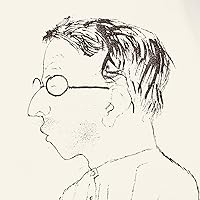
John Allyn Berryman (originally John Allyn Smith) was an American poet, born in McAlester, Oklahoma. He was a major figure in American poetry in the second half of the 20th century and often considered one of the founders of the Confessional school of poetry. He was the author of The Dream Songs, which are playful, witty, and morbid. Berryman committed suicide in 1972.
A pamphlet entitled Poems was published in 1942 and his first proper book, The Dispossessed, appeared six years later. Of his youthful self he said, 'I didn't want to be like Yeats; I wanted to be Yeats.' His first major work, in which he began to develop his own unique style of writing, was Homage to Mistress Bradstreet, which appeared in Partisan Review in 1953 and was published as a book in 1956. Another pamphle.
His thought made pockets & the plane buckt, followed. It was the collection called Dream Songs that earned him the most admiration. The first volume, entitled 77 Dream Songs, was published in 1964 and won the Pulitzer Prize for poetry. The second volume, entitled His Toy, His Dream, His Rest, appeared in 1968.
The two volumes were combined as The Dream Songs in 1969. By that time Berryman, though not a "popular" poet, was well established as an important force in the literary world, and he was widely read among his contemporaries. In 1970 he published the drastically different Love & Fame. It received many negative reviews, along with a little praise, most notably from Saul Bellow and John Bailey. Despite its negative reception, its colloquial style and sexual forthrightness have influenced many younger poets, especially from Britain and Ireland. Delusions Etc., his bleak final collection, which he prepared for printing but did not live to see appear, continues in a similar vein. Another book of poems, Henry's Fate, culled from Berryman's manuscripts, appeared posthumously, as did a book of essays, The Freedom of the Poet, and some drafts of a novel, Recovery.
The poems that form Dream Songs involve a character who is by turns the narrator and the person addressed by a narrator. Because readers assumed that these voices were the poet speaking directly of himself, Berryman's poetry was considered part of the Confessional poetry movement. Berryman, however, scorned the idea that he was a Confessional poet.
If Salinger's Holden Caulfield had shown promise as a brilliant scholar, if he'd gone on to Columbia University and won a scholarship to study at Cambridge, if he could think of only reading and writing and girls, then this collection of poems -- really a novel in verse -- by John Berryman would have been the book Salinger's character might have written. Hilarious, callow, wildly arrogant: at times; at other times, sad, lonely, pathetic: throughout these poems demonstrate a singular, consistent, large-voiced style that would be (I believe) impossible to write today.
“I had, from my beginning, to adore heroes & I elected that they witness to, show forth, transfigure: life-suffering & pure heart & hardly definable but central weaknesses
for which they were to be enthroned & forgiven by me. They had to come on like revolutionaries, enemies throughout to accident & chance, relentless travellers, long used to failure
in tasks that but for them would sit like hanging judges on faithless & by no means up to it Man. Humility & complex pride their badges, every ‘third thought’ their grave.
These gathering reflexions, against young women against seven courses in my final term, I couldn't sculpt into my helpless verse yet. I wrote mostly about death.”
Some terrific poems in this collection, but after a while I grew tired of Berryman going on and on and on about all the woman he bedded (I kept turning to his author photo, an old, gray, long-bearded Berryman, and wondered how this man possibly could be the same guy who slept with so many women, so easily, many of them married). Also grew tired, more so, of his narcissism -- too many references to himself as a famous poet or to his famous poet friends.
The first 3 parts of the book consist of 48 poems, and I liked 12 of them enough to want to reread them. We see Berryman drinking and carousing and being arrogant. Then, at the end of Part 3, the book takes a turn: Berryman is in a sanatorium, where people "slob food" and he must endure "nights of witches" and dreams of a headless child. "Sobbings, a scream, a slam." He writes: "Many of the sane / walking the streets like trees / are weirder than my mournful fellow-patients; / they hide it better."
What truly makes the book is Part 4, "Eleven Addresses to the Lord," some of the most moving and powerful poetry I've ever read. He admits that God is "Unknowable, as I am unknown to my guinea pigs." He writes, "I have no idea whether we live again. / It doesn't seem likely." Both the evil and the just "fall asleep / dreamless forever while the words hurl out."
It is supernal what a youth can take & barely notice or be bothered by which to him older would work ruin. -- "Down & Back"
Will I ever write properly, with passion & exactness, of the damned strange demeanours of my flagrant heart? -- "Monkhood"
The President of my Form at South Kent turned up at Clare, one of the last let out of Madrid. He designed the Chapel the School later built & killed himself, I never heard why or just how, it was something to do with a bridge.* -- "Transit"
Somewhere up in the murky constellation of Government & the scientists & the military responsible to no-one someone knows that he too doesn't know anything and can't say what would then have happened or will 'now' happen on the Atlantic bottom in the long dark of decades of ecology to come while the 20th Century flies insanely on. -- "Have a Genuine American Horror-&-Mist on the Rocks"
Man is ruining the pleasant earth & man. -- "Eleven Addresses to the Lord"
The final section strikes me as sad in a way that I don't think Berryman intended. What a guy, to be writing like that. Even if you don't want to risk mixing up author/speaker, it speaks to how wildly through-the-ringer the speaker must have been by part four if he is the speaker of "Message," a wildly atheistic and generally irreverent poem from part three. The religious turn in part four strikes me as outlandish even though it has some foundation, as the speaker was devout until he was 12. And that the book was published so soon before Berryman's suicide :(.
Not liked by many critics perhaps because it was contained some religious poetry(?) or maybe it was just too personal and raw. I felt it was some of his best work and it seemed to truly described some of his inner life's struggles. The title is Love and Fame but much of it as he notes in the scholia deals with regrets.
A strange and unconventional poetry collection. The poems in parts 1,2 and 3 are not really poems in a sense but make up a longer narrative and part 4 is a single longish poem called "Eleven Addresses to the Lord" which is in my opinion and some of other people's, one of Berryman's best poems.
My initial impression, as I read the first few poems, was disappointment because of the convoluted line structure of the poems. They evoked the voice of Yoda: "..thought much I then on perforated daddy..." However, as I read on, then re-read, my appreciation deepened. Berryman's confessional style - blunt, sexual, introverted - is not always appealing but grows on one. This particular book, written later in his life, looks backward, to youthful escapades and adventures. They reflect stages of his life designated Parts 1-3. (Dani and Marjorie will appreciate his disdain for Ruskin). But Part 4, Eleven Addresses to the Lord, are poems of gratitude and humility. They are lovely, heartfelt contemporary psalms that deeply moved me. Please read them and let me know what you think.
Yeah, I guess I'm the only poet in America that is left pretty cold by the Dream Songs. However, I really like Love & Fame. This is Berryman does Frank O'Hara, all that personal reference, wildly inventive language, elliptical slip of consciousness, and lots and lots of sex, of course.
In four sections. Each reads more personal and intimate. The most beautiful in section four, "Eleven Addresses to the Lord.". So surprising and unforgettable. My first book of Berryman.