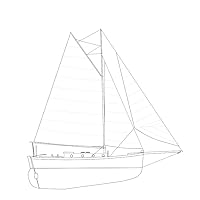
Principles of Yacht Design is both comprehensible to amateurs and comprehensive for professionals. It follows the design of a 40-foot cruising sailboat from the first sketch to the final weight, strength, and sail area calculations, with tables, charts, and diagrams to let the reader adapt the process to any design. This edition is revised and expanded to cover powerboats as well as sailboats.
Whew. This is boat design in some extreme detail. To be perfectly honest I was expecting something a bit lighter than this - but it is a great insight into how yacht design has gone from 'It looks about right' to the current Americas Cup foilers. The book starts with the 'basics' - stability and hull design etc, then follows the progression through the other aspects of yacht design by having example workings on an imaginary boat. It has graphs, algebra etc, but is written in a relatively readable style that allows you to follow the progression of the imaginary yacht without having to deeply understand each section. Recommended if you want to understand your boat in a scientific manner - not for everyone however. It is somewhat heavy going in places.
I love buying and reading these types of books. Boats, yachts, historical events and books about the sea are generally excellent. If there are sequels in your series, I would love to read them.
The beauties of owning the books of important authors cannot be discussed. I'm looking forward to your new books.
For friends who want to read this book, I leave the importance of reading a book here. I wish good luck to the sellers and customers...
Top 10 benefits of reading for all ages:
1. Reading Exercises the Brain
As we read, we need to remember the different characters and settings of a particular story. Even if you enjoy reading a book in one sitting, you need to remember the details during the time you devote to reading the book. Therefore, reading is an exercise for your brain that improves memory function.
2. Reading Is a (free) Form of Entertainment
Did you know that most of the popular TV series and movies are based on books? So why not indulge in the original form of entertainment by immersing yourself in reading? Most importantly, it's free with your Markham Public Library card.
3. Reading Improves Concentration and Focus
We all agree that there can be no reading without focus, and we need to concentrate on every page we read to fully understand the story. In a world where gadgets only speed up and shorten our attention span, we must constantly practice concentration and focus. Reading is one of the few activities that requires your undivided attention, so it improves your ability to concentrate.
4. Reading Improves Literacy
Have you ever read a book where you come across a word you don't know? Books have the power to improve your vocabulary by introducing you to new words. The more you read, the more your vocabulary will improve as well as your ability to communicate effectively. Also, reading improves writing skills by helping the reader understand and learn different writing styles.
5. Reading Improves Sleep
By creating a bedtime routine that includes reading, you can signal to your body that it's time to sleep. Now more than ever, we rely on increased screen time to get through the day. That's why you put your phone away and pick up a book and tell your brain it's time to calm down. Also, since reading helps you relieve stress, reading right before bed helps calm your mind and anxiety and improve your sleep quality.
6. Reading Increases General Knowledge
Books are always full of fun and interesting facts. Whether we read fiction or non-fiction, books have the ability to provide us with information we might not otherwise know. Reading various topics can make you a more knowledgeable person and therefore improve your speaking skills.
7. Reading Is Motivating
By reading books about heroes overcoming adversity, we are often encouraged to do the same. Whether it's a romance novel or a self-help book, the right book can motivate you to never give up and stay positive.
Excellent beginner's guide to yacht design. Includes an overview of the fluid dynamic principles that govern hull, keel, and sail performance, in addition to some commonly used heuristic relationships. The book is well-written and easy to read, but somewhat light on theory -- engineers and naval architects will likely want to supplement this text with Hoerner's Fluid-dynamic Drag: Theoretical, Experimental and Statistical Information and Glauert's The Elements of Aerofoil and Airscrew Theory.
Buku ini menjelaskan prinsip-prinsip dasar perancangan kapal secara umum, khususnya jenis Yacht. Penting sekali dimiliki oleh seorang naval Architect maupun mahasiswa dibidang bersangkutan. Meski tidak benar-benar menyelesaikan membaca buku ini tapi saya yakin suatu waktu ketika mendesign kapal, adakalanya kita kembali mengingat kembali teori-teori dasar yang dapat membantu proses kreatif tersebut, maka buku ini dapat digunakan sebagai rujukan yang baik.