Between 1955–1962, Saint Gianna Beretta and her husband Pietro Molla corresponded through a series of letters, collected here.Touching, inspiring, and refreshingly human, their exchanges reflect the everyday experiences and the abounding love of a modern day couple, revealing that the way of holiness can unfold in the midst of this world. From balancing work and family life, to dealing with a long-distance relationship, to parenting, to coping with illness and death, Gianna and Pietro conquered it all.But none of it was accomplished without tremendous trust in each other - and in God.
Everything that St. Gianna and her husband wrote is totally fine. It was cute, though I felt like I was reading a very private correspondence that was not my business. Perhaps I am just cold-hearted and can't enjoy romance but, that's fine I guess. The larger part of the book are these series of letters from a time where St. Gianna and Pietro (her husband) spend a few MONTHS apart due to his work, and it felt like a novel for me almost, so much so that I felt let down because I couldn't experience when they finally got back together, after all those letters. It just moved on to the next series of letters for the next time Pietro left for a trip. It felt a bit jarring, but that's not the fault of this book, since it was not written to be like a novel anyway.
HOWEVER, moving on to the commentary in this book...
"The Church's 'Suspicious Silence' and 'No Room For Married Life'"
In one of the introductions, I was more than a little unsettled by this particular section here: "..these letters are a convincing proof that the way of holiness does not necessarily pass through religious life or the priestly ministry, but can unfold in the midst of the world, living one's own vocation as a Christian called to holiness with Christ in married life. This ancient truth (as we can see in the Acts of the Apostles, 'saints' is synonmous with 'Christians') was hidden in oblivion during certain centuries which passed over in suspicious silence anything that had to do with the body and sexuality. Among the different types of saints (martyrs, confessors, doctors, virgins), there seemed to be no room for the many Christians who had embraced married life and had viewed it as as mission given to them by God, as the field in which to bring their talents to fruition. More often than not, the few married persons (Rita, Nicholas of Flue, Frances of Rome, Jane de Chantel, Louise de Marillac) whom the Church proclaimed as saints had more or less renounced their marriages."
Here's the thing the last thing we need today are Catholic books that start to put doubt in how the Catholic Church has done things in the past ("in the past" meaning, of course, what some like to weirdly call the "Pre Conciliar Church" aka, the Catholic Church before the year 1962.) I get the point they are trying to make - there seemed to be less books on married Saints in the past. But here's the thing... in the past it was simply easier to get ahold of the documented private, and spiritual life of those who were in the religious life. Why was this so important? Because the Catholic Church was always, consistently careful about canonizing Saints. Just because a holy person was not canonized, it doesn't mean they didn't make it to Heaven, but the Church canonized certain holy people to both give the laity ROLE MODELS in the Faith, as well as to give them a higher honor in the Church as models of the Faith well-lived. This is actually why it took years (and years!) before She (Holy Mother Church) finally canonized anyone! It's also the reason why they used to have what was called a "Devils Advocate" during the canonization process - a person was hired to dig up any "dirt" on the servant of God, to make sure there was nothing that might lead anyone astray by their life choices, before they made them "official Catholic Role Models" so to speak. And if there was "dirt", the servant of God would of had to have shown total and complete rejection of their past bad deeds and have lived a life almost perfectly living Faith, Hope and Charity. Again, this was not done to show that it is impossible to make it to heaven, but if Holy Mother Church decided to give us laity a proper Role Model that we can imitate, these Role Models MUST be the very best. It doesn't mean that they are the only ones in Heaven - anyone in Heaven is a "Saint". This book, I have found, had some areas that do not coincide with how the Catholic Church does things. Because of this, it showed leanings towards the idea that the Church's Teachings change with the Times (aka Modernism, which is a heresy that Pope Pius X spoke of in his encyclical "Pascendi Dominici Gregis (September 8, 1907)".) (For more information and a clearer explanation of the heresy, I highly recommend reading that encyclical as well as the A Catechism of Modernism which is extremely helpful in understanding it. Both can be found online to read for free.) "Modernism" is essentially the belief that Dogma, Scripture and Tradition, ect, can (and should) change simply because it is "old" and "not up to date". Modernists believe that the Catholic Church must "update" Herself in her Teachings and practices. Or, here's another good one, "Anything the Church has taught before Vatican II doesn't count anymore because.... Vatican II." Yeah no. that's not how this works.
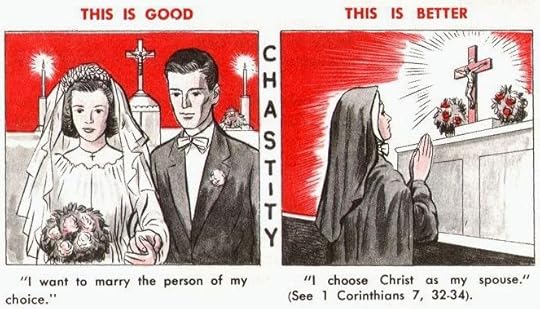
The complaint that the Church "passed over in suspicious silence anything that had to do with the body and sexuality" is laughable. Barring scrupulous Catholics in History, the Catholic Church hardly stays quiet on "the body and sexuality", in fact, She took both of these very, very seriously. Just because one does not use syrupy or banal language concerning the topic of sex and the body, it hardly means that one is passing over it in "suspicious silence". Let me direct you to a few "Pre-Conciliar" writings on these very topics; Casti Connubii: On Christian Marriage (Given in 1930) in which the first paragraph states, "How great is the dignity of chaste wedlock, Venerable Brethren, may be judged best from this that Christ Our Lord, Son of the Eternal Father, having assumed the nature of fallen man, not only, with His loving desire of compassing the redemption of our race, ordained it in an especial manner as the principle and foundation of domestic society and therefore of all human intercourse, but also raised it to the rank of a truly and great sacrament of the New Law, restored it to the original purity of its divine institution, and accordingly entrusted all its discipline and care to His spouse the Church." Another encyclical from Pope Leo XIII Arcanum Divinae "On Christian Marriage" in 1880 states, "Marriage, moreover, is a sacrament, because it is a holy sign which gives grace, showing forth an image of the mystical nuptials of Christ with the Church. But the form and image of these nuptials is shown precisely by the very bond of that most close union in which man and woman are bound together in one; which bond is nothing else but the marriage itself. " Pope Pius XII's 1958 Address to "The Large Family" (https://bit.ly/3g89slT) is also another beautiful read. Here is an excerpt, "But you do not represent just any families at all; you are and represent large families, those most blessed by God and specially loved and prized by the Church as its most precious treasures. For these families offer particularly clear testimony to three things that serve to assure the world of the truth of the Church's doctrine and the soundness of its practice, and that redound, through good example, to the great benefit of all other families and of civil society itself." "(L)et the weak and selfish take their example from you; let the nation continue to be loving and grateful toward you for all the sacrifices you have taken upon yourselves to raise and educate its citizens; just as the Church is pleased with you for enabling her to offer, along with you, ever healthier and larger groups of souls to the sanctifying activity of the divine Spirit." The Catechism of the Council of Trent (its compilation was completed in the year 1564!) states, "Thus when Christ our Lord wished to give a sign of the intimate union that exists between Him and His Church and of His immense love for us, He chose especially the sacred union of man and wife. That this sign was a most appropriate one will readily appear from the fact that of all human relations there is none that binds so closely as the marriage-tie, and from the fact that husband and wife are bound to one another by the bonds of the greatest affection and love. Hence it is that Holy Writ so frequently represents to us the divine union of Christ and the Church under the figure of marriage." And here it speaks directly about marriage as as path to sainthood, "Thus will they find the blessings of marriage to be daily increased by an abundance of divine grace; and living in the pursuit of piety, they will not only spend this life in peace and tranquillity, but will also repose in the true and firm hope, which confoundeth not, of arriving, through the divine goodness, at the possession of that life which is eternal." Hmm... this doesn't sound much like the Church gave "no room" for married couples! In fact, it sounds more like the opposite. She gives a high place of honor to those who are given the vocation to raise Saints for Heaven! Some of the greatest Canonized Saints were married (and no, not all of them "renounced" their marriages! (see also https://bit.ly/3RZuqAg) I think a large part of this (perhaps unwitting) misinterpretation of the Church and the vocation of marriage is not only misreading the holiness of this sacrament that the Church always held, but the authors seem to be unaware that the Church teaches that it is not marriage that is considered "the best way" but the religious life, because it is in this vocation that the person gives themselves totally to God! However, it is an immature error to read this as something insulting, or demeaning to the Sacrament and Vocation of marriage, for the Church not only regards this as a necessary Vocation, but one that is very very holy. After all, it is from these holy Catholic marriages that come vocations to the religious life! It all works out for the best. (Photo below from the Baltimore Catechism)
Quoting Dubious Theologians I wonder why so many Catholic's today seem to only quote "Theologians" that came after Vatican II. The Church always takes holy wisdom from all ages - simply because wisdom and Catholicism are not bound to any age, but to Christ, Who is God, Who is outside of time.
This book (not the saints, but those who wrote commentary to the book) go on to quote the dubious, modernist theologian "Cardinal Henri de Lubac." (See why I say this about Lubac here - https://bit.ly/3yDmzSt where they write, "In June of 1950, as de Lubac himself said, 'lightning struck Fourvière.' He was removed from his professorship at Lyon and his editorship of Recherches de science religieuse, and he was required to leave the Lyon province. All Jesuit provincials were directed to remove three of his books – Surnaturel, Corpus Mysticum and Connaissance de Dieu – because of 'pernicious errors on essential points of dogma.' 'In 1962, well after the death of Pius XII, de Lubac wrote the book Teilhard de Chardin: The Man and His Meaning, extolling the writings of the pantheist paleontologist whose notes he had studied along with his colleagues at La Fourvière. De Chardin himself had been censured and stripped of his teaching position already in 1925 for denying Original Sin and the existence of Hell. His writings are still officially proscribed, but remain, however, immensely popular today among Jesuits and even within some of the highest ranking circles of the contemporary Roman Catholic Church.' There's more too!! Yikes.) In another part of the book, they also speak about Hans Urs von Balthasaar (on page 68, footnote 34) who is also known to have VERY problematic views that contract Catholic Teaching (see https://bit.ly/3RWYNrm , also Balthasaar wrote this in the forward to Meditations on the Tarot: A Journey into Christian Hermeticism , contrary to the teachings of the Church, "A thinking, praying Christian of unmistakable purity reveals to us the symbols of Christian Hermeticism in its various levels of mysticism, gnosis and magic, taking in also the Cabbala and certain elements of astrology and alchemy. These symbols are summarised in the twenty-two so-called “Major Arcana” of the Tarot cards. By way of the Major Arcana the author seeks to lead meditatively into the deeper, all-embracing wisdom of the Catholic Mystery." This article also charitably puts into question some of the views held by Balthasaar https://bit.ly/3z0rkFV)
More Weird Footnotes
On page 82, footnote 59 rushes to explain St. Gianna's statement to her husband, concerning their future marriage. Here is St. Gianna, "We will be working with God in his creation; in this way we can give him children who will love and serve him." Beautiful! However, the commentators just couldn't help themselves, and they added a footnote stating, "Here is expressed a pre-conciliar theology of marriage, however, with feminine grace and delicacy typical of the saint: she often repeated almost verbatim statements in use at the time, but softened and transformed with her finesse." O...kay?? Since when did the Church change the "theology" of marriage to stop being about raising saints to worship God?? All I got out of that footnote was a rushed, confusing, word salad that seemed to disagree with St. Gianna while also agreeing with her at the same time. I can't stand this sort of writing. Ooo! Here's another good one. Pietro, is writing to his wife, St. Gianna, while on a business trip. He writes that, "The songs and saints of our homeland speak much more powerfully to our hearts and our feelings when we see them in the frigid North, which is cold by nature, and also in regard to religion." Here, the commentators quickly add a footnote, "Mr, Molla was referring to the diversity of religious sentiment and practice between the Nordic and the Latin countries. It should be noted that the great majority of Swedes are Lutheran and that the veneration of the saints in not very common among them. One should also keep in mind that, at the time," wait for it... "Vatican Council II, with its emphasis on ecumenism," which, by the way, the Catholic Church has officially denounced as a heresy (more on than in a bit), "had not yet taken place." Yeah. Okay. Sure. So, first of all, these footnotes almost read as if they see something totally offensive to non-Catholics and quickly try to fix it. But the thing is, there is nothing offensive in these letters. The only offensive thing here, are these weird, awkward footnotes. In my opinion. Now, about Ecumenism. There is a difference between the Muslim route of "COVERT OR BE BEHEADED!!" and Catholicism. Remember all the martyrs and missionaries in the past? All the religious who gave their lives to care for the poor, sick, and needy, regardless of their creed? All the sacrifices these brave men and women made to bring souls to Christ - aka, converting them to Catholicism. Yeah. That's Catholicism. False ecumenism was condemned by the Church, see On Fostering True Religious Unity: Mortalium Animos , "(false ecumenism is) founded upon the false opinions of those who say that, since all religions equally unfold and signify- though not in the same way - the native, inborn feeling in us all through which we are borne toward God and humbly recognize His rule, therefore, all religions are more or less good and praiseworthy. The followers of this theory are not only deceived and mistaken, but since they repudiate the true religion by attacking it in its very essence, they move step by step toward naturalism and atheism. Hence it clearly follows that anyone who gives assent to such theories and undertakings utterly abandons divinely revealed religion. " "(S)ome are more easily deceived by the outward appearance of good when there is question of fostering unity among all Christians." "Furthermore, in this one Church of Christ no man can be or remain who does not accept, recognize and obey the authority and supremacy of Peter and his legitimate successors. " One can spend a whole afternoon pouring over Papal Documents, Catholic Teaching, The Bible, writings of Fathers and Doctors of the Church, and writings of Saints that completely and totally uphold this statement by the Holy Father. And no, something this theologically weighty, carrying with it the weight of Tradition and Magisterium, is not something that can supposedly be brushed aside by one Council.
In Conclusion I enjoyed reading the letters of St. Gianna and her husband, Pietro, however, the commentary from different Catholic's unsettled me very much. It only confirmed my belief that Catholic's today are very, very confused and improperly Catechized. I was too! I hope and pray that some day, anything that is published by a Catholic Publisher will be free of theological error and confusion. We Catholics should be promoting the Simple Truths, not modernist word salad. (Though to be fair, my writing can probably be defined as "word salad" at times). I cannot say that the intentions of these Catholics were to confuse; most likely not! But I couldn't leave a review on the book without talking about these issues that left me very unsettled. I am not a theologian or even a very well-read Catholic, but I love the Faith and desire that Her Teachings not be confused. I hope that I have clearly expressed Her Teachings and not made anything more confusing.
Although slow at times, (it truly is just their letters) this book was too sweet. Gianna and Pietro loved each other with a deep spousal love that participated in the supernatural spousal love for God for us. What a gift that these letters have been published for people around the world to read. The letters of this wonderful saint and her husband give a look into what their life was like, how they dealt and processed the everyday trials and joys, and how they remained faithful to the Lord amidst both working and three (eventually 4) children! This was a good before-bed read, as the letters are short and it’s easy to find a stopping place every few pages.
Read as my 3rd book club book with my friends! What a blessing that the format of their marriage, Pietros many business trips and Gianna’s traveling as a doctor, which caused them much time apart, a sacrifice and often a sorrow, has one of its fruits in materializing the communication of a Saint and her good husband into a record for people to look back on! Their love is ardent, realistic, loyal, and holy, the type of thing because of its sacredness is kept mostly private. But their letters! We get to see what that type of love looks like through the means they used to keep it active during times apart. How God works! Thank ya, Jesus :). It does increase the gravity of their sacrifice to know that 54 days was their longest time apart ever, a trial which aggrieved both greatly, which after about a year of together-ness after, was superseded by 58 years for Pietro after the early death of Gianna (one she chose during labor to ensure the livelihood of her newborn) (Pietro living 58 years after her death). Their children “popi” were their “treasures.” How sad but how beautiful. What that must’ve looked like for Pietro I can’t imagine. Though this is not written (because the letters cease), I am taught of his faithfulness to his family and to his deceased spouse through his example of remaining a loving person and father, in her honor. He kept all these letters, organized them and reread them often. ❤️ And lived long enough to see her be recognized as a Saint! What that was like Id love to know. The Saints I most know about are consecrated religious. Can Sainthood be achieved through the vocation of marriage? Obviously, yes! But what does that look like? Well someone once asked me “how do you avoid falling out of love with someone [you’re married to]” I thought about it and said: “…….I suppose if you [choose not to] see love as something to be fallen out of.” In these two, absolutely I know they didn’t always “feel” love when assuring each other of their love and commitment, gratitude, and during their job hours and times traveling/household tasks. Yet it was there because they chose for it to be there. And relied on Christ in all things, to be their strength. Love is an action. This all I knew already but it was nice to see it personified in this family. I was reccomended this book as a possible source of healing over my poor models of relationships/ fear of such things. Could I be good for someone? Could someone be good for me? Could we really do it and make it last until death, and even dare to dream to be “happy” (not “just making it”) as Gianna (and Pietro) recommits herself to capturing for the other in almost every letter? I don’t feel confident I won’t screw something up. But I know I’m in Gods hands! And for now I have these Saintly models until God answers the prayer of an earthly model of a married couple with a good relationship 😂. God help me be good! There is no plot to this. It is just their letters to each other back and forth through four or so years. My experience reading it was not five-star in that I was always enthralled and stimulated and really deeply moved. But I do like it. I think it’s such a sweet thing to desire to be good for someone. To want to make someone happy. To share joy in simple things and domesticity. That is not a drag but where life actually is! And it’s such a unique thing to get to read. For that reason it is 4 stars! St. Gianna, pray for me (us)!
Although “just” a collection of letters between a saint and her husband, there’s so much insight into what a holy marriage can and should be—lessons that are lacking in our current culture now more than ever. I felt for Saint Gianna and Pietro and their many physical separations due to work commitments, and yet without those sacrifices on the Molla’s part, we wouldn’t have this beautiful insight into their marriage and family. Saint Gianna said at one point she was “already on the other side”, but “they sent me back here to suffer some more, because it is not right to appear before the Lord without having suffered much.” (Footnote, pg 25). Thank you for having suffered for us. Saint Gianna, pray for us!
This correspondence had been on my reading list since the first time I heard about the couple (in 8th grade Catechism class?). I told myself - my future spouse, better write letters to me! In the last decade, I have received a fair share of emails, journal entries, snail mails, post cards from two relationships; ofc: Yahweh Yireh :)
I see - in Pietro, a man, a leader who prays via his letters; in Gianna, a woman, the co-leader who held the fort, matured in time, through experiences. I love that their individual lives were hidden away from the readers, as it is meant to be lived in God. I loved the absence of continuity that was reflected in letters, and I pray that I can aspire to live a life in the present - without the need to document every single thought, action and moment. However, there exists a notable temptation to re-read this book in a later season and observe what has changed from 2025. St. Gianna, pray for me :)
The compilation shows nothing remarkable - and thus, extraordinary. I love the beauty of a man and woman coming together and facing each other, and how that progresses over courtship and marriage. I live during these times when it is purported that one needs to find unique hobbies to start an interesting conversation, or showcase the exclusive creativity that one can only deliver - these letters show that love grows in the extraordinari-ness of ordinary life. You become a gift of yourself in any relationship. I guess, I am called to be a sign of contradiction in this age of 'aspiring to be unique through exterior actions'. Just be normal - that is so unique in the present.
Final thought: it is a crime to rate a compilation of letters; hence committing to the gravest degree of mortality.
I loved reading this book. Though I wouldn’t call it a page turner or a gripping novel since it is just letters back and forth between Gianna and Pietro (and their story at the beginning which I found super interesting and loved reading), I actually got a lot out of this book. You just have to expect it to be a little slow and repetitive but so worth the read.
The excitement in their love letters to each other in the beginning was really beautiful and inspiring.
It was really eye opening seeing the way Gianna was a saint going through similar struggles most young moms experience - difficult pregnancies, sick children, and everything else that comes with young kids. I really felt I could relate to her.
It was cool seeing the closeness of Gianna’s family and how much her sisters helped her out with her kids. It was also cool seeing her love for her life, her enjoyment of vacations with family and being in the mountains. The anxieties she experienced, how she struggles with her husband working so much and having to travel for work. I found it really interesting how her culture and the time period she lived in shaped her as well.
I felt really sad at the end of the book, mostly for her children and Pietro. I can’t believe Mariolina died two years later as well.
I just read the book slowly and I really loved it. I think it gives invaluable insights and inspirations into how to be a saint as a wife and a mom.
The story told through these letters and just the realness of the mundane details, and the love the couple had for each other, were really beautiful.
For what the book was meant to be - a collection of Gianna and Pietro’s letters to each other - it hit the nail on the head. The footnotes were super helpful in piecing together the use of pronouns and names. Their letters clearly painted a beautiful picture of their affection, love and sacrifice for each other and for their family.
But… I wanted more of their story intertwined. Because the letters were only when the couple was a part from each other, I feel like I missed a lot of their story as a couple. I would have loved if their story was continued in a more narrative fashion during the “spaces” between letters. Like after Pietro’s trip to America when their third child, Laura, was born. I felt like I was following their story and Giana’s hardships during the pregnancy and then all of the sudden the next section of letters, Laura was already 6 months old. I think the addition of narrative could make this a wonderful book to learn more of the story of this Saintly couple.
Wow! I loved this book! I knew I would, but it still exceeded my expectations! What a wonderful example St. Gianna is for all women who want to be devout wives and mothers. Pietro is also a wonderful example of the kind of Catholic man I hope to marry someday. How lucky are we to have such an inspiring example of holiness that is not so far in the past!
It was cool to read their letters, very chilling to realize they stopped because of her death after childbirth. But what ever happened to their other two kids Pierluigi and Lauretta??
"Now, I kneel before her, a marvelous and strong woman, fiancee, wife and mother, who, in her love for life and for the child in her womb, knew how to scale the heights of the greatest love which Jesus showed us." ~ Peitro Molla
Happy Wednesday All.
I hope and pray your day is good. Before I review the book, I wanted to tell you a little about Saint Gianna. She lived her life in God's domain and it shows in these beautiful letters, her career, her marriage, and every aspect of her life. Deeply spiritual, Saint Gianna is the epitome of Christian Motherhood as she gave her life, so her fourth child could live.
Around the time of her canonization, Saint Gianna's letters to her beloved Pietro were published. After he passed away, his children allowed their letters to be published together for this book. This book is a beautiful testimony to their love of God, family and one-another.
This review has been a long time coming. I have to say, it's a challenging review to write. Let's face it, love letters are personal and though I am so happy to have them, for their great example and gift to married couples (and those who want to marry), it's quite strange to assess them -- according to the more practical part of my mind.
Some people, when reading books, skip the Foreward. This book has a Presentation (by Cardinal Angelo Scola, the Archbishop of Milan), Forward (by Cardinal Angelo Comastri of the Vatican), two Prefaces (one by Gianna Emmanuela (their youngest daughter) and one by Pietro) and an Introduction by Elio Guerriero (editor). Please do not skip any of this. I think without these parts, the letters, though beautiful, would not come to life, as much. It's just my humble opinion.
In the Introduction, Elio Guerriero said this about the letters:
The exchange of letters between Saint Gianna and her husband Pietro intrudes a new and significant chapter in Christian Spirituality. Better than a theological traits, these letters are a convincing proof that the way of holiness does not necessarily pass through religious life or the priestly ministry, but can unfold in the midst of the world, living one's own location as a Christian Called to holiness with Christ in married life.
In another passage, he says:
In fact, lifting the veil on their private life, they show us that love centered in Christ takes away nothing of the beautify of being in love of attraction toward and passion for the beloved, of loving transports and dedication to the children. On the contrary, in these letters of husband and wife, these sentiments are set before us, fresh, pure and joyful, ever renewed by participation in the Church's liturgy and by communion in prayer which kept the two united during their separations, the birth of new babies and the demands of their professions.
This couple worked, prayed, lived apart, struggled with loss, and loved so deeply and tenderly. They complimented each other in every way.
The letters span their dating lives through their mature marriage. They show the love and laughter and perhaps the little things. I am struggling to describe them to you because they are simple and profound at the same time. I can see many of us, if we still lived in the time before Internet, writing the same kinds of letters to our spouses. Some are romantic. Some are childlike. Some are descriptive and longer. Some are very short. All are received with love and treasured.
For me, these letters give insight to a great woman. A Saint that I was introduced to a year or two ago, whom I wish I'd "met" sooner. They also give insight to a beautiful man who remained faithful to her and the family they built and the faith they lived their lives by... until the end of his life. Mostly they give insight to the humanity of marriage and the love that faith builds.
This book is a testimony to how we should all live our lives (and I dare say, examples of the many ways we need to step it up while we have the chance). I am going to read it again.
Thank you Cathy Kinpper for sending me this book six months ago. Please forgive my delay in reviewing it.
This book is a collection of letters between two people who gave witness to their faith through the joy of married love.
Gianna Beretta Molla is a popular figure in the Catholic Church. She was a young doctor in Italy who died in 1962 due to complications in childbirth. The story of her death is well known, as she chose to save the life of her unborn child despite a dangerous diagnosis during her pregnancy. What is not as well-known is the beautiful marriage that she shared with her husband Pietro.
As a married woman, it’s inspiring for me to read about the simple, everyday exchanges between this holy couple. He was an engineer and she was a doctor, and they raised a family while still living out their calling in the world. The letters in this book provide a glimpse into the way they loved each other and lived out their vocation.
As Gianna states in her first letter to Pietro in 1955, “I really want to make you happy and be what you desire: good, understanding, and ready for the sacrifices that life will require of us.”
Pietro replied, “My love is yours and I want to raise a family with you. I too want to make you happy and understand you well... Thank you for your help and trust.”
I'd read Gianna's letters to her husband years ago and loved them, but reading them alongside Pietro's in this new edition was incredible. I kept thinking of all the times in life when tragedy seems meaningless; surely Pietro must have felt that when his wife died at such a young age. But without the heroic witness she gave in her death, we'd never have had the chance to see this quiet, beautiful example of a holy, joyous marriage--and we'd never have met the very quiet, unassuming man who became a saint alongside her. My one complaint is that the footnotes are pretty obvious. I'm trained to jump down the page at every little asterisk, and it became annoying when the only note was something like: "Here we see how Gianna's love for God overflowed into love for her family." (That's my paraphrasing.) I think we all got that already...
These two are a sweet couple and an inspiration for married people. That said, many of the letters are banal concerns, and, being letters, don’t cover important situations they found themselves in while together.