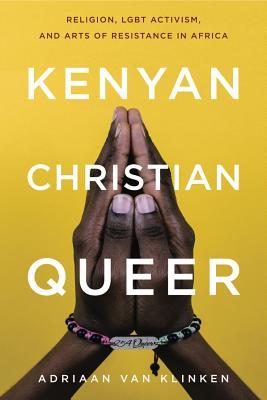
Popular narratives cite religion as the driving force behind homophobia in Africa, portraying Christianity and LGBT expression as incompatible. Without denying Christianity’s contribution to the stigma, discrimination, and exclusion of same-sex-attracted and gender-variant people on the continent, Adriaan van Klinken presents an alternative narrative, foregrounding the ways in which religion also appears as a critical site of LGBT activism. Taking up the notion of “arts of resistance,” Kenyan, Christian, Queer presents four case studies of grassroots LGBT activism through artistic and creative expressions―including the literary and cultural work of Binyavanga Wainaina, the “Same Love” music video produced by gay gospel musician George Barasa, the Stories of Our Lives anthology project, and the LGBT-affirming Cosmopolitan Affirming Church. Through these case studies, Van Klinken demonstrates how Kenyan traditions, black African identities, and Christian beliefs and practices are being navigated, appropriated, and transformed in order to allow for queer Kenyan Christian imaginations. Transdisciplinary in scope and poignantly intimate in tone, Kenyan, Christian, Queer opens up critical avenues for rethinking the nature and future of the relationship between Christianity and queer activism in Kenya and elsewhere in Africa.
A fascinating exploration of the intersections between sexuality and religion in the Kenyan context, combining fieldwork in an lgbt-affirming church, nuanced analysis of cultural productions (books, music videos, social media, etc.), and personal reflection. Methodologically, the inclusion of interludes of reflection on the experience of fieldwork as bodywork is particularly interesting. To me as a reader not familiar with the Kenyan context except through some social media contact (mainly with Quakers in Kenya), the descriptions of the church and how a queer Christian identity can be constructed in that specific situation were especially useful.
Carole Lynn Stewart is Professor of English Language and Literature at Brock University and the author of Strange Jeremiahs: Civil Religion and the Literary Imaginations of Jonathan Edwards, Herman Melville, and W. E. B. Du Bois.
Rarely does an academic book feel like such a page-turner. Van Klinken's prose is graceful and intimate, weaving personal reflection with rigorous scholarship. The stories of Binyavanga Wainaina, George Barasa, and the Cosmopolitan Affirming Church will stay with me for a long time.
Van Klinken rightly critiques the secularist bias in much queer scholarship, which often ignores or dismisses religion as inherently oppressive. This book makes a compelling case for taking religion seriously as a resource for queer subjectivity and agency, especially in the global South.
The analysis of Binyavanga Wainaina as a "queer prophet" who appropriates Pentecostal modes of charismatic leadership is absolutely brilliant. Van Klinken shows how religious forms can be repurposed for radically inclusive ends. A standout chapter in an outstanding book.
Van Klinken moves beyond despair to show queer Kenyan Christians creating change through art, music, stories, and church. Hopeful, rigorous, and deeply human.
This book challenges the common story that Christianity and queer identity are always opposed. Van Klinken shows religion can also be a site of LGBT activism. A strong, thoughtful read.
The author’s personal tone makes difficult ideas feel accessible. The Kenyan case studies are rich, though some sections are dense. Recommended for patient readers.
The book proves religion is not only an obstacle but also a resource for queer liberation. The four case studies are varied and compelling. A landmark contribution.
Van Klinken takes African queer Christianity seriously. His “arts of resistance” framework is fresh and useful. Highly recommended for scholars and activists.
The Cosmopolitan Affirming Church chapter alone is worth reading. Van Klinken shows how faith, tradition, and identity are navigated and transformed. A must read.
an Klinken writes with grace and deep insight. The stories of queer Christians finding belonging in Nairobi are both heartbreaking and inspiring. A must-read.
This is scholarship at its most courageous. It refuses easy answers and shows the messy, beautiful work of queer resistance within Christianity. Highly recommended.
If you think Christianity and queer identity are incompatible, read this book. It will open your eyes and your heart. The case studies are unforgettable.