New research finds that Christians are less involved in spiritual conversations today than we were twenty-five years ago. As society has changed, it seems we have become more uncomfortable talking with people about our faith. We are reluctant conversationalists. The reality is that many of our churches and communities are shrinking instead of growing. What can we do about this? Don Everts, himself a reluctant witness, grew up assuming that spiritual conversations are always painful and awkward. But after falling into one spiritual conversation after another, he was surprised to discover that they aren't. Don's surprising―and sometimes embarrassing―stories affirm what Scripture and the latest research reveal: spiritual conversations can actually be a delight. Unpacking what God's Word says about spiritual conversations and digging into the habits of eager conversationalists, Everts describes what we can learn from Christians who are still talking about their faith. With original research from the Barna Group and Lutheran Hour Ministries on spiritual conversations in the digital age, this book offers fresh insights and best practices for fruitful everyday conversations.
Don Everts began writing while spending nearly two decades on college campuses in Washington and Colorado. He wrote his first book, Jesus with Dirty Feet, as a 25 year-old who had just gotten married and moved to Boulder, CO.
Since then Don has published 12 books with InterVarsity Press and is currently mulling over writing an uplifting zombie novel.
Having finally gotten off the college campus, Don is serving as a minister at a nearly 200 year-old Presbyterian Church outside of St. Louis, MO.
Summary: One reluctant witness shares personal narrative, helpful principles, and survey data that indicate that spiritual conversations may be delightful rather than dreadful.
Most Christians are reluctant to bear witness to their faith. The idea of this raises images of street preachers, intolerance, arguments, and offended friends. Most of us don't want to be those kind of persons. We love people too much, and frankly want to be loved by them as well. Don Everts was like so many of us, except for a small problem. He was a campus minister, part of whose job was to witness to his faith, and help others learn to do this.
In this book, Everts shares his own journey of discovery that spiritual conversations can be delightful, not just for the believing person, but also for the other person in the conversation. He also shares Barna research that both offers support for his contention, and a bleak picture that indicates that if anything, there is far more reluctance on the part of Christians to engage in spiritual conversations, even with each other, than a couple decades ago.
First the bad news. We are having fewer spiritual conversations, our level of discomfort in having these conversations has risen, we mention Jesus and the Bible less, even though we know we should have these conversations. Furthermore, these practices find parallels in the general culture. The main reason for our silence is fear, particularly the fear of offense. We also feel far less prepared by our churches. In 1993, 77% felt their churches prepare them well to speak of their faith. Today it is only 57%.
Through various conversations--on a long bus ride, with a neighbor, and others, Everts discovered that these conversations could be delightful, and that some of those he conversed with became friends, and some even changed their beliefs. He describes five myths and how these conversations gave the lie to them for him:
1. Spiritual conversations take place in special places, at special moments, by special people. The reality is that most belief-changing conversations took place with friends in everyday settings. 2. Spiritual conversations are serious and sober events. The reality is that laughter and joy are actually a significant part of conversations for both parties. 3. In a spiritual conversation I need to be able to give the right answer. Actually, what is more important is having the chance to ask one's questions and responses that are humble and honest, which sometimes means, "I don't know." 4. Most spiritual conversations involve conflict, which ruins everything. Actually, this turns out not to be a significant factor in the data, and most people expect some disagreement and even think it is healthy. 5. Spiritual conversations are burdensome duties that are, in the end, painful and regrettable. Actually, 35 percent of Americans report making a change in their lives because of a spiritual conversation. Among Christians, 38 percent report that someone has come to faith after a spiritual conversation. And only 14 percent of those who would identify as non-Christians said "no" to the statement "I'm glad about my latest spiritual conversation."
This doesn't mean that negative conversations never occur. Rather, all this suggests they are far less frequent than imagined, and especially as we grow in our conversation skills. Everts goes into the factors that turn reluctant conversationalists like him into eager conversationalists. He discovered that the difference was that eager conversationalists look for spiritual conversations in everyday life, they pursue and initiate conversations, they are open to share their faith in a wide variety of ways that are sensitive to those with whom they speak, and they gently push through awkward moments.
One thing Everts doesn't name, although I think it is assumed in his account, is that Christians are genuinely persuaded of the goodness of what they have believed. I can't help believe that for some, they have at least in part believed a mythical cultural narrative of Christian faith as naive, narrow-minded and intolerant. Sometimes, this is the case despite the transforming work that has taken place in their lives. One of the delightful moments in the book was when Everts admitted in a class where a professor belittled the idea of a chaste lifestyle, both the problems he faced when he previously had embraced the morality his professor commended, and how trusting Christ in the area of his sexuality had made a huge positive difference in his dating relationships.
Beyond all the interesting statistics, the most winsome part of this book was Everts' own modest example. His story, and the principles he offers are so helpful for those who have a sense that their faith is too good to keep to themselves and want to break through their reluctance. He helps us see that much of it comes down to having good conversations with people, where we welcome questions, listen with respect, and share what we've found with honesty and humility. If Everts is right, we might even find ourselves laughing together with our friends. That would be delightful, wouldn't it?
________________________________
Disclosure of Material Connection: I received this book free from the publisher. I was not required to write a positive review. The opinions I have expressed are my own.
Absolutely great book! Very helpful to help you understand how you yourself operate when it comes to spiritual conversations and definitely helps to remove some of the myths and barriers to us being bolder in our conversations
Loved the stories and the insights! Very applicable. In some studies, I did expect the sample sizes to be higher, though I’m not a statistician. Very interesting trends for sure
The pairing of data and analysis is awkward at times and it seems like some of its observations are incredibly obvious. Having said that, this book encouraged me to have spiritual conversations more often and to believe that they can even be enjoyable. It has accomplished its goal and I look forward to applying it.
“There is something delightful about spiritual conversations,” writes Don Everts in The Reluctant Witness. Scripture seems to agree. “How beautiful are the feet of those who bring good news!” (Romans 10:15) is the way Paul puts it, quoting Isaiah 52:7. Can anyone not smile in response to a friend saying, “I have good news”? I doubt it.
And yet, spiritual conversations strike many Christians as “pesky, painful, awkward things,” as Everts puts it. He defines a spiritual conversation as “any conversation about spiritual or faith matters (including doubts) with anyone.” That broad definition includes, but is not limited to, evangelistic conversations. It is those conversations that many find pesky, painful and awkward.
In The Reluctant Witness, Everts considers why this might be the case and shows how spiritual conversations, including evangelism, can be more authentic. The book is based on research conducted by the Barna Group in cooperation with Lutheran Hour Ministries, which Everts serves as content manager. It is the first of three collaborative projects focused on “how Americans are expressing their faith.”
So, why aren’t Christians engaging in spiritual conversations? Everts points to “the silencing effect of fear,” specifically, the fear of giving offense. “Our culture is increasingly secular (less and less colored by our Christian heritage) and more and more relativistic (looking down on exclusive truth claims),” he writes. “In this postmodern context, the idea of attempting to convert someone else to your own faith is seen as religiously extreme by most Americans.”
More is going on than just fear, however. Christians also don’t engage in spiritual conversations because they subscribe to a number of myths about them. Spiritual conversations, so the story goes:
1. take place in special places, during special moments, by special people; 2. are serious and sober events; 3. require that the Christian be able to give the right answers; 4. involve conflict, which ruins everything; 5. are burdensome duties that are, in the end, painful and regrettable. If that’s what evangelism requires, it’s no surprise that the average American Christian chooses to be a “reluctant witness,” in the words of the book’s title.
Here’s the crucial point, however: Neither spiritual conversations generally nor evangelistic ones specifically have to live down to the myths. There is a better way to talk about spirituality and share the Christian faith.
“Eager conversationalists,” as Everts calls them, practice four habits on a regular basis. First, they “look for and expect spiritual conversations in everyday life.” They look for “God moments,” in other words, defined as “a moment when we see God actively at work in the people around and sense God is opening a door for us to be a part of his work in their life.”
Second, they “pursue and initiate spiritual conversations.” Everts denies that this means “awkwardly inserting Christian non sequiturs into conversations,” giving this example: “Speaking of your new car, if you were hit by a bus tonight, do you know where you would spend eternity?” It’s a good question, but a canned one, one that feels inorganic and unauthentic. Instead of making hard, awkward transitions like that, eager conversationalists explore “tentative, hopeful moments in a conversation,” such as when people begin to ruminate about larger issues and deeper feelings.
Interestingly, these conversations are impactful. Thirty-five percent of “all adults in America claim they have personally made a ‘big change’ in their life because of a conversation about faith,” according to Everts. Fear silences, but genuine spiritual conversations help people change.
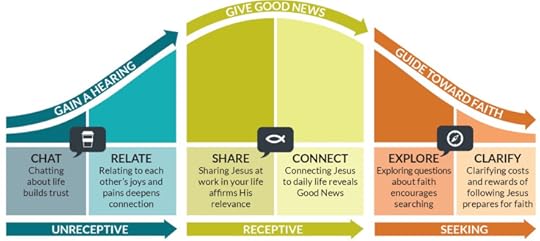
Third, eager conversationalists are “open to sharing their faith in a wide variety of ways.” This openness takes into account whether our conversation partners’ spiritual posture is “unreceptive,” “receptive,” or “seeking.” In turn, our “prayerful response” to them seeks to “gain a hearing,” “give good news,” or “guide toward faith,” respectively. Depending on the relationship dynamic, our conversation may take one of six forms: “chat,” “relate,” “share,” “connect,” “explore,” or “clarify.” Lutheran Hour Ministries calls this dynamic the “Spiritual Conversation Curve.” (See figure below.)
Finally, eager conversationalists “gently push through the awkward moments” in spiritual conversations. The deeper a conversation goes, the more likely “tension or conflict” will surface. It is tempting to bail on spiritual conversations (or on any other deep conversation) when this happens. As Beau Crosetto has pointed out, “right after some of the initial tension is released, some kind of breakthrough comes, whether in the other person, in us or in the conversation.” So, keep talking!
The Reluctant Witness is a short book that can be read in a single sitting. But Everts uses words wisely, quickly and memorably addressing why Christians don’t engage in spiritual conversations more and how they can do so better. Its advice is data-driven, Bible-grounded and road-tested, and well worth reading if you’re a pastor or church leader, or just a Christian interested in better sharing your faith.
Book Reviewed Don Everts, The Reluctant Witness: Discovering the Delight of Spiritual Conversations(Downers Grove, IL: IVP Books, 2019).
Actually rated 3.5 stars. I primarily listened to this book on audio whenever I was working in the kitchen. At times slow, the material was still engaging. I was worried that the book would be difficult to follow in audio format because each of the chapters includes graphs and charts based on research from Barna, but the audio breakdown of statistics was done very well. The author kept saying "Think back to a conversation where you..." I have always struggled to think of very specific examples for myself or others (on any topic) when prompted to do so. The book might be more impactful for a reader who is able to have specific examples. The main points that I came away with: to not shy away from opportunities to engage in deeper, more meaningful discussions and to be aware of those around me who might be seeking, hurting or lonely, who would be blessed by the opportunity to engage in a spiritual conversation. There will be two more books in the series and I would read them.
This is an excellent book for Christians about having spiritual conversations with those who are not Christians. The book is short: 157 pages and maybe 1/3 of those are charts. The positive is this allowed me to digest the book in one sitting. I think this is an excellent tool to introduce new Christians or reluctant Christians to the idea of talking to other people about Jesus, I found the author's suggestions for other resources to be helpful too. To me, the constant charts were a little off-putting. I'm not a chart person. I think for those with a more visual learning style, though, the charts would be helpful. The text itself is simple, winsome, and uplifting. The book encourages witness without being judgmental or pedantic. Well worth reading for most Christians.
A low-pressure encouragement for spiritual conversations. Where we are and how we can have more. Author works for Lutheran Hour Ministries and presented some resources LHM has. I haven't seen then, but everything LHM does is first-rate. "People need good news. They need peace. They become desperate for happiness, for salvation, for hope. And they are sitting right next to us."
"The good news is that anyone who calls on the name of the Lord will be saved. But how will they call on someone they don't believe in? And how will they believe in someone they've never heard about? And how will they hard unless someone tells them about him? And what if God wants that person to be you?"
Good book on evangelism. Better than most I've read. I challenged myself to read 2 books on evangelism this year. This was one of them. It's helped me be encouraged personally to have more spiritual conversations and it's helped me see the people in the pew a little differently. Linked to the Barna/Lutheran Hour Ministries research that resulted in the published report "Spiritual Conversations in the Digital Age," it was a presentation of that material from the perpective of a life-long evangelist and pastor, Don Everts.
Don Everts shares current research about the attitudes of Christians about the challenges of sharing the faith with others. He also shares relevant stories from his personal experience as a reluctant witness that help to illustrate the truths of the research he is presenting. This is a very readable book for laypeople that helps to overcome our resistance to witness
A motivational and practical guide to seizing opportunities to witness in everyday life. It describes steps to take and things to say, without being formulaic. It combines biblical direction with tips based on research from Barna.
The book explains that you should expect spiritual conversations in everyday life, and that you should initiate and pursue such conversations. In your conversations, you should share good news (how God has worked or is working in your life), and gently push through awkward moments, including conflict. The book reminds us that we must be not only willing, but eager, to do this, because we desire the salvation of our neighbors.
I highly recommend it to all Christians!
Notes Reluctant Conversationalists People experience big life changes due to spiritual conversations. Increasingly, those conversations are digital.
Why We Stopped Talking We should not be silenced by fear. "For whoever is ashamed of Me and My words, of him the Son of Man will be ashamed when He comes in His own glory, and in His Father’s, and of the holy angels" (Luke 9:26). "For I am not ashamed of the gospel of Christ, for it is the power of God to salvation for everyone who believes, for the Jew first and also for the Greek." (Romans 1:16).
Delightful Conversations 90% of people who've had a life-changing spiritual conversation had it with someone they knew well (31%) or very well (57%). Christians and non-Christians prefer to have spiritual conversations with friends (versus others). It's important to form trusting relationships with non-Christians to "gain a hearing" to share your faith.
Honestly, humbly seeking answers is more helpful than immediately having the right answers to all questions.
Conflict doesn't play a significant role in how people feel after a conversation.
35% of American adults say they've made a big change in their life because of a conversation about faith. 38% of Christians say a non-Christian believed in Jesus as their savior because of a spiritual conversation.
In your conversations, share good news (how God has worked or is working in your life).
Eager Conversationalists Becoming an eager conversationalist requires being spiritually prepared for conversations, not extroversion or any other personality traits.
What they do, what they believe, how they feel.
Eager conversationalists are active in their faith. They pray more, read the Bible more, and attend church services more than reluctant conversationalists. The more "every day" your faith is, the more you'll tend to talk about it in everyday situations.
Traits of eager conversationalists • Actively practice spiritual disciplines (pray, read the Bible, attend church) • Believe what Bible teaches about witnessing, salvation, afterlife • Feel prepared to talk about their faith
Everyday Conversations When you have an opportunity to discuss faith, ask yourself, "Is this an awkward moment to be escaped, or a 'God moment' to be entered into?"
When you have the opportunity, be honest about your temptations or past sins, and how you're glad for God's involvement in your life.
Rather than trying to be persuasive or argumentative, simply talk about your own life with God.
Ways to continue a spiritual conversation • Ask person more questions about their story (What's happened in past? What are they doing now? How's that working?). • Empathize, sharing about your similar experiences and God's involvement in them. • Explore what Bible says about topic, and why. • Suggest ways God could be involved in their story. • Reschedule to talk in a more private place or more convenient time.
Habits of eager conversationalists 1. Look for and expect spiritual conversations in everyday life. Actively seek opportunities to share your faith; don't view spiritual conversations as accidents that occur (Col 4:3). Expect God to be at work in world around you, including in non-Christians. Watch for tears, earnest questions, heartfelt responses, etc. (1 Pet 3:15). 2. Pursue and initiate spiritual conversations. Dive deeper (e.g., "When you were talking about your weekend, you seemed reflective. Did anything big happen for you or your family?"). Be honest and vulnerable about your own story. 3. Be open to sharing your faith in a wide variety of ways. Don't use the same evangelistic device all the time. Adapt your approach and medium to the situation (Col 4:5-6): if non-Christian is unreceptive, gain a hearing; if they're receptive, give good news; if they're seeking, guide them toward faith. Be gentle, respectful, thoughtful, wise. 4. Gently push through awkward moments (1 Pet 3:14-15). Their hearing about Jesus is important, so it's worth pushing through conflict.
A great book for those who may seem on the shy side of having spiritual conversations. Myths about spiritual conversations are broken down as well as how to develop habits of engaging in spiritual conversations more often. If you’re looking to grow in sharing good news with those in your life, this is a good book to start with.
A short book with some great stories and good things to think about. I'm just not a big fan of using statistics and science to determine Gods work. I know some people find it helpful, but it feels too much like trying to quantify God. He can't be contained in our boxes. However, there is some good stuff here.
Written like a true evangelical evangelist! Dan Everts clearly has a heart for engaging the world with the gospel. I enjoyed reading this call to deeper spiritual conversations through formed relationships and thoughtful witness. It wasn’t anything revolutionary to me, but great insights and a short read for anyone looking to grow in evangelism in a western context. I’d recommend it.
Pretty good. Everts combines research by the Barna Group, personal anecdotes, and some Scripture to encourage Christians not to be reluctant witnesses. I particularly appreciated his emphasis on the delight of spiritual conversations, yet his realism concerning how they might, at times, be awkward.
Good resource for telling others about God. Would be a great book for leading a class along with the book "out of the saltshaker and into the world" by Pippert. Written on a level that anyone can learn from.
A mix between personal stories and insights from research done by Barna, this is a short read and introduction to some reasons why people are scared to have spiritual conversations, how research debunks those myths, and what people can do to have more conversations
Anytime I read a book on gospel sowing, I learn something and am encouraged. This simple and short book will hopefully encourage many others who are on the fence of being ones who spread gospel truths.
pretty good. easy read. lot of graphs and stats if you are into that (i’m not). but basically just share the gospel with people it isn’t as hard as you think. definitely put fuel on the flame of evangelism that God has put on my heart lately.
Very encouraging and helpful to learn about how to have more spiritual conversations. It showed me how they don’t have to be awkward or stressful - they can be beautiful, even enjoyable! The book itself got a little repetitive at times, but it was still worth the read.
Fantastic well researched and practical book on witnessing. Very much in the same category as Rebecca Manley Pippert whom he quotes. delightful, personal, encouraging and challenging.
This is a fantastic and eye-opening book! If you’ve ever felt hesitant or awkward about sharing your faith, The Reluctant Witness will challenge and encourage you in the best way possible.
I may have to buy this one in hard cover to fully appreciate the work. However, as I already a good portion of the background work by way of LHM, the impact of this one was more like, "Yes, that's exactly what Tony Cook and company at LHM have been needing to polish up based on the research they commissioned." This one strikes me as a potential game changer.