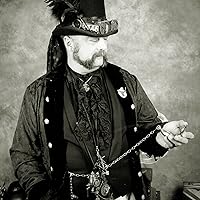
In the last few decades, steampunk has blossomed from being a rather obscure and little-known subgenre of science fiction into a striking and distinctive style of fashion, art, design and even music. It is in the written word however that steampunk has its roots and in this book Simon Webb explores and examines the real inventions which underpin the fantasy. In doing so, he reveals a world unknown to most people today.
The Real World of Victorian Steampunk shows the Victorian era to have been a surprising place; one of steam-powered airplanes, fax machines linking Moscow and St Petersburg, steam cars traveling at over 100 mph, electric taxis and wireless telephones. It is, in short, the nineteenth century as you have never before seen it; a steampunk extravaganza of anachronistic technology and unfamiliar gadgets. Imagine Europe spanned by a mechanical internet; a telecommunication system of clattering semaphore towers capable of transmitting information across the continent in a matter of minutes. Consider too, the fact that a steam plane the size of a modern airliner took off in England in 1894.
Drawing entirely on contemporary sources, we see how little-known developments in technology have been used as the basis for so many steampunk narratives. From seminal novels such as The Difference Engine , through to the steampunk fantasy of Terry Pratchett’s later works, this book shows that steampunk is at least as much solid fact as it is whimsical fiction.
This is an interesting book, full of interesting facts and information. It's well researched, informative and entertaining. Some more pictures in the text would help. Recommended! Many thanks to the publisher and Netgalley for this ARC, all opinions are mine.
This is an interesting book, tying together the modern steampunk aesthetic with the object of its fascination…Victoriana. Mr. Webb shows the originals of some of the ideas of steampunk as having been a reality in the mid to late nineteenth century. His last sentence in his Endword was “Steampunk, although generally described as a genre of science fiction, has in fact far more in common with science fact than most aficionados ever realize.”
I did find this fascinating and while there is a good bibliography, much of which the author mentions in the text, I would have like to see annotations/citations. It did seem that Mr. Webb had many axes to grind, disputing many proclaimed inventors (high school textbooks are notorious about getting a lot of history wrong) as having either built off of others without credit, or downright purloining the intellectual property of the real inventor. He provides supporting arguments, though some seem a bit of a stretch. Regardless, this is a good read for the history.
A few curated highlights: “The first recorded use of the word ‘steampunk’ dates back to 1987 and 30 years later, steampunk has expanded to include not only literature, but also computer games, graphic novels, art, clothing, various accessories such as walking sticks, fob-watches and glasses, and even music.” I am a fan of the visual imagined physical and art creations, more than costumes, which I like more than the literature and the rest.
“Readers will also learn that the Wright brothers’ place in history is ensured by a secret document which discourages any investigation into their claim to have piloted the world’s first aeroplane and that the facts are a good deal more complicated than most of us realize.” “The aeroplane [of John Stringfellow, in 1848], which carried out what was indisputably the world’s first successful flight by a powered, heavier-than-air machine, used a very small steam engine weighing a little over 6lbs, including water and fuel. Heat was provided not by coal, but by a compact oil lamp. The two contrarotating propellers sent the plane rushing along the guide-wire until it lifted away from the wire and flew straight and true for over 30ft.” “Nevertheless, it is indisputable that it was Ader and not either of the Wright brothers who first left the ground in a self-powered aeroplane. A powered hop it may have been, rather than sustained and controlled flight, but there is not the least doubt that to Ader belongs the distinction of having taken to the air first, without the assistance of any ramp.”
Part of the controversy as to “first” is a dubious account of Gustave Whitehead that gained almost conspiracy theory magnitude in resurfacing in 2013. The claims of two flights sound outrageous and James Dickie, who was named as a witness to the 1901 flight (the other alleged witness was never found) said, “I believe the entire story of the Herald was imaginary and grew out of the comments of Whitehead discussing what he hoped to get from his plane. I was not present and did not witness any airplane flight on August 14, 1901, I do not remember or recall ever hearing of a flight with this particular plane or any other that Whitehead ever built.”
And the “secret” document isn’t secret at all. Distilling the legalese (courtesy of wright-brothers.org): * The Estate of Orville Wright agrees to sell the 1903 Wright Flyer to the United States (represented by the Smithsonian) for $1. * In return, the United States guarantees the aircraft to be displayed prominently in the nation’s capital and to be identified as the first heavier-than-air flying machine in which men made a controlled and powered flight. * The airplane is to be valued at $1 for tax purposes. * Should the United States not prominently display the airplane, display it without the agreed-upon identification, or identify another airplane as being capable of controlled and powered manned flight before December 17, 1903, the ownership of the airplane reverts to the Estate. * Additionally, if the airplane is valued at more than $1 and the Estate is assessed for taxes, the United States will pay those taxes. If it does not, the title reverts. * If the United States forfeits its title to the airplane for any of these reasons, it has five years to comply with the agreement to regain title.
Anyway, a few more:
“Interestingly, the one book by Jules Verne which everybody associates with balloons, Around the World in Eighty Days, does not feature any travelling by balloon.” “Both The Mysterious Island and Five Weeks in a Balloon by Verne have manned balloons as a central plot device.” Note to self: reread those.
“Those reading the first acknowledged steampunk novel, The Difference Engine, will not fully appreciate it unless they have a comprehensive grasp of the historical events upon which it is based.” I had a fairly “comprehensive” grasp of the history but was unimpressed with Gibson’s (and Stirling’s?) neologisms that got in the way of the story.
Thanks to Rosie Croft from Pen & Sword for sending me a paperback review copy of this book, which I loved and freely chose to review. I cannot claim to be an expert on the history of the Victorian period, and I did not discover steampunk as a literary genre until a few years back, although it has captured my imagination. I follow some blogs whose stories are set in the period, I am fascinated by the artwork and clothing inspired by the genre (there is a steampunk yearly convention not far from where I live now in Barcelona, and it’s a joy to see people walking on the streets dressed in steampunk fashion), and although I haven’t read many novels in the genre, I’ve enjoyed the ones I’ve read. Because of all that, I was immediately grabbed by the title and the cover of this book. And I enjoyed it immensely. The book is a joy to read. The author is an authority both, in steampunk fiction (although he mostly talks about early offerings and classic titles, but not exclusively), and in Victorian history, at least when it comes to little-known (at least to the general public) inventions and projects. His style of writing is easy to follow, not excessively technical when it comes to descriptions of machines and engineering feats, and he has a knack for bringing to life the material, including anecdotes that make us see the events in our mind’s eye (and wonder why many of those have not been made into movies). Webb divides the book into nine chapter, plus a list of plates (there are 20 of those and they are a delight), an introduction (where the author talks about steampunk, shares a working definition, and explains the characteristics of the genre and its different visions and versions of the future or alternative history), and endword, a bibliography (not too long, consisting mostly of fiction books in the steampunk genre, some of the original books they got their inspiration from, and some research titles), and an index. As the author explains, there are many topics that could be covered in such a book, but he chooses some of the more habitual and the ones that give steampunk its flavour. I marked many passages in the book, so many that it is impossible to fit them all into a review, and, in any case, I’d rather you read it, but I’ll briefly mention what each chapter is about so prospective readers can decide if they’d like to find out more (Yes, you would). Chapter 1, titled ‘Dreams of the Future, Visions of the Past’, elaborates on the introduction, talking about several of the early titles in steampunk (and proto-steampunk), and their visions of the future. As he notes, there usually is some point where some historical event changed (or some invention happened or didn’t) and that results in a fairly different future (or present). What we might not know is that some of the inventions and the alternatives these books offer are not as far-fetched or fantastic as we might think. Chapter 2, ‘Of Steam Buses and Atmospheric Railways’ describes the existence of steam buses and other forms of steam transport that might sound strange when we read about them in this genre of novels and also of real railways built to work by the application of air pressure (similar to the system used to send messages via tubes in some old supermarkets and offices). And they were very fast! Chapter 3, ‘The Mechanical Internet’ fascinated me. The fact that there were semaphore-towers across Europe in the XIX century that would allow messages to travel at incredible speed even from our perspective (the author mentions Terry Pratchett’s Dreamworld series) is mindboggling. Chapter 4, ‘Steam Planes Take Off’ was an eye-opener for me. I knew about balloons and dirigibles, although not about balloons going into the stratosphere, and the explanation for why the Wright Brothers have been granted the fame and reputation they have now in the world of flying when there were many others who’d gone quite far (if not farther) before, makes one stop and think. History has always been unfair and not everybody who deserves to be remembered is. (Hiram Maxim is a captivating character and one I hope to learn more about in the future). Chapter 5, ‘Steam-Powered Computers and Mechanical Calculators’ is another sobering chapter, a reminder of how different things could have been, and although I knew about some of the people involved (like Ada Lovelace, Lord Byron’s daughter), I didn’t know that the word ‘computers’ was first used to refer to human beings whose job it was to make lengthy calculations (for example to compile logarithm tables). Chapter 6, ‘Radiophones, Fax Machines and Hard Drives’ offers a great introduction to the topics. I learned new information about telephones, discovered that there had been fax machines even before the telegraph was widely in use, and found out that the technology behind televisions is much older than I realised. Chapter 7, ‘The Quest for Renewable Energy’. This chapter is particularly applicable to this day and age, but the Victorians were already worried and thinking about such matters. Much of what appears now as new is nothing but, and the chapter goes a long way to explain how and why our society came to rely on petrol as much as it does. Chapter 8, ‘The Resistible Rise of the Internal Combustion Engine’. Anybody who loves cars and/or is puzzled by our reliance on petrol engines will find this chapter a must-read. I knew that there were electric cars well before the first reliable petrol cars existed, but have now fallen in love with steam cars as well (I’d love to have one of the Doble Brothers’ inventions), and I found the explanation of why the internal combustion engine took over convincing and understandable (although quite sad. Oh, taxes and cheap oil… You have much to answer for). Chapter 9, ‘The 11-Mile-Long Shopping Mall that Never Was’ describes a fabulous plan to build what would have an enclosed section of London, like a bubble of glass, where people would not have been at the mercy of the weather and traffic would have been fast and easy. It sounds wonderful but, once again, money was a problem (and I agree that a new sewage system was a priority). Webb advises readers of the genre to do some research and concludes: Steampunk, although generally described as a genre of science fiction, has in fact more in common with science fact than most aficionados ever realize. This book is probably not for history buffs and experts on the matter, but for people interested in the topic and who are not specialists, it is full of gems. In sum, this is a great book, a joy to read, informative, and inspiring. It will delight equally lovers of history, steampunk novels, and researchers interested in the topic. Readers and writers will find much to ponder upon (I’ve finished the book with a long list of other books to read), and it occurred to me as I read it, that writers of post-apocalyptic fiction would find it a good source of inspiration, as it has all kind of suggestions for contraptions and inventions that could have taken over the world if things had been different. Highly recommended.
I came across Simon Webb’s book purely by accident while browsing through the internet. I am a Steampunk author and have been involved in the British Steampunk scene for about 12 years now. I am also a Historian, Archaeologist and Lecturer. I’ve taught a lot about the industrial revolution in Britain and the Victorian era, and, as a Steampunk author, I’ve done a lot of research around the more surprising technological inventions of the 19th century, but I’ve never read such a concise review of the subject. Webb’s book opens up a Victorian world few of us have even imagined was real, a world in which Caractacus Potts himself would have felt at home. Here, even the things we were taught as facts, and taught as facts, are turned upside down. Steam powered airplanes flying before the Wright brothers ever got off the ground. A system exactly like Terry Pratchett’s ‘clacks’ was real and functioning across Britain and Europe. Cable music and news being piped into homes, and palaces, before Marconi had invented the radio. Steam powered cars that could reach over 100mph. And as for the atmospheric railways! Wow! The mind-boggling list goes on. Webb’s book is a treasure trove of the incredible, whimsical and downright amazing, plus, as a good history book should, it made me angry at some points. If solar power and electric vehicles were so advanced in the Victorian age, why are we in the climatic and political mess we are in today? Answer the answers are obvious, and Webb cites the reasons clearly; political short sightedness, corruption, and industrialist's greed. I loved this book, and consume it in quick time. I cannot recommend it any better than to quote Webb himself; “One might say that to be a good author of Steampunk, a vital prerequisite is to be well versed in the history of nineteenth-century technology.” I think all my fellow Steampunks, and anybody interested in the history of the nineteenth century should read this book.
This is a book about how the fiction genre of Victorian Steampunk is inspired by attempted inventions or real technology created during the reign of Victoria. The author started by explaining what steampunk is, and he frequently referred to various novels that were inspired by the real technology that he's describing. I think this book was aimed more at fans of this genre than history buffs as I've read most of this material in more detail in books by other authors. This was more of an overview of the many ideas that were coming out at the time with some general descriptions of how they worked and why they didn't last longer at the time.
He talked about various steam-powered vehicles (cars, buses, lorries, dirigibles, a motorcycle, and a plane) and described why petrol vehicles "won" when electric and steam-powered vehicles were much more desirable (quieter, more reliable, etc.). He described several stretches of pneumatic railway that were actually built and why the technology was abandoned. He talked about wind-powered cars, the mechanical telegraph network, mechanical computers and calculators, wireless sunlight phones, telegraph fax machines, recording voice on metal wire or disks, their understanding of how televisions could be made, home stereo music over the telephone line, attempts to make mechanical men or animals, and solar-powered generators.
I received an ebook review copy of this book from the publisher through NetGalley.
Edit: My thanks to Pen & Sword for a replacement digital copy of Simon Webb’s “The Real World of Victorian Steampunk: Steam Planes and Radiophones’ in exchange for an honest review. It was published on 30 June in ebook and paperback editions.
A highly informative study that explores the real inventions mainly during the Victorian period that inspired the sub genre of steampunk in science fiction and fantasy, which has further influenced fashion, art, and design.
Webb clearly has a strong grasp of the technology of the period covered alongside a passion for the literature associated with steampunk. He cites many works and their relation to the original inventions.
It really is a treasure trove and almost on every page I found that I was amazed by the revelations including of many inventors and their inventions sidelined by history. I had no idea that the electric car predated the petrol driven one by decades or that Victorians were exploring solar power and other sustainable energies.
I felt that I was learning a great deal about the history of science and technology alongside a deeper appreciation of steampunk in literature.
In his Endword Webb writes: “The world created by the authors of steampunk novels and short stories strikes us as outlandish and fantastic, simply because we do not know enough about the history of the real world in which we live. It is hard to find a single invention mentioned in steampunk literature which did not have its counterpart in the age of the Victorians.”
He concludes: “Steampunk, although generally described as a genre of science fiction, has in fact far more in common with science fact than most aficionados ever realize.”
Just fascinating from start to finish. I would love to see this commissioned as a television series! Highly recommended.
Late June: Unfortunately my review copy via NetGalley had formatting problems and as this title has now been archived no chance for me to download an alternative.
Therefore, I won’t assign stars.
Maybe in the future will have a chance to revisit.
The Real World of Victorian Steampunk is a short book about a number of lesser known inventions of the industrial era -- optical telegraphs, steam aeroplanes, wireless telephones -- that, as the author argues, served as direct inspirations for the staples found in the genre of steampunk. It's an enjoyable enough read. It's light on the science, so if you're hoping for an in-depth explanation of how Babbage's analytical engine was meant to work you're in for a disappointment, but it's lucid enough to tickle the fancy. The author does have an irritating tendency to discuss the same four steampunk books in every chapter, in case we forgot that this book is not just about industrial inventions but literary critique, but these asides are short enough not to detract from the good stuff overmuch.
Taken me a while to get through this one. Not because of the quality or writing, but because I had a lot on last year. Fascinating look at real Victorian and earlier technology that has influenced the steampunk genre.