“Above all, do not lose your desire to every day I walk myself into a state of well-being and walk away from every illness.” —Søren Kierkegaard
Duncan Minshull has always walked and in the last twenty years has made use of it by writing and publishing books on the subject. He has described the whys, hows, and wheres of traveling on foot for various magazines and newspapers, including The Times (London), the Financial Times , Condé Nast Traveler , and Vogue . He has edited two other collections on While A Walking Companion (originally The Vintage Book of Walking ) and The Burning Walking Scenes from Classic Fiction .
Walking and writing have always gone together. Think of the poets who walk out a rhythm for their lines and the novelists who put their characters on a path. But the best insights, the deepest and most joyous examinations of this simple activity are to be found in nonfiction—in essays, travelogues, and memoirs.
Beneath My Writers on Walking rounds up the most memorable walker-writers from the 1700s to the modern day, from country hikers to urban strollers, from the rationalists to the truly outlandish. Follow in the footsteps of William Hazlitt, George Sand, Rebecca Solnit, Will Self, and dozens of others. Keep up with them—and be astonished.
An attractive and high quality little book containing a selection of excerpts on writing from various authors. A few are excellent. A few have introduced me to writers I have not heard of who I will read more of. The writing standard is high but too many of the pieces are just a little dull - including some of the longer ones. Hence only 3 stars.
“There will be many footpaths in Utopia.” H. G. Wells So ends this book of tributes to walking. Unfortunately, whilst the quote may perhaps be true I do not feel that this book will help you to find many of these footpaths! It held so much promise, and I was so looking forward to reading it, but in the end I found it a very mixed bag. There were some high-quality, compelling and uplifting quotes, but others where it felt like you were wading through foot-sucking mud! Many of the long excerpts seemed like they would never end, and I would often feel an inordinate amount of relief when they did. This was unfortunate and detracted from those quotes that were very good.
My overall comment: The idea behind this book was excellent but the execution at times left a lot to be desired.
Novelists send characters across the pages. The walking and wandering experience of 36 different personalities, mainly writers has been incorporated in the book. Every chapter holds its own essence, where the neighborhood is different and characters are distinct. There are seasons described in the chapters, while the narrators continued to walk in different lanes.
With the lockdown and things coming to a halt, I think everyone who had a habit of taking a stroll down the lane just came by to a stop. Well, the narrators have described situations or scenarios during their walk. What walking means to them? This question has been evidently answered as walking helps to connect to soul spiritually.
Then, one of the chapters also focused on Charles Dickens who strodes edges of London to shrug off insomnia. That's how amazingly the book has described characters and their habit of walking. In the afterword, Duncan has quoted writers and their love for walk. I am simply mind blown with the quotes mentioned towards the end of the book.
This is very beautiful little book with fabrics cover and small red page divider which I just loved. It is nice to hold in hand. Also I loved the wealth of stories and authors mostly from old times who I would not find myself. Though I enjoyed most the well known names lol Frantz Kafka. Some stories from Victorian times didn’t resonate with me but that is ok.
Gems within!! pulled from a swath of 36 writers: some expected, like Twain and Muir and Thoreau. The former puts to page an alpine Jodel in the onomatopoeic, quite unique.
In a genuine description of Climbing the Rigi, Twain is taunted by an impatient porter, impatient himself with the progress, completely assured of the guidebook's faultiness, bickering with his agent, complaining about European 'ice water', totally beat.
He is wet, cold, lost in the fog, oversleeping and mistaking sunsets with sunrises but still appreciating, "The cloven valleys of the lower world swam in a tinted mist which veiled the ruggedness of their crags and ribs and ragged forests, and turned all the forbidding region into a soft and rich and sensuous paradise."
George Sand relates the novel privacy of manonymity and the bright side of the phrase, 'desert of men.'
A fascinating pull from Mary Kingsley! The Victorian ethnographer in West Africa is downing tinned meat and beer in a corset under stinging rain atop Mount Cameroon.
A truly comical travelogue from 1782 by Karl Philipp Moritz, apparent vagrant, on his poor reception had at "Eton College, one of the first public schools in England, and perhaps the world. I have observed that there are in England fewer of the great schools than one might expect." Many tourists herein.
Robert Louis Stevenson camps with his donkey, Modestine.
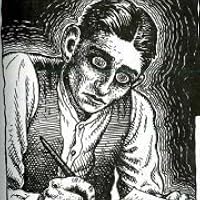
Kafka very briefly describes the phenomenon of The Sudden Walk.
We are visited by the masterful stylings of Woolf. The pedestrian offers business to the urban center just as the golfer preserves open space, "so when the desire comes upon us to go street rambling the pencil does for a pretext, and getting up we say: 'Really I must buy a pencil,' as if under cover of this excuse we could indulge safely in the greatest pleasure of town life in winter - rambling the streets of London."
Unfortunately, the point is somewhat fumbled. Woolf's making pretense of metaphor of pretense to draw us into a 5-page carousel of wintry diversion for the eye--something so joyfully escapist and coy--is sandwiched between a fairly dated identification with and definition of the word flaneuse from 2016 and a too-discursive revisiting of the moral panic surrounding street lights from 2007.
I am offended by the latter, this William Woodard Self.
Icky! The man in Glasgow is not grateful for your 'sententious' witticism about the patio furniture, nor for you addressing him as if he 'possesses a brain not sodden.'
You: "Sodium, bilious, bilious sodium, Baalbec!, privet hedges, mizzles, diaphanous, brown miasma!" I'm a serious flaneur! "I'm discomfited by the presence of a fellow night walker; a woman, trim..." "...reverse paranoia...walking behind a single woman at night...worth remembering that for many others the night-time city is a genuine jungle, not merely a psychic adventure playground." "I'm relieved by the presence of the police - it damps down my reverse paranoia." I see the cosy dwelling of the couple in the handsome house, "I covet...their family photos more than anything I've ever wanted before." "...for sale here is an idea of cosy homeliness that can never be experienced, except by a voyeur." "herbaceous border, Oh! those herbaceous borders, those privet hedges flocculent...bucolic!"
Cut this toad.
Structure and temporality is often confusing, for example: De Quincey describes Kant's inveterate nasal breathing in The Last Days of Immanuel Kant, 60 years posthumous. This is followed by Petrarch (5 centuries prior) waffling on a travel companion for Mount Ventoux. Back to 1860 for an interlude on tramps by Dickens. Then a genuinely scandalous moment between Madame de Larnage and Rousseau! to round off that 15 page snippet.
Some great picks from some of the greats. Jumbled, confused, loosely connected by the act of walking. Could do with annotations. Cut 20%
An interesting read, if you like walking and are interestef in what others say about it.
Of note: I felt totally in tune with Rebecca Solnit; enjoyed the descriptive and evocative language of Henry David Thoreau; was surprised to find Mark Twain funny and so modern in his writing, and felt part of the story as I had so often lived the same as his characters; was challenged in my thinking by what William Hazlitt had to say about walking alone, and also fully understood his views of walking amongst strangers and the freedom it grants; found Charles Dickens' style bland and boring; loved George Sand anonymity so she could roam freely in Paris; have been pondering Listen Elkin's "Learning to see meant not being able to look away"; and was reminded that I love Virginia Woolf's writing which, in this case, made me want to walk the streets of London in the winter evenings in search of a pencil....
Walking is the best of panaceas for the morbid tendencies of authors.” — Leslie Stephen.
The premise of this little anthology was irresistible, and several selections will bear re-reading — Rebecca Solnit and Virginia Woolf for the sheer delight of their prose, Mark Twain for humor (his tale of hiking in the Alps was hilarious), and George Sand for the way she invented herself, seizing freedom by dressing as a man (“I cannot tell you the pleasure I derived from my boots … With those little iron heels, I felt secure on the sidewalks. … my clothing made me fearless”). Editor Duncan Minshull also introduced me to new writers like Will Self who drove me to the dictionary a half dozen times and Lucy Hughes-Hallett who so charmed me I’m determined to read more of her. Mostly though, these writers made me want to take a walk.
“All truly great thoughts are conceived by walking” -Nietzsche
“There will be many footpaths in Utopia” -H.G. Wells
“Thinking is generally thought of as doing nothing in a production-oriented culture, and doing nothing is hard to do. It’s best done by disguising it as doing something, and the something closest to doing nothing is walking. Walking itself is the intentional act closest to the unwilled rhythms of the body, to breathing and the beating of the heart. It strikes a delicate balance between working and idling, being and doing… Walking allows us to be in our bodies and in the world without being made busy by them.” -Rebecca Solnit
A Notting Hill Edition anthology of essays (or portions of essays) of more than 35 authors, some well known and some not, addressing the experience of walking. While some are treats to find, such as the humorous narrative by Mark Twain, others seem to be mere fillers added to complete a book-length tome. Of particular interest to me were the additions from more than a century ago discussing the perceived health "benefits" of walking. Most of the included authors were British. Some narratives make one wonder if the definition of "mile" was different back then and there, as it is remarkable to see that casual walking 20 to 30 miles a day was not unusual for many of these authors.
Overall, I quite enjoyed this book. The essay form that they utilize was charming and thoughtful. Each story was unique and personal. I found I enjoyed some sections more than others but the collection itself was well paced and put together. Great reading for someone who wants to be drawn into the world of another.
A book on walking by a selection of writers, which I found variable in quality. Some left-field topics, including urban flaneurs make the choice interesting, as does the huge variety of authors from the obscure to the very well-known. I particularly enjoyed Richard Jefferies on 'The inevitable end of every footpath', and some of the little gems, which are often not much more than quoatios.
I picked this book up because I am doing a lot of walking since COVID-19 has kept me house-bound. I love picking it up and reading one or two of the stories and imagining walking where they take me. Lovely little book.
I enjoyed this book of excerpts, many from older writers I did not know, thinking about the land and stories about walking. A little book it felt like a throwback to a slower time.
The passage about walking in 1768 is puzzling. Why would people not want to walk far, when cars, trains and other forms of transport were not invented yet? I downloaded the 1768 book, to read later.