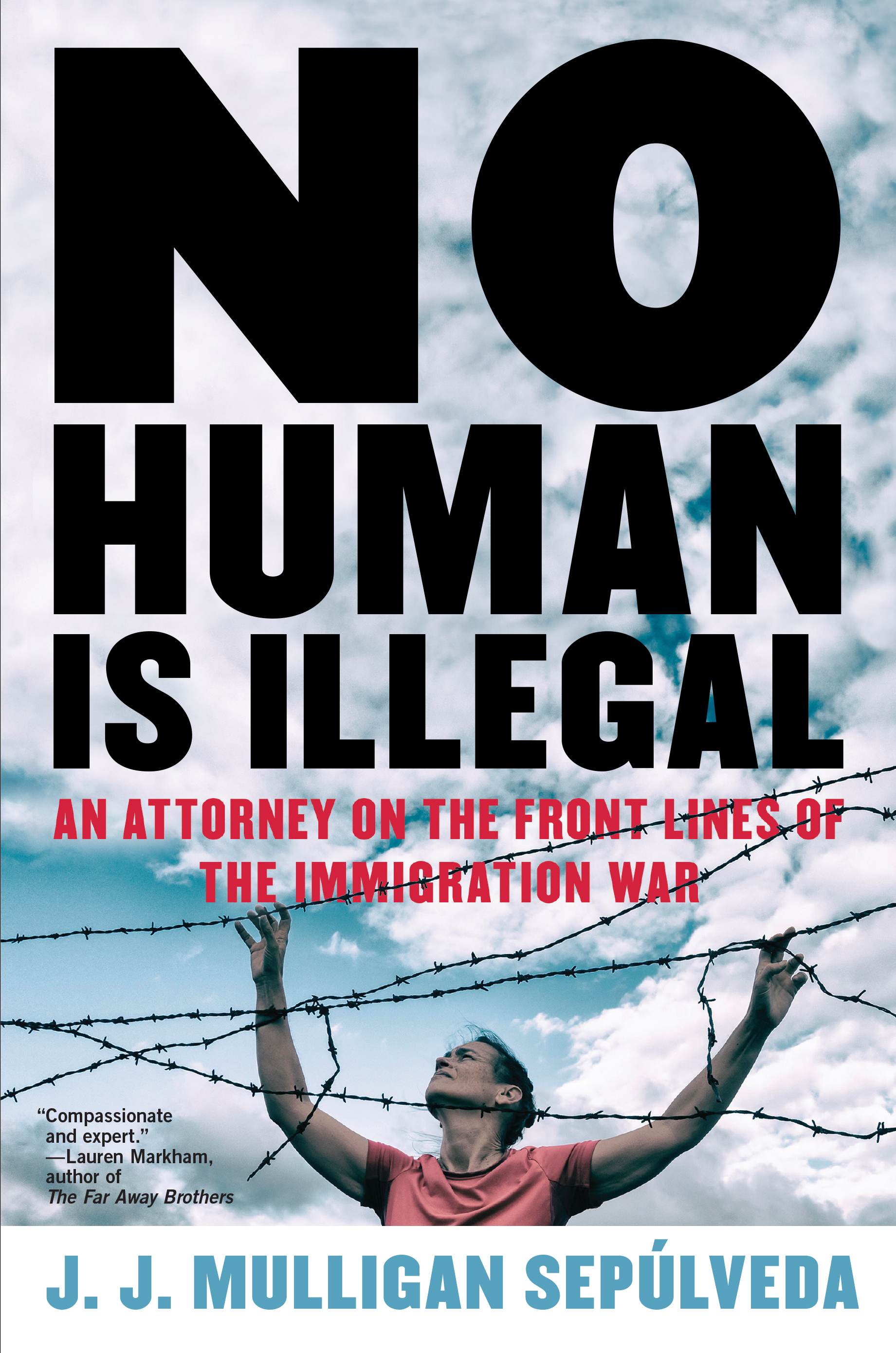
The perfect author on one of today's hottest topics - an immigration reform lawyer's journalistic memoir of being on the front lines of deportation.
No Human Is Illegal is a powerful document of one lawyer's fight for those seeking a better life in America against its ever-tightening borders. For author Mulligan Sepúlveda, the son and husband of Spanish-speaking immigrants, the battle for immigration reform is personal. Mulligan Sepúlveda discusses visiting border detention centers, defending undocumented immigrants in court, and taking his services to JFK to represent people being turned away at the gates during Trump's infamous travel ban.
J. J. Mulligan Sepúlveda is an immigration lawyer working at the Immigration Law Clinic at the University of California Davis School of Law. He is a former Immigrant Justice Corps fellow and Fulbright Scholar. This is his first book.
One can't unsee the pictures of what's been going on at the US-Mexico border under Trump, or at various airports when the travel ban came into effect, and circumstances don't look likely to get much better any time soon. As an immigration lawyer, the author has been and continues to be on the frontlines of these events, experiencing horrible, heartbreaking, disillusioning and infuriating treatment of immigrants time and time again. However, he rightly points out that cruel and dehumanizing treatment of immigrants and more and more obstacles thrown in their way didn't start with the current US administration but have been building up for decades. Equally, he makes clear that this is not solely a US issue, but that immigration systems in other regions face similar problems of overburdened and overwhelming bureaucracy, horrible treatment at borders and in detention centers, and people's lives utterly disregarded as politicians scrabble for power without caring about the cost.
I feel inadequate to make any attempt to “review” such a gut-wrenching book. Beautifully written and inspiring. I wish I had prettier words to write the author and tell him so. This may very well have changed my career path.
Maybe I’ll come back to this review to add more words when I feel up to a challenge. For now this is just to mark it read.
I picked this book from the public library's NEW shelf because this is an issue I care deeply about and knew little beyond what I read in the news and columnists' essays. I know little about the law on immigration (though a lot about the current administration's view of it). And to pass up this book is to me an act of saying to an immigrant "you are not worthy of my attention." If nothing else, I can in a sense bear witness.
The first chapter was difficult to read for JJMS just sort of drops the reader into a day's work with an immigrant. What is going on is confusing and arcane. As I said I know nothing about the law on immigration and so like an immigrant certainly need someone to inform me, figure out what section of the law pertains to me and that I can use to gain asylum or whatever. The court appearance seems chaotic and vague. JJMS in short puts the reader into an immigrant's shoes, so to speak; at least I felt like I was an immigrant (though without the anxiety that each must feel for the chapter was a visualization and my future was not at stake).
Subsequent chapters take the reader to more "front lines", down in Texas an a border facility, the disrupted JFK airport when the president issued his first travel ban, but then outwards into the world to Europe and North Africa when JJMS obtained a study grant to study how immigration is handled in Spain and Morocco. (Note: the more things change, the more they stay the same.) What is heartening is to learn through this book that there are a number of people, lawyers, advocates, donors, etc., that try to increase the amount of decency and hope in this issue, who see immigrants as human beings born into situations that they cannot influence much less control. All should have a right to a decent life; the right to life does not end with birth.
I gave this book 4 stars as I think it does a really good job of describing the current immigration policies in America. It really goes into the details of the immigration crisis from a lawyer's perspective which is different than what most normal people might see it.
"I have two equally powerful visions of the border-one fiction, one fact." Page 109 This quote to me speaks the loudest of the border situation. It talks about the sort of fictional version we hear about on the news. In reality, the border is much more complicated than it seems. In my opinion that quote really summarizes the whole immigration crisis.
The book goes through Sepulveda's fight for immigration law in the US. In part one it describes how Sepulveda started as a lawyer working for any youth facing deportation. It then goes through Elvises trial who was a young immigrant from El Salvador. Sepulveda then revisits his home country of Chile where his mother was an activist and campaign worker for Salvador Allende. He talks of his struggle of identity as his mother was Chilean but he was born in the USA. Sepulveda then talks about crossing the border and what immigrants have to go through. He talks of the brutal heat and endless desert they are forced to cross then the process of getting documentation in the US. He criticizes how complicated and hard it is to get actual documentation which is why many immigrants chose to cross illegally instead of going through the tough legal process.
The theme of the book is that Of overcoming an obstacle which is similar to other books like The Kite Runner. The kite runner also deals with the struggle of immigrating as they face the Russian army as they escape Afghanistan. In no human is illegal an attorney on the front lines of the immigration war, they face the US government prosecuted to deport many immigrants and the policies of the border
If I went to law school, I would’ve become an immigration lawyer. I’ve often thought that, because of my interest in — or obsession with — border lands, but after reading this book by an immigration lawyer, I know it for sure. I know it in spite of the fact that being an immigrant lawyer is a thankless, poorly paid, not overly respected, and heartbreaking career.
I’m not going to law school and I’m not going to be an immigration lawyer, but I’m glad I read this book, which takes you behind the scenes and into the reality of fighting for human rights, decency and kindness in a post-Trump world. It’s messy and sad and full of unbelievably heartless and incompetent people making life-altering decisions for other people with minimal thought or concern. The things this author sees have to make it at least a little hard for him to close his eyes at night. But then again, maybe it makes it a little easier, because he knows he’s done something to make the world better.
This is a thought-provoking book, no matter what your thoughts are on the issues.
I was looking for a more practical explanation of what a functional immigration system would look like. I was a little disappointed but understanding that especially in the cross-cultural comparison to Europe's refugee crisis, there just might not be a solution. At least not one that lies within the immigration system alone. Mostly this supplied me with enough anecdotes about the treatment of immigrants in detention centers to be sick. I was logically and vaguely aware and opposed to detention centers as they exist, but I had no idea that things like withholding water as punishment were occurring frequently enough to warrant a judge's formal comment. So back to feeling sort of hopeless and low level horrified at my own country, I guess.
This was a very timely book because of what is happening at the border. The author is an immigration lawyer and tells of the horrible conditions and choices faced by undocumented people in the US. I especially liked that he included his experiences on the border of Spain and Morocco, as it shows that immigration is not just a US issue and that other countries handle undocumented people much differently, but it is a worldwide problem. After reading this, more than ever I feel that there should be a free movement of people, as borders are really meaningless and it is much more effort required to track people and contain them than if you just let them do what they have to do. The way the US treats undocumented people is inhumane, cruel, and evil.
This is an easy and informative read. The author is an immigration attorney who takes the reader from immigration proceedings in New York, to the border between Texas and Mexico, into the detention centers, asylum proceedings, the travel ban and the immediate aftermath at JFK airport, and some international perspective with a trip to Spain and a look at Syrian refugees. He does a good job of layering in historical trends and perspective, without breaking the flow of his narrative.
Wow... a great book with an insiders perspective of the current immigration crisis. No matter what your current position is on this situation, you cannot read this book without becoming more empathetic with the plight of people seeking asylum to the greatest country in history- America. The most powerful words in the book that will be in my thoughts forever were - when you die citizenship is no longer an issue. Hope more education on this subject will render reforms soon.
This book gives insight into the United States immigration laws and enforcement over the years as well as a close up look at what is happening at the boarder to give people due process when seeking asylum. It does not answer what to do, but does show what we are doing and how in very recent years we have begin treating people less humanely.
Interesting story. There's a mess at our border that I don't have any answers or solutions to. It really is maddening how actual people are treated and how families are split apart. And most of them haven't committed any real crime. And children are suffering. Sad.
Tore through this on a plane. Gripping personal story that is impressively interwoven with the political and legal context that is involved with each person and each case. At some times, being so emotionally invested made it frustrating to keep reading.
I plucked this off a shelf at the library without knowing anything about it, but hoping to better understand our immigration system and the increasing injustice of it. After slogging through the court system and a labyrinth of policy in the first few chapters, the narrative finally gained some traction with the story of Mulligan-Sepulveda’s mother. But the trajectory of the book felt disjointed, even as a sequential telling of events.
There were some piercing accounts like that of a mother and baby abruptly deported to Mexico where they were left to fend for themselves and minors beaten and so mistreated by guards that they hoped to be deported or attempted suicide to escape. These stories offer a glimpse into the brutal fun house that border-crossers face as they desperately seek refuge. And yet after confronting all the fallibilities of the system and feeling exasperated with it, I was left with a handful of loose ends—there wasn’t a cohesive takeaway.