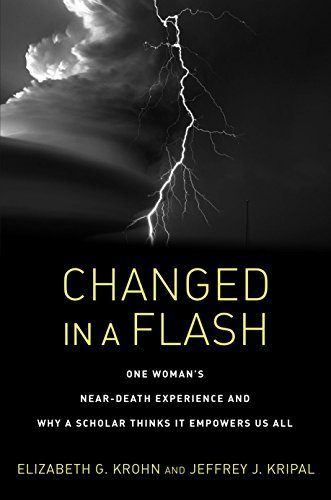
This fascinating account and analysis of how one woman’s near-death experience sparked an awakening into psychic consciousness will “inspire your to rethink . . . humanity, death, and an afterlife” (Bruce Greyson, MD, University of Virginia School of Medicine). When Elizabeth Greenfield Krohn got out of her car with her two young sons in the parking lot of her synagogue on a late afternoon in September 1988, she couldn't have anticipated she would within seconds be struck by lightning and have a near-death experience. She felt herself transported to a garden and engaging in a revelatory conversation with a spiritual being. When she recovered, her most fundamental understandings of what the world is and how it works had been completely transformed. She was “changed in a flash,” suddenly able to interact with those who had died and have prescient dreams predicting news events. She came to believe that some early traumatic and abusive experiences had played a part in preparing her for this experience. Told in matter-of-fact language, the first half of this book is the story of Krohn’s journey, and the second is an interpretation and analysis by respected professor of religion Jeffrey J. Kripal. He places Krohn’s experience in the context of religious traditions and proposes the groundbreaking idea that we are shaping our own experiences in the future by how we engage with near-death experiences in the present. Changed in a Flash is not about proving a story, but about carving out space for serious discussion of this phenomenon.
This is a book of two parts: Elizabeth Krohn's story of how she was struck by lightning, died, went to heaven, came back, and what happened next; then Dr. Kripal's opinion on what that means.
Elizabeth's story is interesting. It has some of the elements one expects from a near-death-experience: at first she doesn't realise she's been jolted out of her body, she is then drawn to the light, heaven is a beautiful garden where she is met by dead family, the choice to return is her own.
Some other elements I did not expect: Elizabeth comes back convinced that reincarnation is real, and that we will all reincarnate until we gain enough experience to become a spirit guide to someone else's many journeys through life. She also claims that her spirit guide originally appeared to be her grandfather, but after some time she came to suspect that it was just wearing the appearance of her grandfather to put her at ease - something that I find immensely creepy and not the kind of behaviour I like to see in beings of pure light and love. She says that time is not linear as we believe - this part is very funny because Elizabeth seems like a nice normal person and is clearly very frustrated by her inability to explain how time actually works, she can only half-articulate that it's not how we think it is.
Things get weirder when Elizabeth returns to her body. She develops psychic powers, the most alarming of which is nightmares about upcoming plane crashes, which leave her shaken and upset. She also develops the ability to know things about people just by looking at them. What's really interesting is that she actually attempts to verify these powers. She emails herself everytime she dreams of a plane crash so that she has a time-stamped record of her perceptions to compare with the eventual reality. She also works for a short amount of time as a professional psychic, but after proving her efficacy to her own satisfaction she gives it up, for the very sympathetic reason that she finds it immensely distasteful to spend her day prying into whether or not someone's husband really is cheating: 'It's just not my business'.
It's actually really endearing that there's nothing of the mystic about Elizabeth. She appears to be the most skeptical person in this story, viewing her amazing new powers as annoying and unwelcome.
The reaction of people around her is also interesting. Her husband eventually divorces her because he just cannot handle how strange and unbelievable his wife has become. She falls out with her Reform Judaism community because they seem to view the whole thing as wildly embarrassing and offer her no spiritual support or explanation (she eventually finds support in the Hasidic community).
She can see and hear ghosts, but this seems to be largely irrelevant. The non-corporeal woman wondering around her upstairs landing does nothing interesting. She gets the occasional phone call from her dead relatives with information to pass on to the living. She's refreshing candid that she has no idea how this works: are they the spirits of the dead? Or echos? Or emotional imprints? Your guess is as good as hers.
Her final spooky encounter is the weirdest: she finds a cursed necklace in a shop. Everytime she wears it someone loses someone they love. So she buries it in the yard. It reappears on the doorstop. She throws it in the trash. It reappears in her daughter's car. She ditches it again. So far it hasn't come back... What does this mean? Is this normal for NDErs?
Dr. Kripal doesn't have much to say about the necklace, but he has lots of opinions on death and time. His part of the book is, honestly, a bit waffly and self-indulgent, but some interesting things emerge. Kripal makes a stab at an evolutionary explanation for precognitive abilities: if you could see the future you could avoid upcoming calamities and improve your fitness. Then he ruthlessly undercuts this argument by providing nothing but examples in which people forsee the future and then completely fail to avoid the calamity. I am actually not sure if he was aware of how badly he was refuting himself. Overall, the whole discussion made me incredibly anxious for the concept of free-will and it's interesting that Kripal doesn't really address the problem of how free-will is undermined by the idea that the future has already happened.
More interesting is his belief that all pre-cognition is information transmitted back in time from our future self to our present self. The psychic can only know things that their future self will learn through mundane means. In Elizabeth's case, Kripal makes a fairly interesting point that she's seeing plane crashes as they are reported in the news; she never learns anything about a crash that isn't widely reported. Often her mental image of the crash is the exact image shown on TV, not from any other angle. But how does future-Elizabeth transmit this information back to her past self? She's clearly not aware that she's doing it or she wouldn't be so mystified by the whole experience. This isn't explored.
So overall it's a strange book. It is just one woman's story, and while I certainly believe that Elizabeth is honest - it's much too easy to just think: 'Well, this is weird but there's probably some rational explanation, probably some facts that have been innocently excluded from this narrative'. And Dr. Kripal's attempted explanations are interesting, but there's not much in the way of attempts to prove or test his hypothesis (and afterall, how could he? Killing and resuscitating people for science probably won't get passed the ethics board). Oh yeah, Elizabeth's emails! Turns out they were all lost during various laptop and computer upgrades. Make of that what you will.
If you are a fan of Jeffrey Kripal’s work, by all means, read this book. If you are looking for an intriguing near-death experience, however, I couldn’t recommend it. While Elizabeth Krohn’s NDE story starts off in a fascinating manner, it soon turns into a strange mishmash of claims that we are all unconditionally loved by God and there is no death, mixed in with stories about a telephone call from God and about premonition dreams of deaths that terrify her. She also tells how she acquired a necklace that, on one hand, filled her with warm memories of her grandmother; whereas, on the other hand, apparently caused someone to die every time she wore it; or at least caused her to hear of the death of someone. She frantically ends up burying the necklace in the yard. But then, years later . . . oh, nevermind.
Add to that, Mrs. Krohn rants about how unspiritual Reformed Judaism is and states: “In their rush to prove to the world that they are fair and that everyone is equal, they want to treat as equal even those who are evil and seek to destroy them. They seem to feel that if we are kind enough to our enemies, they will be nice to us. How childish. How foolish. If a group of people has sworn to annihilate you and everyone you love, you do not give them your house in the hope that they will then like you and live in peace. Reform Judaism has become a Far Left political organization–a far, far cry from what I feel religion should be. Where is the spiritual component?” Huh? Where is the “spiritual component” in calling one’s “enemies”, if one should even have "enemies", “evil", and not even considering kindness might be the solution to conflicts? It’s particularly strange a woman who has had a NDE, where she experienced unconditional love and realized death was an illusion, would say such a thing.
Why so much oddness and conflicting feelings in Elizabeth Krohn’s NDE story? I blame Jeffrey Kripal. I think he was just using her NDE so he could write another book telling the world all his brilliant ideas about life and death. Although he throws in self-deprecating comments here and there in his part of the book, he obviously terribly wants for his words and beliefs to profoundly affect readers. I believe they worked on the book for two years, and my guess is he coached and encouraged her to elaborate on things she really wasn’t prepared to elaborate on. Her part of the book had to be deep enough and long enough to justify his part of the book. One wonders, too, who first brought up the New Age garbage idea that Elizabeth Krohn chose a lifetime where she knew she would be sexually abused as a child? An idea that ends up trying to justify violence against females by males in some New Age books, because they chose a lifetime knowing what was coming. See, they wanted it! They asked for it! It helped them to spiritually grow! Garbage!
That's not to suggest Ms. Krohn is not a deep, sincere thinker who thinks for herself, but that there is something unbalanced about her story and the whole book. It’s very, very heavy Jeffrey Kripal. Jeffrey Kripal, a religion professor at Rice University, who apparently believes in such things as alien abductions and mutants, and obviously thinks it’s really intriguing that being sexually abused as a child; as Elizabeth Krohn was for six years and as often were those who claimed to be abducted by aliens; can “crack open” an individual in a way that allows in all sorts of fascinating paranormal experiences. He tries hard not to appear insensitive about that matter, yet it seemed obvious his intrigue far outweighed his concern about horrific things happening to others, including children.
Yes, Dr. Kripal seemed far more interested in ideas than he did in human suffering, which is to be expected from someone who has spent so much time in an ivory tower and the Esalen Institute. Not that some of his ideas weren’t interesting, and he is, of course, so right in pointing out the folly of science attempting to investigate metaphysical issues. But much of what he went on and on about just ended up sounding like gobbledygook, or like science fiction being proclaimed as reality. Maybe it is reality to him, as well as to those who like his writings. If so, may all his followers enjoy this book, have interesting dreams about it, and send those dreams to Dr. Kripal, so he can continue believing his books “express some superpower”.
Personally, I’m more interested in the human experience and how metaphysical topics relate to humans, and much less interested in the words of those who are alienated or detached from the human race, or at least terribly bored with it. Dr. Kripal ends this book by talking about the afterlife, which is where the book began with Elizabeth Krohn’s near-death experience. His final words are: “As fantastic an unbelievable as it might sound, we are all, together, really and truly changing the afterlife.” Huh? Mrs. Krohn’s NDE, like so many others, stresses the “afterlife” is unconditionally loving. What are we changing it to? One that is conditionally loving? Or one that has aliens and mutants and the Starship Enterprise? Oh, that was snippy, wasn’t it? It’s just a bit scary to think we can change the afterlife, considering how we are changing the Earth these days in not so good ways. But, hey, no one knows for sure what happens after death. Not me, not you, not Jeffrey Kripal or Elizabeth Krohn. We all just believe what we want to believe, or what we think we should believe.
(Note: I received a free ARC of this book from Amazon Vine.)
"Changed in a Flash" by Elizabeth Krohn and Jeffrey Kripal, is a collaborative effort. Part One is Ms. Krohn's account of her extraordinary experiences. "Late in the summer of 1988, Elizabeth Balkin (now Krohn), a [twenty-eight year old] wife and mother of two young boys, was struck by lighting in the parking lot of a Houston synagogue." Although Elizabeth was injured, she survived, but was never the same again. She describes a near-death experience (NDE) in which she visited "a garden paradise of unspeakable beauty." While there, she learned about the fluid nature of time, the soul, and reincarnation.
She would later develop synesthesia, perceive auras ('fields of light generated by energy-producing entities"), and have dreams predicting future events. Elizabeth was at first reluctant to discuss her transformation, fearing that skeptics would dismiss her as emotionally disturbed or a fraudulent attention-seeker. In Part Two, Jeffrey Kripal, a university professor of comparative religions, offers his interpretation of the theological, paranormal, and philosophical implications of Elizabeth's experiences. He addresses the questions of how we might explain what Elizabeth went through and what it might mean for the rest of us.
Individuals who are broad-minded about the nature of reality will find Krohn's odyssey fascinating. For example, Elizabeth claims that we do not die when our bodies die, that we have inhabited other bodies and may do so again, and that the afterlife is "conditioned and shaped by our own expectations and needs." It does not matter whether or not you take these contentions as true. The value of "Changed in a Flash" lies in the possibilities it offers about the nature of existence.
Professor Kripal's chapters are less compelling than Ms. Krohn's poignant narrative. Kripal uses abstract language that may leave readers more bewildered than enlightened. He incorporates such elements as quantum theory, religious tenets, materialism, and science fiction (literature and film) into his essays, but his prose is confusing, abstruse, and fails to shed much light on what is admittedly a subject that is difficult to conceptualize. It is easier to relate to Elizabeth, who comes across as sincere, shocked (literally and figuratively), and eager to convey that death may not be as forbidding or as final as many of us fear.
Wonderful book. Elizabeth Krohn details her near-death experience (NDE) and the way it changed her life (as well as the numerous paranormal aftereffects that resulted in the subsequent decades of her life, such as precognitive dreams) in roughly the first 40% or so of the book. Jeffrey Kripal, a dramatically talented and learned scholar of comparative religion, details in exhilarating fashion the implications of her experiences in the remainder. I’m a relatively conservative Christian (though far from the fundamentalist extreme right) and much of what is written here does not jibe easily within this framework.
Nevertheless, I think what Krohn and Kripal have written here is solidly on track of teaching us something about the nature of reality and a potentially-malleable afterlife. “Changed in a Flash” is an important contribution to the growing library of material emanating from the cutting-edge scholars and philosophers of Esalen (such as Kripal’s own “Authors of the Impossible,” Bruce Greyson’s “After” and such indispensable, collectively-produced tomes like “Irreducible Mind,” “Beyond Physicalism,” and “Consciousness Unbound.”).
I won’t mince words. If you’re open-minded, this book will likely throw you into a metaphysical crisis. It has for me deepened the already-uncomfortable rabbit hole I’ve found myself in perhaps a year or so ago when I first encountered writings such as this one. Be that as it may, I am grateful. Discomfort is often necessary to produce enlightenment. I think works such as “Changed in a Flash” could prove invaluable in helping us (humanity) take that next step in understanding, and even harnessing, reality.
Elizabeth Krohn was just an ordinary house-wife, aged 28, when a lightening strike in a synagogue car park threw her into an out of the body experience which changed her entire life, turning her into an aura seeing psychic who sensed the diseases of other people, dreamed of plane crashes which occurred the following day and caused electronic devises to malfunction. After 30 years of trying to come to terms with her transformative experience, she mustered the courage to tell her story with courage and verve. She writes "As I hovered over my body, I suddenly got it. I went from "Shit, my shoes are ruined" to "I was so wrong about so much."… I was looking at my body and thinking something like: "What a waste. You were so wrong? …, I was in a grease puddle that made everything look grey. All of the black and white that defined my life up to that point was gone." Initially, she was surrounded by mostly skeptical people and she herself made futile attempts to suppress the "crazy beliefs" she now held (such as "all of time is everlasting present" and that reincarnation is a reality) and return to her "pre-strike" self. But her new-found energy and sensitivity, which enabled her to sense "new dimensions of the world", proved to her time after time that her experiences and abilities were real and not figments of her imagination. In the second half of the book, Jeffrey Kripal ( a professor of comparative religion), does an outstanding job of providing a framework for understanding Elizabeth's paranormal experiences. He is neither overcredulous nor needlessly skeptical .Unlike many other researchers of the paranormal, he doesn't waste our time with an endless attack on scientific materialism, but instead seeks to find plausible contexts for Elizabeth's extraordinary experiences to help us "make the impossible possible". He defines a paranormal experience as " an exceptional experience-event that temporarily collapses the mental and material or subjective and objective dimensions of our ordinary human experience and sensing". This book is full of insights into the implications of the paranormal. From an evolutionary perspective, near-death experiences " enable people to survive dangerous situations and hence to procreate". From a cultural perspective, Elizabeth's paranormal experiences (like flying into other realms, meeting a spiritual guide or developing supernormal capacities) fit well with gnostic, kabbalistic or shamanistic traditions and even into a science fiction film. From a psychological perspective, Elizabeth's childhood sex abuse made it much easier to dissociate breaking out of the shell of her ego when struck by lightning . Her decision to return to life to have another child is another link to sex and procreation. Kripal also regards reincarnation as "one big cosmic orgy" because ultimately everyone has sex with everybody else. One of the most fascinating parts of the book is the analysis of time-loops. Kripal noticed that Elizabeth was not dreaming about future plane crashes but of her future experience of media events reporting them.He invokes Eric Wargo's ideas of time loops where time appears to flow both ways from present to future (precognition) and from the future to the present (retro-causation where we "remember" the future). Kripal writes "… we really can “see” or “feel” the future a few seconds, days, sometimes even years out, and that these acts of vision, intuition, and interpretation are all about helping us to adapt, survive, and create the future, which is in turn reaching back to us to create us." Maybe as he says , these anomalous experiences indicate the direction that future science must take to understand the nature of the universe. We already have our own individual time machines to journey in. A great read which I cannot recommend highly enough.
This was pretty well-written in the sense that it was compelling line after line, but not in the sense that any of it is actually true.
Can’t believe I had to read this for a class and then write a 10 page essay explaining how he misinterpreted Freud and basic physics. It would’ve been harder explaining that ice cream tastes good. I want my life back.
Possibly the most vivid and believable modern near-death experience I have read. It almost begs for a second or third book of insights and experiences—because many near-death survivors have a range of “psychic” experiences for months or years afterward. I skipped the attempts by Jeffrey Kripal to “explain” Ms. Krohn’s experience because, frankly, I like to do my own research, and I understand her account quite well.
This is closer to 3.5 stars than four. The first half of the book is the subject's fascinating experience when, and after, she was struck by lightning. But I couldn't finish the book ... the second half is a nicely written-but-academic discussion of how her experience connects to various religious theories. I just couldn't stay with that part.
I could probably read this book (or at least the second half of this book) multiple times and discover new things every time I read it. Seriously thought provoking and incredible- I highly recommend!!
This book is a collaboration between a woman who experienced a near death experience after being struck by lightening (hence the title), and a religious scholar named Jeffrey Kripal. The two evidently live not far from each other in Houston, Texas and decided to present the experience (hers), along with the analysis (his).
A lot of rocks are overturned in the process of not just explaining what happened and its aftermath, but also in the level of depth involved in trying to establish the veracity of her story and claims. When a thing happens, you're usually able to just explain what happened, but when it's as unusual a story as Elizabeth's, there's now a compulsion to respond with a ready-fit, air-tight model that validates or disproves all of its claims. Understandable, but also not terribly helpful - about as helpful as a mother testifying that her felon son is a good boy.
What this book does, is supply the reader with a pretty plausible story from a woman who appears reasonable, and without a clear pathological motive to tell us otherwise. And in so doing, then tries to proactively answer any of the questions a discerning reader might ask. So in that sense, a reading of the book accomplished what it set out to do, for a reader like me. It offers a few scents toward a far-off resolution, but at least it offers a meaningful manner of engaging with the ineffable.
A fascinating and insightful book. It describes a near-death experience through the lens of multiple frameworks that help us to understand its nature and meaning.
What I appreciate about it is that it shows both the personal lived experience of Elisabeth as well as an in-depth analysis of different aspects and wisdom that resulted in that experience.
Some of those aspects are: - nature of afterlife, - reincarnation, - framework for precognition, - time loops, - what a soul is.. and many others.
Jeffrey Kripal shares his impressive knowledge on various religions and cultural beliefs and pierces through the narrative layer, getting into the essence of them all. The NDE experience serves as a guiding, integrating thread across those various narratives.
I found this book packed with so much both abstract and deeply resonating knowledge, that it took me while to process and integrate it. The experience felt very validating.
I also have experienced precognition, vivid symbolic dreams. I constantly evolve my spiritual practices that help me to reach the source within and through that to find the state of oneness, the all-encompassing interconnection of life.
The book Changed in a Flash by Elizabeth Krohngive her account of her near-death experience (NDE) after being struck by lightning in 1988. During this profound experience, she describes leaving her body and entering a realm of light where she encountered spiritual beings. In this state, she was shown visions of future events, including natural disasters and societal upheavals. Remarkably, some of these visions have since manifested in reality, leading her to believe in the prophetic nature of her experience. Krohn's story delves into themes of spirituality, the afterlife, and the potential for NDEs to provide insights into future occurrences.
This book is co-writen by Jeffrey Kripa0l who offers insight to the experiences that Elizabeth had.
If you don't believe a human being can be struck by lightning, physically die, and return from "death", this book may change your mind. The book was written by the victim of a lightning strike and a scholar of religious literature who researched similar events from now back to the ancient Greeks. It is a compelling and interesting look at how people through history have reported their similar experiences in the afterlife. Krohn also discusses how that experience has changed her life in every way. And if you care to continue reading on this subject, there are many references to researchers of past life and near death experiences in the appendix.
A young woman is stuck by lightning and dies. She enters a netherworld of love and vibrant colors and, with her spirit guide, learns of the beauty we are all to see in death but she returns to her earthly self. Now, she has premonitions and sees auras but is looking for answers. Her story is interesting but followed by the snarky, anti scientific screed full of conjecture to prove a point. It falls into the idea that when you are a hammer, everything is a nail. This took an interesting discussion and turned it into a mess
The first part of the book describing the authors experience held my interest. Then we got into the second part written by another person and I completely lost interest. There were so many explanations as to why and how it became quite confusing. I think they would have had a better book had they just embellished her initial story more with more of her experiences. Somethings are just that some things no explanation wanted or needed.
I thought this book would be a good book, but I do not believe in reincarnation, and ghosts. I am Christian and very spiritual. I do believe in a life after death, but not ghosts and spirits that are lost. Would not recommend this book unless these are your beliefs.
Read this entire book right to the ending and you can't help but be richer. The world and universe requires us to suspend our disbelief, so see it how you do. Yes this is (pun intended, unintended, inevitable) enlightning.