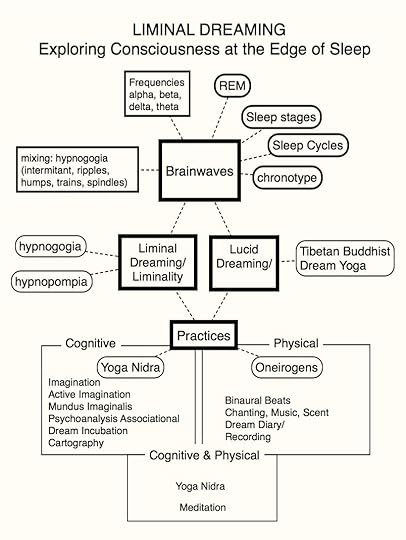
According to Jennifer Dumpert, hypnagogia and hypnopompia, those pseudo-lucid moments experienced on the cusp of falling asleep and waking up, respectively, “you can channel for creativity or problem solving, use as a form of metacognition to explore your thought processes, or simply play with as a form of consciousness exploration.” Her book contains exercises to make the most of liminal dreaming after explaining that this time is uniquely fertile “because different modes of thought come together …. The logical, linear, and focused part of your mind remains active to varying degrees. But you’re also dreaming, adrift among intuitive, visual, emotional thought processes and associations.”
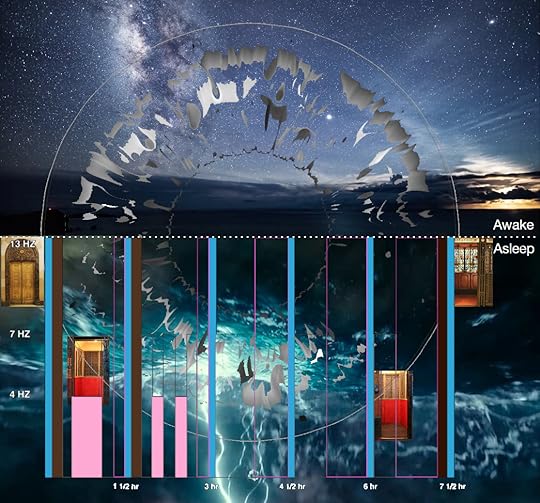
“[T]hink of the conscious mind like the land, known and solid, and the unconscious mind like the ocean, deep and largely unknown. At the threshold area where ocean and land meet, the waves become churning and wild. That’s where people surf. Similarly, liminal dreaming is where you surf the edges of consciousness.”
Dumpert’s style - less scientific and more, um, alternative - requires an open mind, as the following characteristic passage will demonstrate:
“Many people believe that the dream world is an actual other place where we can literally meet other dreamers or visit places that exist objectively, not just subjectively in our own minds. I neither believe nor disbelieve this. I try to avoid belief as much as possible.”
And the book’s repetitive and meandering manner will frustrate those attempting a cover-to-cover read. Which isn’t to say there’s nothing to it. I just came away thinking the truly important bits could have been more fruitfully covered with a focused, shorter telling. I slept on it and landed in the same place.
(Gail Cornwall is a former lawyer and public school teacher who now works as a stay-at-home mother and freelance writer in San Francisco.)