Jump to ratings and reviews
Rate this book

The Dweller's Guide To The Planet: All You Need To Know About Everywhere

Rate this book
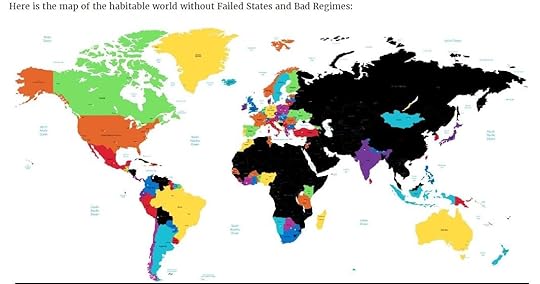
2018 B.R.A.G.Medallion Honoree. I was very pleased to be given this B.R.A.G's own words, it "tells readers that this book is well worth their time and money!" I hope you find it so.There are many 'brief histories' - 'Of Time', 'Of Nearly Everything', 'Of Humankind'. The Dweller's Guide is a brief geography - an accessible guide to the most important information about any country or place in the world, from the point of view of someone who might consider living there.It starts off with 219 identifiable places to live in the world - 195 countries and various other states, non-sates, dependencies, and 'overseas territories'.Each chapter defines and applies a single disqualification (failed state, bad regime, conflict, crime, climate change, affordability, culture) going through remaining places in alphabetical order - with an open mind and some discussion; sometimes satirical and sometimes downright rude. So that I couldn't 'cheat' to get the result I wanted, I selected the criteria and the definitions before writing any of the entries. At the outset it was relatively easy to predict some early departures but impossible to know how many or which would be left at the end.(You might want to make a note, before you start reading, of the countries you think are most likely to survive to the last chapter.) In this sense, it really was a journey of discovery. At the end of each round of disqualification there is a map of the remaining 'habitable' world. By the end only 8 countries remain - and they are not the ones you are most likely to think of. They survive simply by not having been disqualified on any of the criteria. This doesn't necessarily mean that they are the best countries in the world, rather that they are the least worst.Statistics tend not to be politically correct. Nor is their use ever entirely objective. As a white, middle aged, metropolitan British male, I cannot escape various conscious and unconscious cultural biases. Without meaning to I probably cherry pick my data to suit them. It won't always be simple or uncontroversial. Some of my conclusions are likely to offend. I wish it could have been funnier - but there are only so many good jokes you can get out of tyranny, war, corruption and the existential threat of climate change! I am also sorry that some of the use of statistics is repetitive and that some data sources are more reliable than others. I provide updates on my but have not found the world to be much improved. Feel free to disagree, introduce your own criteria or data sources. I am setting out the results of my quest. You may have your own.

299 pages, Paperback

Published July 11, 2018

6 people are currently reading
445 people want to read

About the author

Andrew Levy

1 book17 followers
Not quite knowing what to do with a 1st class degree in philosophy and half a Phd from Oxford, I went to work in advertising and awoke some time later to find that I'd become the global planning director of one of the world's top agency networks. Then I co-founded, helped to build and eventually sell Mustoe Merriman Levy - one of only a small handful of independent agencies to make it into the UK top 30.

Some time later, I sat on a terrace in Tuscany and started thinking about where to live...

I'd never written either fiction or non-fiction before (though you might regard advertising as either) so I was very pleased to be awarded a BRAG Medallion for The Dweller's Guide.

Ratings & Reviews

What do you think?
Rate this book

Friends & Following

Create a free account to discover what your friends think of this book!

Community Reviews

5 stars
15 (44%)
4 stars
11 (32%)
3 stars
6 (17%)
2 stars
0 (0%)
1 star
2 (5%)
Displaying 1 - 20 of 20 reviews
Profile Image for Catalin Negru.
Author 3 books88 followers
August 26, 2018
Target audience: The book addresses to the general public, with the exception of children.

About the author: According to his Goodreads profile, Andrew Levy has a 1st class degree in philosophy and half a Phd from Oxford. He also co-founded, helped to build and eventually sold the independent agency Mustoe Merriman Levy.

Structure of the book: The books has 170 pages in PDF format and it is divided in 9 chapters, without taking into account the introduction and the sources.
Overview: The book analyzes each country if it is suitable for living depending on factors such as political regime and the liberties of their subjects, war, climate change or natural resources. Complete safety is nowhere because problems exists everywhere. But some countries are more safety than others, while other countries are dismissed not because of one single reason, but because of many.
The book starts by stating a couple of directory lines according to which it was written, and with defining expression such as “bad regime” or “failed state”. Moreover, the author also states that the book is for entertainment purposes. This is important because the reader has often the feeling that he is in front of a survival guide or a geopolitical analysis. Probably it has a little of both. In fact, every time you take it seriously, the author cleverly inserts humorous commentaries and ironic remarks regarding the situation or history of the countries in discussion. My favorite example: “If, in Plato’s heaven there is a perfect idealised form of Autocracy, it probably looks like Saudi Arabia.”
The author’s effort to gather all the information is laudable. I also read geopolitics, but such information is never enough; so, while some refreshed my memory, others were completely new to me; I read about countries I never knew they exist. I believe that every reader, like me, can’t wait to see the position of his own country and the motives/information provided by the author for his choice. I can confirm that, at least regarding my country, the information provided is according to reality. But I was surprised to find out that it (I won’t name it) was in the last 18 that are indicated for a living.
While I totally agree with the classification of countries affected by war and dictatorships, when it comes to effects of the climate change some choice (such as USA) are debatable. I believe that the developed countries have the power and resources to minimize or even annul the effects of the climate change, given the fast-changing technology. To no surprise, the best places to live are in Europe and North America, but many of them are dismissed on the grounds of costs. Germany, for example, is one of the last eight that are called the “promised lands”: “reasonably easily, safely, unmolested by state or criminals, in relative material comfort, and with not too great a sense of alienation.”
Some interesting figures from the book. For example, 2,992,585,586 people live in Bad Regimes, while 115,661,061 people live in Failed States. From another point of view, of the 7+ billion people living on the planet at the moment, 6 billion of them live in places where ordinary daily life is blighted, principally or exclusively, by human beings who are criminally greedy, morally bankrupt or sociopathic. In other words, bad people spoil the daily lives of 80% of the world’s population. Damn human race!


Quote: If you’re reading this, the chances are that you’re living in one of the twenty or thirty fully functioning, well governed, relatively benign countries on our planet and, like my daughter, you tend to see what’s wrong with it, more clearly than what’s right with it.

Strong points: The book is very informative and an eye opener; it shakes the bubble we live in and it gives us a new perspective upon the world. The reader realizes not only how many bad regimes and failed states are there in the world, but also how much we have to work to make this planet a better place, how fragile our world is and how lucky the reader is to be able to have access to information, including this very book.

Weak points: First, one of the major drawbacks of this book is the fact that in 10 or so years it will largely become obsolete. So, the author will either have to update this and publish a new edition regularly, or the readers at a certain point will have to skip this book and go straight to the website indicated at the start to see the latest updates. Second, without specifying a reason, countries have different text resources allocated, without identifying a pattern on my side. And lastly, there are some minor problems with the formatting of the text both in Kindle and PDF edition.
_______________

★★★Follow us on Goodreads

★★★Visit our website www.reasonandreligion.org
Author 3 books14 followers
July 30, 2018
Do you ever find yourself tired of your home country. Have you consider emigrating someplace else? Somewhere more exciting and exotic, or just moving somewhere with a better quality of life? 


If so, then Andrew Levy' s book is a good place to start. Essentially it is a concise encyclopedia of every country and state in the world, with information on what life is like in that place.


Now, hold on. Are you thinking 'that just sounds like Wikipedia to me?' 


Levy's book is rather more entertaining than your usual list of population demographics, historical chronology and geographical terrain - because it is funny.


Sometimes it is very funny indeed. Take the Sudan for instance. A country that, it must be said, doesn't have much to laugh about. Sudan's "currency is weaker than a twice-used teabag" and it's leader "al-Bashir is unquestionably a very bad person and not the kind of boy Donald’s mother would have chosen for him to be friends with". And if you were in Bosnia on your holidays recently, think twice before moving there because it's "not so much a country as a ceasefire".


Countries are eliminated, chapter by chapter, in Levy's quest for the perfect home. Failed states, rogue nations, or countries just too shambolic or expensive are eliminated, before we reach the final chosen few. There is a curious sense of suspense to see who will make the final list. And you may not agree with Levy's decisions. New Zealand didnt make it? Nooooo....! 

But like many books it's not the destination, it's the journey. And Levy never fails to be informative and sometimes as funny as the best of them. Well recommended.
Profile Image for Douglas Charles Charles.
Author 1 book4 followers
August 10, 2018
Riveting, disturbing and compelling. I didn’t expect to be captivated or to be reading sections aloud to my wife. The Dweller’s Guide to the Planet – All You Need to Know about Everything promised to be an entertaining approach to finding a desirable place to live, but it’s so much more: The product of thorough research, a compassionate testimony to the plight of human existence across the globe, an indictment of almost every form of governance in this world, and a compelling case that nearly every government fails to protect its citizens from corruption, crime and armed conflict. Nearly six billion people live in failed states under horrible regimes under constant threat of war or criminal acts of violence. Andrew Levy delivers the bad news with a wry sense of humor that staves off despondency for the reader and provides a contextual world view that reorients the reader’s axis. As a bonus, The Dweller’s Guide provides a pocket reference for unraveling events in world news or making travel plans, but, best of all, it provides a clear prism for viewing the positive elements of tolerable governance, however flawed, as long as the citizens have the choice to change it should it become intolerable.
Profile Image for Nick Wall.
Author 6 books2 followers
September 3, 2018
If you want a travel guide that tells you about the good places to go, don’t buy this book !

This is like an anti-travel guide : a book that tells you what’s wrong with places, and where not to go.

I can see a lot of people who could get into this. It’s a bit of a British national pastime, to be cynical, to find fault, to always see the downside. (I’m of a different persuasion, but more on that later.)

The way in which Levy engages people is that the whole book is structured like a game. There are a series of seven tests, and at each test a number of countries are disqualified as places where a dweller might want to emigrate to, progressively reducing the number of potential destinations until eventually we have our winners. I found myself ‘joining in’ the game by having imaginary arguments with Levy over which countries should get the chop (there’s no shortage of good conversation starters here!)

Do we buy into Levy’s tests ? How reasonable are they ? Failed states, bad regimes and warzones are identified in chapters 1 to 3. Chapters 4 and 5 deal with crime and climate change before we arrive at the two chapters which for a lot of readers will be the real meat and drink of this book. Chapter six covers such things as cost of living, house prices and levels of taxation, while chapter seven looks at language, culture, education, and how welcoming the people are.

At times you feel that Levy’s made a rod for his own back. There’s so many different factors to weigh up in the later chapters – how can one person make an objective judgement ? It’s to Levy’s credit that he’s lucid and able to justify his logic most of the time, though the last chapter would definitely have benefited from a simpler test. In general he’s a credible referee : a few of his judgements are coloured by his personal views/perspectives, but they’re not at all intrusive, and he does come over as being objective.

At times Levy strikes a semi-apologetic tone as countries that many would think of as dream places to live are disqualified for one reason or another, while countries with colder climates – and arguably less charm and less romance - survive the cull. Personally, I would always look first to find the positives in a place, rather than the negatives. Perversely though, I think I might have enjoyed this book a little more if Levy had been less respectful, and told me that I was a fool to think this way, and that people who choose a sunny place to retire to having enjoyed a few holidays there would be much better advised to do some serious research and to apply the Levy tests.

There are some faults : most notably the USA is given two strikes against it in successive chapters, though I suspect that some people may see this as more of a merit than a fault ! But it’s readable and thought provoking, it asks questions that are to the point (and you don’t have to agree with all the answers !) and it kept me wanting to get to the end to see how the game was going to play out.
Profile Image for gj indieBRAG.
1,805 reviews97 followers
January 21, 2019
We are proud to announce that THE DWELLER'S GUIDE TO THE PLANET: All You Need To Know About Everywhere by Andrew Levy is a B.R.A.G.Medallion Honoree. This tells readers that this book is well worth their time and money!
Profile Image for C.J. Shane.
Author 23 books64 followers
September 12, 2018
The Dweller’s Guide to the Planet has as a subtitle “All You Need To Know About Everywhere.” Not really. This book is actually a guide to countries in the world that are: a) suitable for retirement, and b) suitable IF you are British and IF you are affluent and If you have certain culturally-defined requirements for your new home.

The author, Andrew Levy, is British. This isn’t obvious because that fact is not revealed anywhere such as the book’s Amazon description page, Amazon Author page or the book’s website. Levy looks at the world through an affluent Englishman’s lens. Levy is quite open about himself and his wife and what they look for when considering retirement: <>

There’s certainly nothing wrong with that set of preferences. But if you are an American, especially one who is not so affluent, then this author’s advice is not necessarily useful when considering where to retire.

Let’s take a look at a couple of countries where I have lived which are covered in this book. I’m an American and I’m definitely not affluent. I’m more a person who thinks “a degree of luxury” means having an inflatable pad under your sleeping bag when you are camping on the North Rim of the Grand Canyon, and I'm one who is not put off by staying at a Motel 6 every now and then. I’ve never stayed in a villa so villas are even not on my radar.

Mexico: Levy dismisses Mexico quickly because of the cartel violence and government corruption. He creates a picture of a dystopian nightmarish landscape. You may be surprised to learn that hundreds of thousands of Americans have retired to Mexico. One source I found said there are over one million and another said almost two million Americans. I personally have several friends who have retirement homes there (San Carlos, San Miguel, Alamos).

Why are so many Americans retiring to Mexico? There are several reasons. It’s close to U.S. Family and friends can visit easily. The cost of living is half of what it is in U.S. It’s actually possible to live comfortably on Social Security. Mexico has a nice climate, wonderful natural areas, and great culture (art, music, food). There are also several large expat communities such as San Miguel de Allende. English is widely spoken as well. Believe it or not, there’s not a shootout happening every day on every corner in Mexico. The cartel violence is often limited to turf wars localized in specific areas. I think Mexico deserved better in this book, especially for Americans who seek a low-cost, close-to-home place. Many Americans are clearly disagreeing with Levy’s assessment.

China: Levy doesn’t seem to realize that it’s not all that easy to retire to China even if you want to. You would have to jump through multiple visa hoops (and pay lots of money) and there’s no guarantee that you’ll get there in the end. The Chinese government just isn’t set up to accept foreigner retirees. The easiest way is to renounce your citizenship and apply for citizenship in PR China. Regarding Levy’s concern about the authoritarian government, he should realize that being an expat means one lives in a kind of a bubble. Unless you are standing out on the street holding up a sign that says, “Down with the Commie Government,” you are unlikely to be bothered by “the authorities.” I’ve lived in China, too. Assuming that I would be allowed to retire there, I would consider it for many of the same reasons Americans retire to Mexico. Low cost of living, a deep and rich history and culture that predates anything the British and Americans can offer, and great food with fabulous regional cuisines are strong attractions. The people are very friendly, too.

A second problem with this book is that I found factual inaccuracies. When I find one (and I found more than one), that puts into question all the other facts in the book.

I do laud the author for even approaching the subject of climate change when choosing a place to retire. These days there are still morons around who deny that climate change is even happening. There are some places in the world that are especially dangerous now due to rising sea levels and extreme weather events. But bottom line is, climate change affects the entire planet and none of us will escape this as a significant factor in choosing a place to live. Another factor Levy mentions is violence against women. That’s a key factor for about half the human race.

My conclusion is that a reader should consider this book with open eyes and make sure that one’s retirement goals match the author’s goals before purchasing it.
Profile Image for Thomas Hiller.
Author 5 books2 followers
August 20, 2018
A Bad, Good and Ugly, gracefully wrapped bundle you don't have to miss!
First of all, I want to say that the book is gracefully written and displays a sharp, clever irony that makes of it an amazingly entertaining read. Even though the subject could well be treated in a quite serious and thoughtful way. After all, it is strictly tied to geopolitics, but the entertainment was the declared goal of the author, who definitely met it.
The result is thought-provoking but with the plus of a typical British levity and humor, which led me often to laughter bouts.
Healing balm, most wanted effect of a read: thank you!!!
Furthermore, it is clear that the author is a working brain, capable of analyzing an overwhelming amount of information to then rendering it in a captivating synthesis. Definitely, a non-trivial accomplishment delivering a super concentrated bulk of worthwhile information. For these reasons, I think that this work deserves well the encouragement of a five stars rating.
Just don’t miss it!

My review could well end here, but, this said, I feel like to add some thoughts about the nature of the book’s outcomes.
I will only propose that what the author obtains, in the end, is the result of the personal Andrew Levy’s selection procedure on planet dwellers’ needs and desires. Something that the author, as the worldly person that he is, fairly recognizes.
Then, somebody could ask: “Why have you bought the book if you think it doesn’t tells the truth?”
That would be a mischievous question. I didn’t say that the book tells lies! It tells very likely, probable facts, which are not necessarily truths.
And in fact, I didn’t buy this book to learn some absolute truth.
To be sincere, I bought it to explore the difference between my viewpoint and the author’s one, and to enjoy his wit, meanwhile, which is all but a nuisance.
What Andrew Levy eventually brought to our attention is, in my opinion, something valuable, because it represents a good average of the wealthy British citizen’s viewpoint. It represents one of the most civilized, politically correct, cleverly pragmatic bits of intelligence dwelling on the planet, in fact, I dare say ruling it so far.
I wanted to watch this type of intelligence at work while classifying the odds and evens of the whole world. And I was satisfied!
For me, it has been like wearing a well-tailored shirt with only some barely noticeable crease on the sleeves.
I’m not feeling disturbed, I only have few subtle objections about some cases.
But it is possible that for some citizen of a rejected state, an African or a Muslim or some Russian, this book, despite his levity and his goal to entertain, may be perceived in a quite different way.
Maybe like a pair of tight shoes?
Profile Image for Mike Wade.
Author 18 books1 follower
September 7, 2018
There are books that you learn a lot from, and there are books that make you laugh.
It strikes me that these are only very rarely the same book.
But The Dweller's Guide to the Planet is just such a rarity.
The first amusement is that anyone should ever embark upon such an ambitious and time consuming undertaking: the research required is phenomenal, even if it didn't involve visiting every location in person.
With a rare combination of respectful thoroughness and disrespectful levity, Andrew Levy inexorably pares away the shortlist of ideal dwelling places, from a variety of ingenious angles - but always leaves enough room for the reader to beg to differ.
In the end, the final candidates are an unlikely bunch, but that is unimportant. Chances are we aren't going to live in these places in any case.
As with so much in life - and books - the important thing is the journey.
Was it fun? Did we learn along the way? Would we do it again? Yes to all three.
Which is handy because, as the author himself points out, the world never stops changing around us, meaning its myriad territories are constantly becoming less or more desirable. Which means he can revise this book annually for the rest of his life, clever boy. For that he surely is.
Profile Image for Holger Wastlund.
Author 2 books2 followers
October 23, 2018
The author of this book has taken on an almost impossible task. To compile facts from all the world's countries as a basis for those who want to make a rational decision where to settle in the world. On the one hand, you will run the risk of such a compilation to be a bit dry and dull and, second, it happens so much in the world that the facts as presented in the book are likely to be outdated the day after the book is released.
Both of these risks, the author manages skilfully. First, the facts presented are mixed cleverly with funny anecdotes and entertaining descriptions. On the other hand, there is a link in the book where readers get continuous updates.
I like the structured way in which the author makes his choice of possible countries where to move. I would choose some other starting points for my own choice, but I would be glad to use the same systematic approach. I live in Sweden and have previously lived in some of the other countries described in the book. I can see that the truth of the facts given is sufficiently credible.
I can recommend this book – either as the factual basis for making a wise decision about where you want to live or as pure entertainment.
Profile Image for Leon Kaminsky.
Author 11 books1 follower
December 24, 2018
I only came across this book by accident, and I must say I was pleasantly astonished by two things:
1) In spite of having been published by an indie author, it reads and looks very much like a professional publication. The only thing that "betrays" the book's origin are a couple of entirely insignificant formatting errors.
2) The amount of research that the author has done to write this book in the first place. While offering concise and objective information, it doesn't read like an encyclopedia article. It's not dry in any way, and it's really easy to read, too - meaning, it manages to maintain just the right balance between being an informative and a personal project. So, you do get a "My wife and I" was the beginning of the book, but not throughout.
Profile Image for Fred Fanning.
Author 46 books53 followers
December 17, 2018
I bought the book thinking it was one thing only to find out it was opposite. The author does an excellent job of explaining why the reader should not consider moving to one country or another. His reasons seem very valid and understandable. I like the way he broke down the reasons for excluding countries and his explanations were easily understandable. I won't give away the author's secrets but suffice it to say the book is filled with great ideas and things to think about. I highly recommend it.
Profile Image for JB.
2,187 reviews8 followers
January 8, 2019
Impressive!

I won this book in a Goodreads giveaway. The title itself was interesting enough to make me want to read the book and now that I have read through the author’s criteria of narrowing down the different countries in the world to find a potential country to move to for whatever reason the dweller may have, I am even more impressed by the extent of research and knowledge that went into this book. Enjoy!
Profile Image for Kimmarie Pozar.
138 reviews2 followers
August 21, 2018
All the dirty laundry

This works not just as a checklist of countries to consider emigrating to, but for travelers also. Think about what you are walking into and what you are supporting.
Profile Image for Kayla Tornello.
1,720 reviews16 followers
November 1, 2020
This book offers small snapshots of the issues in each country in the world. It offers ideas on which countries would or wouldn't be good to move to. It mostly eliminates countries. There aren't too many countries that this book deems good.
1 review
August 9, 2018
A whistle stop tour of the world in search of the hospitable avoiding violent wildlife, religious mania and intolerable climates. Sardonic and well informed. If not here where?
Profile Image for Jodi.
54 reviews1 follower
September 2, 2018
Good resource for pre-retirees interested in moving to other countries after retirement.
Profile Image for Eleanor.
135 reviews59 followers
March 30, 2019
Book evaluates the countries of the world from a how desirable they would be to move to. I found the short assessment of each country to be interesting.
Displaying 1 - 20 of 20 reviews