

What do you think?

How to Be a Poet
The Roman poet Ovid's The Book of Love instructed women on the "art" of seduction and men in the "art" of romantic conquest. It is a "classic" sexist text on men, women, love, and sex.
In her second book of erasures, JM Farkas takes on Ovid's Ars Amatoria, or "The Book of Love." In her signature feminist, revisionist twist, Farkas speaks to emerging "girl" poets. How to Be a Poet is not only for writers, but for anyone who wants to create beauty in the world. In addition to the erasure, How to Be a Poet includes a second version of the poem in a style that leaves the original text visible for readers who want to read the scandalous source material.
avenge your mother. invent
a girl with a reckless heart.
free her in her tower. be a thief,
snatch time, every time you write...
In her second book of erasures, JM Farkas takes on Ovid's Ars Amatoria, or "The Book of Love." In her signature feminist, revisionist twist, Farkas speaks to emerging "girl" poets. How to Be a Poet is not only for writers, but for anyone who wants to create beauty in the world. In addition to the erasure, How to Be a Poet includes a second version of the poem in a style that leaves the original text visible for readers who want to read the scandalous source material.
avenge your mother. invent
a girl with a reckless heart.
free her in her tower. be a thief,
snatch time, every time you write...
- GenresPoetry
232 pages, Paperback
Published November 5, 2019
About the author
J.M. Farkas
5 books10 followershow to find me:
www.jmfarkas.com
for any formal inquiries, please contact my literary agent, Kerry Sparks, at Levine | Greenberg | Rostan Literary Agency: ksparks@lgrliterary.com
www.jmfarkas.com
for any formal inquiries, please contact my literary agent, Kerry Sparks, at Levine | Greenberg | Rostan Literary Agency: ksparks@lgrliterary.com
Ratings & Reviews
Friends & Following
Create a free account to discover what your friends think of this book!
Community Reviews
Displaying 1 - 7 of 7 reviews
August 19, 2020
First of all, I’d like to thank Mutiara for giving this book to me as her generous gift! I’m not yet a poet, but I’m constantly in the process of becoming (to borrow a phrase from Bob Dylan).
===
Poetry is resistance, that’s what I first think of as I began reading this book. How to be a Poet comes out of Ovid’s The Art of Love. The Ancient Roman’s poem is originally an instructional elegy in the art of love which is comprised of three books. This book actually consists of two parts. The first half is Farkas’ own modification of Ovid’s poem by employing the technique of erasure, which she gained through his teacher’s inspiration. While the second half contains Ovid’s original Ars Amatoria with bolded words in each poem so that we could trace the creative process of Farkas in discovering her poem inside Ovid’s work.
I can’t help but drawing a line between Farkas’ creative process with how Andy Warhol reproduced various silkscreens of famous people’s portraits (such as Marilyn Monroe, Mao Zedong, etc to note some). In a way, it hardly could be said as an original piece of art. But another way to look at it would be that even inside one’s art, there’s another way to reinterpret it that we could claim it as our own works by putting our own hands on it. It shows us an alternative, that we don’t always have to start working on a piece of art from a blank canvas.
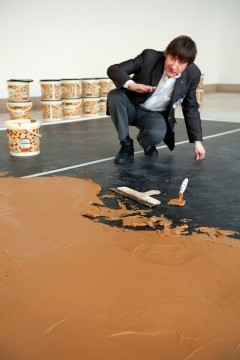
I think of How to be a Poet less as a manual to write a poem. Moreover, the act of erasure itself is more important in itself than the poem that Farkas produced. It reminds me of Happening, the kind of performance art that can only be witnessed at a particular moment in a situational way, like what the Dutch artist Wim T. Schippers did with his Pindakaasvloer (Peanut-Butter Platform). He’s just literally only covered a floor with peanut butter and nothing else. The act looks simple at first, but it holds deeper meaning as we try to see the situation when he did that act.
TL;DR “Don’t only think about what the author thinks as you read a book, but also think of what you originally think as you read each passage.”
===
Poetry is resistance, that’s what I first think of as I began reading this book. How to be a Poet comes out of Ovid’s The Art of Love. The Ancient Roman’s poem is originally an instructional elegy in the art of love which is comprised of three books. This book actually consists of two parts. The first half is Farkas’ own modification of Ovid’s poem by employing the technique of erasure, which she gained through his teacher’s inspiration. While the second half contains Ovid’s original Ars Amatoria with bolded words in each poem so that we could trace the creative process of Farkas in discovering her poem inside Ovid’s work.
I can’t help but drawing a line between Farkas’ creative process with how Andy Warhol reproduced various silkscreens of famous people’s portraits (such as Marilyn Monroe, Mao Zedong, etc to note some). In a way, it hardly could be said as an original piece of art. But another way to look at it would be that even inside one’s art, there’s another way to reinterpret it that we could claim it as our own works by putting our own hands on it. It shows us an alternative, that we don’t always have to start working on a piece of art from a blank canvas.
I think of How to be a Poet less as a manual to write a poem. Moreover, the act of erasure itself is more important in itself than the poem that Farkas produced. It reminds me of Happening, the kind of performance art that can only be witnessed at a particular moment in a situational way, like what the Dutch artist Wim T. Schippers did with his Pindakaasvloer (Peanut-Butter Platform). He’s just literally only covered a floor with peanut butter and nothing else. The act looks simple at first, but it holds deeper meaning as we try to see the situation when he did that act.
TL;DR “Don’t only think about what the author thinks as you read a book, but also think of what you originally think as you read each passage.”

November 10, 2019
"How to Be a Poet"
Written by J.M. Farkas
Reviewed by Diana Iozzia
"How to Be a Poet" is the second book written by J.M. Farkas, in the style of black-out, or in this case, white-out poetry. Farkas draws from Ovid's poem, "Ars Amatoria", an epic poem about love.
Farkas uses seven bottles of white correction fluid to mark out about 90 percent of the poem, leaving words out that help make a cohesive poem for herself. Her encompassing poem sets out to teach the reader how to be a poet, using the secluded words to create metaphors and personification.
Personally, this is not a type of poetry that I had delved into before. In reading the pages and thinking how many of Ovid's words had been manipulated, I found myself drawing a dislike for this style of poetry. I think using someone else's poetry in this way is a bit cheap. Although her final poem reads nicely in a style of poetry I would read, I do not like the entire poetry style.
The second half of the book is Ovid's original poem, but Farkas's poem's words typed in a bold font. I personally did not enjoy this section, because I do not enjoy Ovid's poetry. I felt that this book used a certain level of effort that just does not appeal to me. I feel that the creation of this book feels disengenious, taking advantage of the source material.
I would not recommend reading this book. I do not plan to continue reading Farkas's work.
I received a complimentary copy of this book in exchange for reading and reviewing purposes. Thank you to Andrews McMeel Publishing for the opportunity.
Written by J.M. Farkas
Reviewed by Diana Iozzia
"How to Be a Poet" is the second book written by J.M. Farkas, in the style of black-out, or in this case, white-out poetry. Farkas draws from Ovid's poem, "Ars Amatoria", an epic poem about love.
Farkas uses seven bottles of white correction fluid to mark out about 90 percent of the poem, leaving words out that help make a cohesive poem for herself. Her encompassing poem sets out to teach the reader how to be a poet, using the secluded words to create metaphors and personification.
Personally, this is not a type of poetry that I had delved into before. In reading the pages and thinking how many of Ovid's words had been manipulated, I found myself drawing a dislike for this style of poetry. I think using someone else's poetry in this way is a bit cheap. Although her final poem reads nicely in a style of poetry I would read, I do not like the entire poetry style.
The second half of the book is Ovid's original poem, but Farkas's poem's words typed in a bold font. I personally did not enjoy this section, because I do not enjoy Ovid's poetry. I felt that this book used a certain level of effort that just does not appeal to me. I feel that the creation of this book feels disengenious, taking advantage of the source material.
I would not recommend reading this book. I do not plan to continue reading Farkas's work.
I received a complimentary copy of this book in exchange for reading and reviewing purposes. Thank you to Andrews McMeel Publishing for the opportunity.
June 30, 2021
This book gives me a new reading experience. I love how it has three different versions of the poet where the first one covered the source text but the poem, the second one highlighted the poem in bold format with a full source text, and the leaving the last one naked with the poem only. I feel like I get to know the poem itself when I read throughout each versions.
My favorite line would be:
“Bring a promise like an apple in the hand,”
Wow.
Hold it. Grip it. Don’t lose it.
10/10 would recommend this poetry book.
My favorite line would be:
“Bring a promise like an apple in the hand,”
Wow.
Hold it. Grip it. Don’t lose it.
10/10 would recommend this poetry book.
This entire review has been hidden because of spoilers.

September 23, 2019
I love this collection and trust me, I am sad that I got to read it in digital version first because given the structure the author incorporates, this is best devoured in print.
It's in two parts; the first half teases what the second half accomplishes and you certainly cannot help but feel lighter and motivated towards the end.
Thanks netgalley for the eARC.
It's in two parts; the first half teases what the second half accomplishes and you certainly cannot help but feel lighter and motivated towards the end.
Thanks netgalley for the eARC.
June 5, 2020
I have loved Julia's work right from her first book, it's always been gorgeous and this book out stands the first one it's even more. I loved the white out poems and the subsequent section which had the complete version which gave an incredible vibe to the whole experience. The galley was worse as the aesthetics hardly appeared in digital copy but the print is incredible

December 6, 2022
I'm telling bout this one to my therapist tbh
Read
January 17, 2021this book didn’t exceed expectations and it didn’t fall flat either, i don’t know how i felt about it and how well it was written and this don’t know how to rate it. i do, however, know that it’s criminally underrated. honestly though, my favorite part was the introduction written by the author.
Displaying 1 - 7 of 7 reviews