Jump to ratings and reviews
Rate this book

The Poetry of Solitude: A Tribute to Edward Hopper

Rate this book
This volume, collected and introduced by Gail Levin, combines for the first time classic pictures by Edward Hopper and the poems they inspired. His much-loved Nighthawks and House by the Railroad are gathered along with many other favorites that have captured poets' imagination. The wide range of poets whose writings pay tribute to this great artist:

William Carpenter
Anne Babson Carter
Stephen Dunn
W.R. Elton
Edward Hirsch
John Hollander
Larry Levis
Robert Mezey
Lisel Mueller
Joyce Carol Oates
Toney Quagliano
Lawrence Raab
David Ray
Anthony Rudolf
Ira Sadoff
Grace Schulman
Sue Standing
John Updike
Samuel Yellen

80 pages, Hardcover

First published September 15, 1995

1 person is currently reading
136 people want to read

About the author

Gail Levin

67 books22 followers
Distinguished Professor of Art History, Baruch College and the Graduate School of the City University of New York

Ratings & Reviews

What do you think?
Rate this book

Friends & Following

Create a free account to discover what your friends think of this book!

Community Reviews

5 stars
24 (27%)
4 stars
32 (36%)
3 stars
22 (25%)
2 stars
9 (10%)
1 star
1 (1%)
Displaying 1 - 13 of 13 reviews
Profile Image for Cecily.
1,329 reviews5,387 followers
February 7, 2021
untitled

Pictures of emptiness
Poems of loneliness
Pens and brushes long ago
Prescient about our present

Lockdown
Locked
And down

Muted hues
Stifled moods
Confined spaces
Same few faces

Longing for escape
For company
But fearful of it

Locked
And down
But not yet out

If a picture paints a thousand words, what’s the point of poems about pictures?

The sum is much more than the parts, and the themes are especially poignant nearly a year into the Covid pandemic. Art, in all media, is about seeing and feeling in new ways, and printing pictures alongside the poems they inspired achieves that brilliantly. C.J. Bulliet described Hopper as “The poet in paint of loneliness.” (I wonder how many other visual artists have directly triggered such a poetic legacy.)


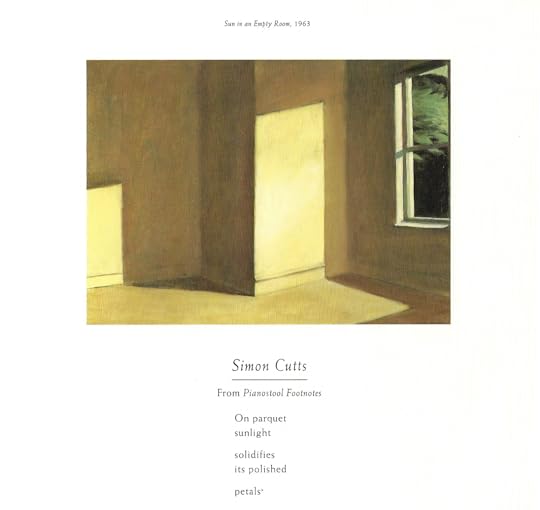
Image: The simplest picture (“Sun in an Empty Room”) and the simplest poem (by Simon Cutts):
On parquet
sunlight
solidifies
its polished
petals


Hopper’s images intrigue, and often unsettle me, but I wouldn’t call myself a huge fan. Few of the poems mean much on their own - which is fair enough. Many of them just describe one of Hopper’s works, and are more prose than poem. But juxtaposed, the words lead you behind the canvas, to the interior realms of Hopper and his subjects.

The book

As important
as what is
happening
is what is not.

From John Stone’s “Early Sunday Morning”. Full text and picture HERE.

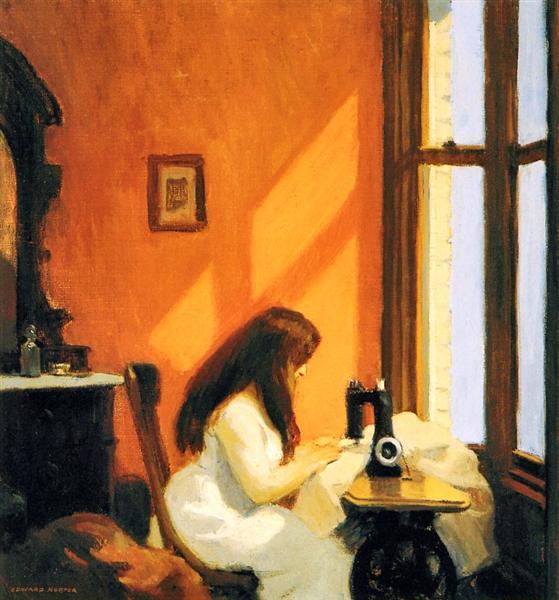
This was put together by Gail Levin, a professor of art history who is a biographer of Hopper as well as a curator of exhibitions of his work. Most of the poems are by writers new to me, but familiar names included two I think of as novelists: Joyce Carol Oates (whose piece is more of a microfiction) and John Updike (“Hopper is saying, ‘I am Vermeer’.” of two portraits of women indoors: “Girl at Sewing Machine”, HERE, and “Hotel Room”, HERE).

The pictures and poems include nocturnal city bars and cafés (there are five poems relating to his most famous work, Nighthawks, that wraps round the book), but also domestic portraits, as well as rural and small town scenes in gentle daylight.

The artist has invested his talent
in loneliness.

From Sidney Wade’s “Gas”. Full text HERE and picture HERE.

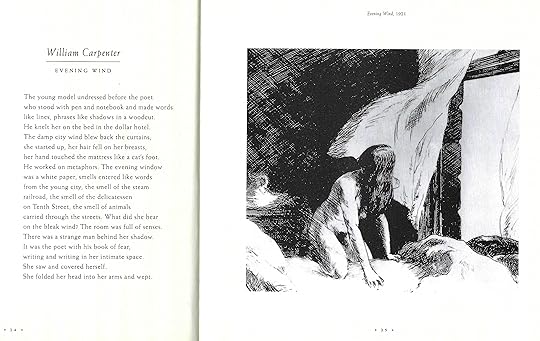
Evening Wind

I prefer the washed out colours and softer lines of his paintings, but this picture and poem are a particularly well-matched pair, in a rather meta way:


Image: “Evening Wind”: sketch by Hopper, poem by William Carpenter

The poet describes the picture by imagining a poet like an artist:
The young model undressed before the poet
who stood with pen and notebook and made words
like lines, phrases like shadows in a woodcut.

Full text HERE.

American Literature, by Lisel Mueller

This is the only poem in the book that does not relate to a specific picture. It encompases them all.

Poets and storytellers
move into the vacancies
Edward Hopper left them.
They settle down in blank spaces,
where the light has been scoured and bleached
skull-white, and nothing grows
except absence. Where something is missing,
the man a woman waits for,
or furniture in a room
stripped like a hospital bed
after the patient has died.
Such bereft interiors
are just what they’ve been looking for,
the writers, who come with their baggage
of dowsing rods and dog-eared books,
their uneasy family photographs,
their lumpy beds, their predilection
for starting fires in empty rooms.


Seven A.M.

What happens here? What is the sort of store
Whose windows frame such generality?
Meaning is up for grabs, but not for sale.


Image: “Seven A.M.”, painting by Hopper and poem by John Hollander
Full text HERE.

Stark(ers)

Edward Hirsch said Hopper’s buildings have:
The utterly naked look of someone
Being stared at, someone American and gawky,
Someone who is about to be left alone
Again, and can no longer stand it.

Full text and picture HERE.

Back to lockdown and social distancing...
Profile Image for Glenn Sumi.
408 reviews1,942 followers
January 26, 2021
If one artist's work sums up what millions of us have been going through during the pandemic, it's the painter Edward Hopper. His images of solitary, seemingly uninhabited buildings and blank-faced people staring out windows or nursing late-night cups of coffee are universal, but they resonate so much more when we're all in isolation.

This book brilliantly combines a couple dozen Hopper paintings and drawings with poems inspired by his works. The poems were collected and are introduced by Gail Levin, who has written several books on the artist and organized many of his exhibitions.

As with much poetry, it's hard to capture a poem's essence in a review or to cherry pick lines that work out of context.

The late, great poet John Updike has pride of place with the first poem, "Two Hoppers," which contrasts two portraits of solitary women in rooms ("Girl at Sewing Machine," from 1921, and "Hotel Room," from 1941) and concludes by comparing the artist to Vermeer.

Then, as if in a relay race, Larry Lewis takes up the baton of "Hotel Room" and imagines the woman's journey to get here ("outside this room I can imagine only Kansas: / Its wheat, and blackening silos, and beyond that, / The plains that will stare back at you until / The day your mother, kneeling in fumes / On a hardwood floor, begins to laugh out loud.") and her inability to catch the train and move elsewhere ("You've kept on sitting here for forty years – alone, / Almost left out of the picture, half undressed.")

The fine poet John Hollander takes on two of Hopper's empty building paintings, "Seven A.M." and "Early Sunday Morning," and finds a philosophy in them that brings to mind the work of Wallace Stevens.

John Stone, a poet unknown to me (like more than half in the book) also deals with "Early Sunday Morning," imagining things that are left out of the picture. He ends it with these haunting lines:

As important
as what is
happening

is what is not.


So true. And applicable not just to painting but to art of any kind.

Hopper's most famous painting, "Nighthawks," provided a detail for the book's cover and understandably provoked the most poetic responses, five in all. Joyce Carol Oates comes up with a long poem that imagines the man and woman seated next to each other are having an affair, while Ira Sadoff imagines what the man seated by himself, the one with his back to us, is thinking. Susan Ludvigson dreams up a scenario in which the couple at the cafe are her parents.

Some poems are brief haiku-like efforts, while others are twisty puzzles to be solved.

My only disappointment is that no poet took on "New York Movie," the painting featuring the female usher standing against a wall, lost in thought in a near-empty theatre.

My favourite poems are the ones that comment on details that make you see a painting in a new way. Here's David Ray's "Automat," inspired by the work that features a woman in a stylish coat and hat nursing a cup of coffee alone:

One at one table,
one at another

Her stray hair is stroked
(by her). He reads Wall St.

It's quite classic –
separate tables

brass glistens on,
polished spittoons

and reflected lights
a highway out to hell,

black as hell.
Extent of human reach, nihil,

and loneliness burning loud
like lamps left on

That "highway out to hell" and the idea of putting the words "loneliness, "burning" and "loud" together and comparing them to "lamps left on" are genius.

I have a feeling I'll dip into this volume again and again, probably with the help of one of those lamps left on.
Profile Image for Blixen .
211 reviews77 followers
January 30, 2016
Io vivo qui


Il libro è una raccolta di poesie ispirate ai dipinti di Edward Hopper. La curatrice è Gail Levine ad oggi la più importante studiosa dell'artista americano.
Hopper si presta facilmente ad un'operazione di questo tipo, infatti questa non è l'unica raccolta nel suo genere, lo stesso Mark Strand, poeta statunitense contemporaneo, ha composto diverse poesie basandosi sulle tele dell'artista (in Italia il libro di Strand è edito da Donzelli).
Edward Hopper si riteneva un "poeta visivo", dipingeva spesso facciate di edifici: a volte palazzi disabitati, a volte condomini con finestre aperte che come un mosaico di esistenze permettevano di spiare la vita all'interno e creare una narrazione.
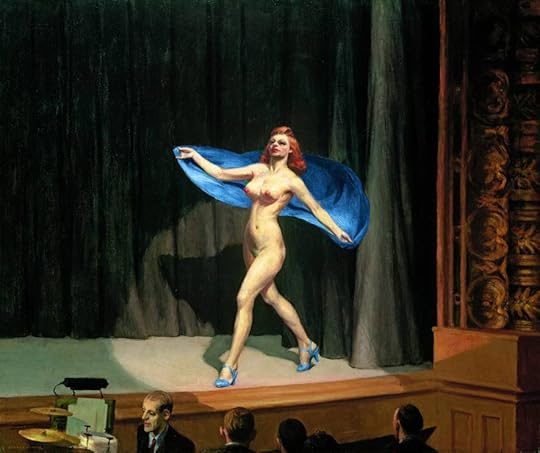
In questa poesia di Lisel Mueller, la mia preferita, ispirata al dipinto Girlie show il corpo è "la facciata", la casa dell'uomo: identità e rifugio dal mondo.

The light
drains me of what I might be,
a man's dream
of heat and softness;
or a painter's--
breasts cozy pigeons,
arms gently curved
by a temperate noon.

I am
blue veins, a scar,
a patch of lavender cells,
used thighs and shoulders;
my calves
are as scant as my cheeks,
my hips won't plump
small, shimmering pillows:

but this body
is home, my childhood
is buried here, my sleep
rises and sets inside,
desire
crested and wore itself thin
between these bones--
I live here.


La nudità esalta ancor di più la discrasia tra esterno ed interno: il mio mondo è la mia forza:

I live here, io vivo qui

...ma quanto è bello questo verso!
Profile Image for Haines Eason.
158 reviews1 follower
June 25, 2017
Levin says in her introduction "I have chosen poems that specifically refer to Hopper, while omitting others that appear to share certain themes or moods with his work." It's a real shame she took this approach; the quality of the remaining available poems is low on average, and there are numerous poets who evoke Hopper tangentially whose work could make for great reading (think Oppen). Only a truly talented artist can confine themselves to another's work for inspiration and come away with something new and surprising; the John Hollander poem in this collection, "Sunday a.m. not in Manhattan," is one of the rare examples here.
Profile Image for Kasandra.
Author 1 book41 followers
October 3, 2012
The paintings get a 5. The poems, a 2-3. It's interesting to read the various interpretations of "Nighthawks", but more engaging were poems on lesser-known paintings, like Hirsch's "Edward Hopper and the House by the Railroad", my favorite in this book. Also, I liked Debora Greger's "The Man on the Bed". A nice gift for Hopper fans, but not such a keeper for poetry fans -- a great many poems in this volume seem only to be here because they're on Hopper paintings, and not because they're especially good.
Profile Image for Harper Curtis.
38 reviews24 followers
December 13, 2013
This is a beautiful book, something to cherish. Gail Levin has assembled a worthy collection of poems inspired by the paintings of Edward Hopper and juxtaposed them with carefully selected images of the paintings. There are over thirty poems from a diverse group of writers including Larry Levis, Stephen Dunn, John Hollander, Grace Schulman and many many others and over 20 paintings are represented.
For more on Hopper and poetry, check out Peter Sacks's lecture on Poetry Foundation.org: http://www.poetryfoundation.org/featu...
Profile Image for Caitlin.
86 reviews164 followers
May 16, 2020
"The light
drains me of what I might be,
a man's dream
of heat and softness;
or a painter's
--breasts cozy pigeons,
arms gently curved
by a temperate noon.

I am
blue veins, a scar,
a patch of lavender cells,
used thighs and shoulders;
my calves
are scant as my cheeks,
my hips won't plump
small, shimmering pillows:

but this body
is home, my childhood
is buried here, my sleep
rises and sets inside,
desire
crested and wore itself
thin
between these bones--
I live here."

--Lisel Mueller, "A Nude by Edward Hopper"
Profile Image for Georgia.
Author 3 books31 followers
June 18, 2008
Outstanding collection of poems based on the work of Edward Hopper. If you like such poetry but always want to see the art work this is one to pick-up. The paintings are just as outstanding as the poems.
Author 1 book12 followers
December 2, 2021
Gail Levin is also the author of a biography of Hopper. So it was surprising to me when I ordered this book from my library's loan system expecting more commentary on the poetic loneliness of Hopper's work and not just mediocre poetry. Levin makes a point in the introduction that she has excluded poetry that evokes Edward's themes and only included ones that reference him directly, which is another huge miss. The poets featured, big names that they are, try to create a narrative from the paintings or simply describe them in flowery verse. I get no sense of the impact Edward Hopper had, but at least this volume includes his wonderful paintings. Waste of time.
Profile Image for Jim.
116 reviews4 followers
July 6, 2022
Think of it as a poetry picture book.
The poems reflect and ponder the Hopper images of emptiness, loneliness, and simple ennui.
And a few of the poems even drift into art criticism, which was fun.

In my experience poetry has the most personal of tastes. What I like the odds are you'd think is meh, or even bad. It's rare when someone has shared a poem with me that they really liked and then my reaction was no stronger than "that's ok".

Here, with so many poets collected, and with the added influence of the Hopper paintings, the reader is going to stumble upon some gems.

Here's a snippet of my favorite by Debora Gregor - reflecting on Hopper's "Excursion into Philosophy, 1959"


If the heart is a house, he thought,
it is rented to strangers
who leave it empty.
If the heart is a house,
it is also the darkness around it
through which a black bird flies, unseen,
and unseeing, into the window,
beating and beating its wings
against the glass.
Profile Image for Theresa.
150 reviews1 follower
February 27, 2023
A new appreciation for the works by Edward Hopper.
Profile Image for Theresa.
201 reviews45 followers
January 24, 2025
My favorite piece (Room in Brooklyn) wasn't even in here- boooo. Although maybe it's for the best because some of this poetry was a bit of a.... disservice to the paintings.
326 reviews
November 11, 2025
Edward Hopper is a fantastic artist, and paring poetry with his work makes this collection a fun book for fans of both!
Displaying 1 - 13 of 13 reviews

Can't find what you're looking for?

Get help and learn more about the design.