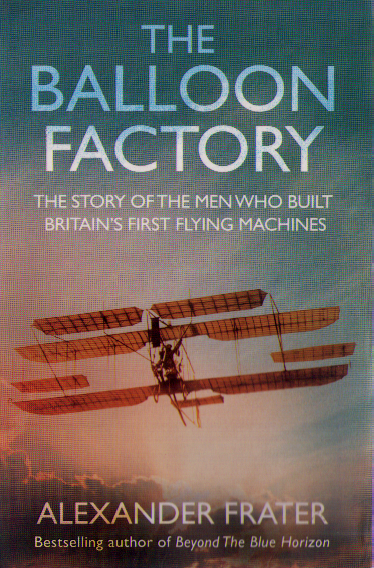
Alexander Frater's new book is about a small, largely forgotten group of young men who, early in the 20th Century, competed to build and fly England's first aeroplane.
Alexander Frater has contributed to various UK publications--Miles Kington called him "the funniest man who wrote for Punch since the war"--and been a contracted New Yorker writer; as chief travel correspondent of the London Observer he won an unprecedented number of British Press Travel Awards. Two of his books, Beyond the Blue Horizon and Chasing the Monsoon, have been been into major BBC television films. One, the Last Aftican Flying Bat (based on the former), took the Bafta award for best single documentary, while a programme for BBC Radio 4 (about his South Seas birthplace) was named overall winner of the Travelex Travel Writers' Awards. He lives in London, though, whenever time and money allow, is likely to be found skulking deep in the hot, wet tropics.
As an aviation enthusiast I found this book very engaging. Frater takes us on a personal journey across various spots of Britain that are connected with early aviation in Britain. It is filled with descriptions of the present day state of the sites and places that had seen the early aviators in action along with the narration of the original (historic) events. If the book had a hero then it had to be Samuel Franklin Cody: the American showman who built the first all British aeroplane and became airborne in it. Reading about Cody was a pleasure, and I must admit that when I finished the book, I became an admirer of his exploits. To the present day aviation enthusiast the trial and error method by which Cody perfected his flying machine, would seem very daunting. Cody experienced numerous crashes and ditched his flying machine many times. These come alive through Alexandar Frater's writing. Those who have read "Beyond the Blue Horizon" will find this book an excellent read.
There are some interesting chapters on pioneering aviators and the early history of aeronautics. I found the authors own interludes relating his visits to present day sites a bit distracting, though it added an insight into how we remember those early fliers. At times it felt almost as if the author wanted to be writing an autobiography and he certainly relates anecdotes entirely unrelated to his subject matter.
An excellent book of the early flying pioneers. I used to live just off the Basingstoke canal between Farnborough and Brooklands and even worked at both colleges - so thought I knew a lot of the history but there were many extra details I was unaware of. For me it was spoilt a little by the numerous distractions (it was interesting to find out where the Bleeding Heart in Covent Garden got it's name from - but...).
The style of jumping backwards and forward in time in narratives seems to have become quite fashionable but I found the rapid jumps between 100 years ago, to 10 years previous (in the author's experiences) and the current time - with the various people he met along the way difficult (for me) to follow.
In summary a book full of interesting details but I found it hard work reading.
The cover says 'the story of the men who built Britain's first flying machines' but what it really is is 'The story of the author's journey to go to places related to the men who built Britain's first flying machines'. There is a lot of the author in this book. Now, if you like the author to take centre stage and tell us about his own flying lessons and about how he went to Africa (or whatever) and the interesting chap he had lunch with while researching this book, then that suits fine. It's a bit like those nature documentaries where we mostly see the presenter talking about their efforts to find the animal, rather than the animal itself. Cover of The Balloon Factory by Alexander Frater.
The book contains some stuff about Sam Cody, De Havilland and Sir George Cayley, and J. W. Dunne who made strange but effective aeroplanes and An Experiment with Time. It is written with great fluency and charm, and does indeed contain some interesting information. Perhaps because written by a travel writer, it does not spend too much time on the technical aspects but tells the human stories of its protagonists, and they are an interesting bunch. On the other hand, it is far from comprehensive -- there were many significant figures (the Short brothers, for example) who get very little attention. The author has been captured by a couple of personalities, mainly Cody who seems to occupy fully half the book, and so the picture is skewed and highly personal.
Despite the title, there is very little in it on balloons. Just FYI.
Conclusion: If you like a congenial host getting between you and the material and telling you his story as well as the story of his subject, this is a very pleasant read. If you prefer a book to focus on the subject rather than the teller, this may not suit. It is not a bad book, but it may not be what you expect.