Jump to ratings and reviews
Rate this book

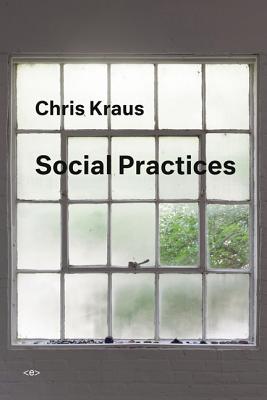
Social Practices

Rate this book
Essays on and around art and art practices by the author of I Love Dick.

A border isn't a metaphor. Knowing each other for over a decade makes us witnesses to each other's lives. My escape is his prison. We meet in a bar and smoke Marlboros.
—from Social Practices

Mixing biography, autobiography, fiction, criticism, and conversations among friends, with Social Practices Chris Kraus continues the anthropological exploration of artistic lives and the art world begun in 2004 with Video Green: Los Angeles Art and the Triumph of Nothingness.
Social Practices includes writings from and around the legendary “Chance Event—Three Days in the Desert with Jean Baudrillard” (1996), and “Radical Localism,” an exhibition of art and media from Puerto Nuevo's Mexicali Rose that Kraus co-organized with Marco Vera and Richard Birkett in 2012. Attuned to the odd and the anomalous, Kraus profiles Elias Fontes, an Imperial Valley hay merchant who has become an important collector of contemporary Mexican art, and chronicles the demise of a rural convenience store in northern Minnesota. She considers the work of such major contemporary artists as Jason Rhoades, Channa Horowitz, Simon Denny, Yayoi Kusama, Henry Taylor, Julie Becker, Ryan McGinley, and Leigh Ledare. Although Kraus casts a skeptical eye at the genre that's come to be known as “social practice,” her book is less a critique than a proposition as to how art might be read through desire and circumstance, delirium, gossip, coincidence, and revenge. All art, she implies, is a social practice.

296 pages, Paperback

Published October 30, 2018

21 people are currently reading
550 people want to read

About the author

Chris Kraus

76 books901 followers
Chris Kraus is a writer and critic. She studied acting and spent almost two decades making performances and experimental films in New York before moving to Los Angeles where she began writing. Her novels include Aliens & Anorexia, I Love Dick, Torpor, and Summer of Hate. She has published three books of cultural criticism—Video Green: Los Angeles Art and the Triumph of Nothingness, Where Art Belongs, and Social Practices. I Love Dick was adapted for television and her literary biography After Kathy Acker was published by Semiotext(e) and Penguin Press. A former Guggenheim Fellow, Kraus held the Mary Routt Chair of Writing at Scripps College in 2019 and was Writer-in-Residence at ArtCenter College between 2020–2024. She has written for various magazines and has been a coeditor of the independent press Semiotext(e) since 1990. Her work has been praised for its damning intelligence, vulnerability, and dazzling speed and has been translated into seventeen languages. She lives in Los Angeles.

Ratings & Reviews

What do you think?
Rate this book

Friends & Following

Create a free account to discover what your friends think of this book!

Community Reviews

5 stars
28 (31%)
4 stars
37 (42%)
3 stars
21 (23%)
2 stars
2 (2%)
1 star
0 (0%)
Displaying 1 - 8 of 8 reviews
Profile Image for Will.
200 reviews210 followers
November 28, 2018
For Chris Kraus, art is relational. It's about perception. The artist creates a piece, that's for sure, but that's only half the story. The value and meaning of a piece of art depends on how the viewer interacts with it. Art is not merely biographical. Without the viewer, the individual personal interpreter, art is nothing. It's just a collection of arranged atoms. Art matters because it makes people feel. Kraus's thesis is that good art makes us interrogate ourselves and the social forces around us that influence our every action. Only then can we attempt to understand and be true to ourselves.

Because art is relational for Kraus, borders are important. A border physically represents a divide in perspective. Those on each side see each other differently, construct different myths from the same set of base facts. In her set of essays on the Mexico-US border towns of Mexicali and Calexico, Kraus's writing plays with perspective, just like the border artists she praises.

"Our first stop in Mexicali was a two-story shelter for homeless migrants in the central city, overlooking the new highway that leads to the border," Kraus writes on page 131. The image is striking: a huge migrant shelter full of freshly rebuffed border-crossers overlooks the newly built highway that could speed them to their dreams – if only they had the capital and the right paperwork. They gaze wistfully down and dream as they watch gleaming tractor-trailers bound north. So close, yet so far. At the same time, the truckers and vacationers headed back to the US just see another squalid building in a dangerous Mexican city. For Kraus, speed and inequality go hand in hand. The highway users can zip past the squalor. The migrants, though, have no choice but to remain static, stuck and immobile. Perspective matters; it shapes belief, which forms reality.

But Kraus also points out that we can play with our perspectives, and therefore play with our beliefs and reality. Luckily for us, artists play with reality for a living. Kraus writes about Tao Wells, a New Zealand artist who decided to run a farcical PR campaign for the country's welfare system. He aimed to reframe the perception of welfare by explaining it as an eco-conscious choice. Less work means less greenhouse gas emissions, means a healthier planet for us all!

Wells plays not only with our perception of welfare, but also exposes how PR spin rules our lives. We believe the stories that we want to believe, and that creates our reality. We already choose to believe that capitalist corporations have our best interests at heart, even though we know they don't, so why can't we see a guaranteed safety net that keeps the victims of capitalism from death as a good thing? Again, perception, belief, reality.

Great art, like Kraus's writing about it, helps us see our understanding of the way things are and challenges us to see beyond it, beyond the current order to new ones. Kraus tells us to harness our feelings, not suppress them, so that we can see different perspectives and discover those that we want to make real. Engaging with art in this way, I think, is the real social practice that Kraus is getting at.
Profile Image for Patrick Steadman.
28 reviews6 followers
June 25, 2019
A triangulation of artists, locales, and politics that focuses on artworks rather than a hot take. Provides an appreciation of trends like "social practice" alongside a critical understanding. A very readable map, sometimes personal, sometimes academic, often sad.
Profile Image for Paulina.
219 reviews52 followers
June 25, 2019
ambition, humility, happiness
Profile Image for Shadib Bin.
136 reviews21 followers
May 14, 2023
Social Practices by Chris Kraus

I first heard of Chris Kraus, through Olivia Laing, when she was exploring the life of Kathy Acker on her book - Every Body - A Book About Freedom. Chris wrote the official biography of Kathy, which I have yet to read, but have heard great things about it.

I have been a devout follower of LARB radio podcasts, focused on reviewing books with their author. I saw one from 2018, Social Practices by Chris Kraus, and I loved the podcast, where I could sense and really appreciate Chris’ strong viewpoints about life, and art, I can clearly hear it - someone who has opinions that have come from deep explorations of life itself, and all the more wise for it.

I read this book, during my time visiting London, and I usually try to read many books (at least 2-3, over 7 days, which is a lot for me), but it felt right to devote to just one book this time - this book happened to be just that, and I am grateful for it.

What I love about this book is Chris explores a lot of variations of artists and art, and reviews them, and never makes it feel like disconnected, and rarely is dry. As much as I love Art, I love when critics can layer in understanding that is personalized and has heart in it - and Social Practices has all that.

I see how Chris follows her intuition, her want to discover different modalities to live life, to free ourselves from the notion of happiness and explore things such as accepting loss and live alongside it, or understanding our own resistance to things and how that causes how biggest downfall. I especially loved her submission to Guggenheim in trying to resurrect Kelly Store, and breed in life again in those parts of town - and although Guggenheim rejected it, it wasn’t a display of indulging good thoughts with no real viabilities, but instead, it’s grounded in how someone like her, and me as a reader, can explore a life that’s worth pushing the needle that helps people and moves beyond our own narcissistic tendencies. That we can indeed dream new things, and pursue them relentlessly, in order to shift things around.

Chris isn’t afraid to be meandering around - Exploring chats with Leigh Ledare about his “pornographic” photography as a means to explore the complex working model he has had growing up with his mother, who was a sex worker, to Thomas Gokey’s fantastic idea to raise money to buy bad debts, so that, people can be freed from those debt and not be continued to further shamed (and raise awareness of the debt complex and the society we live in that perpetuates such dire conditions and ruthlessly penalizes individual people for systematic failures). It helps to see how sprawling Chris ideations are to move the world forward, one artist at a time.

Perhaps the most important connection for me personally, aside from finding a compelling new writer that I want to explore quite a lot, is that, she happens to be a key editor for Semiotext, a publication that I have been obsessed over - covering Kate Zambreno, David Wojnarowicz and many more of some of the best writers I know and love. To see Chris has had direct hand in selecting some of these books, and knowing she has pioneered this model, where they highlight such marginalized but crucial writing & artists, makes my own discovery of this book and Chris, all the more fascinating and humbling.

It’s a welcome new addition to my life and can safely say, it left me feeling a lot more hopeful and uplifted.
Profile Image for Fanny Aboulker.
36 reviews2 followers
April 26, 2021
I really enjoyed this book. Kraus' analysis of art but also of life, hers and other people (artists alive and dead) and the connection she makes between them are very insightful and nuanced. She acknowledges the limits of the critic of a system in which we are living and the limits of art as a social practice while pinpointing qualities of the art that partly succeed in operating in this realm without being gimmicky. As per usual with Chris Kraus, I have discovered lots of artists and authors I didn't know and advanced my own reflections while having an enjoyable and easy read.
Profile Image for Shawn Cremer.
47 reviews
August 20, 2024
I am so so so much improved for having read Chris Kraus! Some real bangers in here…I feel like I got a really brilliant overview of visual art in the first decade and a half of the 20th century even if it did take me half a year to get through it
Profile Image for Frank Keizer.
Author 5 books46 followers
February 3, 2019
Ik hou van de manier waarop Kraus over kunst schrijft, ook al ken ik de kunst vaak niet.
Profile Image for Marije de Wit.
110 reviews6 followers
September 22, 2019
An important book that is critical of how, after having observed developments that came from within the arts, institutions have begun directing the arts. Social Practices as an education program is but one example that undergoes Kraus' mercilessly sceptical eye. The pieces in which she anthropologically chronicles contemporary artists' practices, and exhibitions and events of the recent past remind us, in a commercialized art world, with the dangers of superficiality and vacuousness around every corner, of what really matters. The book is like a refresh button on the current situation.
Displaying 1 - 8 of 8 reviews

Can't find what you're looking for?

Get help and learn more about the design.