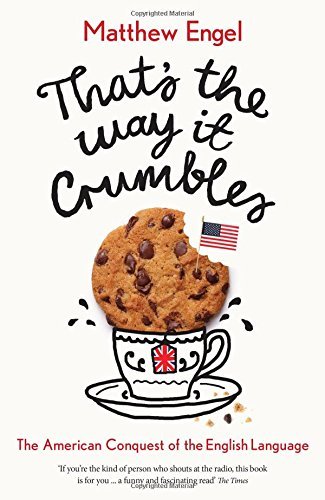
Are we tired of hearing that fall is a season, sick of being offered fries and told about the latest movie? Yeah. Have we noticed the sly interpolation of Americanisms into our everyday speech? You betcha. And are we outraged? Hell, yes. But do we do anything? Too much hassle. Until now. In That's the Way It Crumbles Matthew Engel presents a call to arms against the linguistic impoverishment that happens when one language dominates another. With dismay and wry amusement, he traces the American invasion of our language from the early days of the New World, via the influence of Edison, the dance hall and the talkies, right up to the Apple and Microsoft-dominated present day, and explores the fate of other languages trying to fend off linguistic takeover bids. It is not the Americans' fault, more the result of their talent for innovation and our own indifference. He explains how America's cultural supremacy affects British gestures, celebrations and way of life, and how every paragraph and conversation includes words the British no longer even think of as Americanisms. Part battle cry, part love song, part elegy, this book celebrates the strange, the banal, the precious and the endangered parts of our uncommon common language.
As someone who cringes at windshield, rolls his eyes at ass and is driven into a fury by zee usurping zed, this should be a book for me.
Unfortunately, the author is such a curmudgeon (calling for letter writing campaigns and the like) that I found myself leaning more towards embracing Americanisms in all their glory.
A few years ago, I attended a session led by a professor on how to find a job in a US university (or school, as universities there are generally called). He repeatedly used the phrase, "That's the cookie cutter," when referring to a key point. At the end of the session, he asked if we had any questions. I raised my hand: "What's a cookie cutter?" He looked at me in bafflement and eventually a (British) colleague (co-worker in the US) of his had to explain it to me.
There's an assumption that US English has come to dominate international discourse so much that British English has been overwhelmed. Having grown up in the north of England and now living in California, I've begun to believe that the truth is far more nuanced than that. There are so many differences - in words, phrases, emphasis, cultural references - that make it clear that the English spoken in the UK and the US are two different creatures.
Engel's book takes a very different approach. It's a reactionary rant claiming that British English has succumbed completely to American English (despite his constant attack on Americanisms, he's guilty of the worst: conflating the US and America as the same thing). A far more interesting book would have investigated how British English has incorporated - both accidentally and deliberately - English from the US but also resisted it.
I understand Engel's concern that British politics is too much under the influence of the US, but at the same time he bizarrely claims that Fahrenheit is a more logical system than Celsius; lambasts phrases that I've never heard used in the US or the UK; and, in a relentlessly pedantic book, writes a sentence that begins, "None were...".
It's unclear where Engel wants British English to return to: Beowulf? Chaucer? Shakespeare? Pope? At every single point of its history, English has taken on words from other languages and cultures, which is why it's so successful internationally. It's no surprise that the language has been heavily influenced by the twentieth-century's great economic and cultural power, but it remains an exaggeration to claim that we all talk American rather than speak English.
This should have been a fascinating book, but for the first time in my life I have to write that the author should have stepped up to the plate.
A really interesting book about what the author feels is the americanisation of British English. He is not a lexicographer, just someone who has a passion for the subject and at times it was a bit ranty. I am not sure I agree with him that soon American English will dominate; I prefer to think that English is flexible enough to be able to cope with all the words originated anywhere in the English speaking world and that British English will still retain its own uniqueness. However, it was a good read; I enjoyed it a lot and it would be a good book to discuss at a Book Group, as everyone probably has their own opinion on this subject and would therefore have an opinion about the book. I particularly enjoyed the fact that he had identified words which had gone from Britain across to the New World, fallen out of favour in Britain and then been reintroduced back as "Americanisation"
By golly! Who knew how many phrases were not originally British, but have travelled from America! For example: stiff upper lip - no not British! A funny, smart cry for the beloved language... loved it.
Splendid, brilliant - just two Britishisms that came to mind when I turned the final page of this book. It was with wit, humor, self-depracation and insight that Matthew Engel has written a book capturing the zeitgeist of American English in today's (or more particularly, Britain's) world.
Understandably, as an Englishman, Engel's book emphasized (yes, spelled the American way) the juggernaut that is American English in Great Britain, and how Americanisms have transformed British English so much so that the pensioner crowd could almost think a different language was being spoken.
Matthew Engel does a masterful job tracing the history of the English language in both England and America, and (as best as can be documented) how, when and where American words were imported (or in many instances, re-imported) into Great Britain. Reasonably, the pace picks up with the advent of mass communication (telegraph, then telephone, on to television, and now, movies [er, films] and the Internet).
The author inveighs against this invasion, and can only offer minor consolation to those who wish to hold back the tide. Engel cites specifically, the rise of Welsh and in England, the English spoken among the British ethnic minority (Jamaican, Polish, South Asian, etc.).
As an American, and an Anglophile to boot - I can't say I'm much aggrieved about this American invasion of words/phrases. Rather, what I find alarming and quite sad is the aping of some American rituals, such as the "prom", the annual rite of passage signifying an end to mandatory school instruction. Halloween too, has made the jump across the pond, and the practice of lighting up one's home exterior for Christmas is another. Hopefully, peoples' in countries around the world will keep some of their long held customs and traditions, and shake off the more commercial and vulgar American ones.
Are we tired of being asked to take the elevator, sick of being offered fries and told about the latest movie? Yeah. Have we noticed the sly interpolation of Americanisms into our everyday speech? It’s a no-brainer. And are we outraged? Hell, yes. But do we deny anything? Too much hassle. Until now.
That’s The Way It Crumbles is a very personal view of the English language and how Americanisms have crept into our everyday speech. I have to admit, being an Ex-Pat; I hear this a lot in Australia. Australian English certainly takes on a lot of Americanisms. The pronunciation of yoghurt and vitamins are some of the most obvious, and I always hear a little snigger when I say ‘I’m heading out to the cinema to watch a film’, rather than just ‘Goin to the movies.’
Matthew Engel brings to this book a plethora of American words and their histories. When were these words first in print? How did they catch on? How did they become part of our everyday language, and how is it affecting a language which is used almost universally?
What Did I Think About That’s The Way It Crumbles?
I particularly liked the last third of the book which had a timeline of words and when they appeared, from the 1800’s right up to today. Some were quite a surprise!
Personally, I think that language is always evolving. You would find it slightly taxing to understand the way people wrote and spoke in medieval times, right? It’s the nature of evolution, and although I admire Engel’s vast knowledge of the English language, and I hate the introduction of new slang terms, I think it’s just the way it crumbles!
This was fine, seriously. It had a rocky start, Engel setting the tone through ironically outdated and insensitive language to describe Indigenous tribes of the US and victims of the Trans-Atlantic slave trade. It took a while for me to adjust to his scathing commentary on linguistic convergence, which would have been a lot more compelling had his analysis of the modern socio-political tension between our nations been a lot less shallow. I feel we didn’t spend enough time on the modern, which was honestly what I’m here for.
Banger lines like “a nation that outsources the development of its own language […] is a nation that has lost the will to live” REALLY made me snort-laugh: how does he think English was founded? I bet Engel would go ape if he read up on Thomason’s (2001) interpretation of Middle English as a creole … poor, narrow-minded guy.
But seriously, the overarching argument of British English as weak and feeble, with no distinct social and therefore linguistic identity, really grates after a while. There’s some very interesting aspects to his argument; his heart is definitely in the right place, but as a very passionate student of diachronic linguistics, etymology and lexical semantics, I dunno … this just didn’t captivate my attention like I wanted it to.
I wonder if I could make his blood boil with how many foreign-derived words I’ve just featured in my review!
Genius. Funny. A delightful read full of history and humour.
If you possess a love of the English language, are naturally inclined to pull a face at words you find distasteful or have an inner pedant struggling to get out then you simply must read this book.
Mr Engel has produced a superb book sprinkled with wonderful humour, some of which is to be found in the footnotes so ensure you read everything. I laughed a lot - be warned if you are planning to enjoy this in a public space.
As a result of reading 'That's the Way It Crumbles' I will:
• vow to replace my use of 'choo-choo' with 'puff-puff' when discussing trains with small children; • loudly and publicly accuse those who deal a 'fizzle', especially if it is within a confined space; • wear a sly grin when informing someone that I believe them to be a 'natural'; • participate in the pressure group as suggested.
This book is full of fascinating information about the origin of English words and the history of sharing vocabulary back and forth across the pond since the first Brits put down roots on North America’s east coast. However, the writing is dripping with contempt for America and Americans (he denies this in Chapter 1) and sweeping generalizations about us that it makes me want to cause him to cringe by saying “Take a chill pill!!”
There is much to appreciate about this book. The author (more a popular historian than a linguist) appears to have done years of independent research on the Americanisation of British English. Of course, nobody needs independent research to be well aware of it, but he unearths lots of interesting stories and is especially good on cultural influences, even if I had some serious doubts about the validity (or point) of some of his conclusions. (I also enjoyed the journeys of words or phrases that died out in Britain but took on new life in the US and were then reborrowed, often with a new flavour or in a new context.)
However, his tone (to quote another review) is frequently curmudgeonly and, at the end, he seems to think we can do something about fighting this development.
I think a more interesting story would be to explore the many ways in which forms of English (all round the world, not just the UK) are maintaining local and contextual differences in vocabulary, semantics, syntax and, indeed, pronunciation/accent - all despite the undoubted bombardment from American English (which itself is not a monolith).