Jump to ratings and reviews
Rate this book

The Glass Canoe

Rate this book
"The Southern Cross is a pub, an old, battered and experienced place, somewhere in the centre of Sydney. Meat Man is a regular, a very regular regular, who views the world - the world of the pub and its clientele - through his beer glass, his glass canoe which transports them all to other worlds, worlds of fighting and loving and, above all, drinking. The grand saga of the Southern Cross or the tragic futility of humanity at a watering hole? Perhaps it's all to be taken on a bent elbow with another swallow."

231 pages, Paperback

First published January 1, 1977

18 people are currently reading
270 people want to read

About the author

David Ireland

14 books26 followers
David Ireland was born in Lakemba in New South Wales in 1927.

Before taking up full-time writing in 1973 he undertook the classic writer's apprenticeship by working in a variety of jobs ranging from greenkeeper to an extended period in an oil refinery.

This latter job provided the inspiration for his second (and best-known) novel, The Unknown Industrial Prisoner, which brought him recognition in the early 1970s and which is still considered by many critics to be one of best and most original Australian novels of the period.

He is one of only four Australian writers to win the Miles Franklin Award more than twice

He was appointed a Member of the Order of Australia in the Queen's Birthday Honours of June 1981.

Ratings & Reviews

What do you think?
Rate this book

Friends & Following

Create a free account to discover what your friends think of this book!

Community Reviews

5 stars
75 (25%)
4 stars
106 (35%)
3 stars
81 (27%)
2 stars
27 (9%)
1 star
10 (3%)
Displaying 1 - 30 of 44 reviews
Profile Image for Daren.
1,581 reviews4,573 followers
June 19, 2022
There is little doubt that this 1976 novel documents a way of life now gone. Remnants remain, of course, especially in smaller, more isolated communities in New Zealand and Australia, but no longer exactly like this.

Having written my rambling review below, I was compelled to return to the start to advise that some of the rambling below could be construed as spoilers.

Through the eyes of Lance, or Meat Man as he is known due to the endowment of a readily guessed part of his anatomy, author David Ireland describes the events in and around The Southern Cross - a pub in a typical Sydney suburban setting. The regulars in the bar, referred to as a tribe feature heavily, as does what I would describe as pub philosophy, where not only Meat Man shares his thoughts on life, but he collects the thoughts of the other regulars. Lance works as a grounds keeper on a nearby golf course, but mostly his life is dedicated to spending time in the pub.
"The next tribe west drank at the Bull, and on the other side the nearest tribe holed up at the Exchange … you never went walkabout to another tribe’s waterhole. Unless there was trouble."

"And now and then, as they drank deeply, they saw in the bottom of the glass, not the face of the man they knew, but the monster within that was waiting and all too willing to be released."

"On hot days we jumped fully clothed into our bottomless beer glasses and pushed off from the shore without a backward look. Heading for the deep where it was dark and cool."

"I went to the bar and got us a small fleet of glass canoes to take us where we wanted to go . I thought of the tribes of Australia, each with its waterhole, its patch or bar, its standing space, its beloved territory."

There are plenty of well described characters who spend (far too much) time in The Cross - Mick, Danny, The Great Lover, The King, Serge, Flash, old Hugh, Alkie Jack, Ronny, Darkfella, Eh, Dog Man... most of these people earned chapters of their own, but many feature in the regular chapters. They drink, discuss the bad hand life has dealt them, women and whatever it is that shares their life with the beer. They also fight. Nothing better than a good bar brawl, or giving a stranger a beating - wrong tribe you see.

Lance has a girlfriend, who is referred to only as his Darling. Sharon is the regular barmaid at The Cross and other than the few barmaids who come and go, and one lady drinker called Liz Large women feature only as conquests and in stories in the bar. Women are not well treated in this book, and to a large degree were not treated well in this culture at the time the book is set. It is, perhaps, not a book which would be published today, and while the reviews of this book on GR are overwhelmingly positive, no doubt there are academic views which take a dim view of it.

The book is written in non-linear chapters, of varying lengths - some half a page others 6 or 8 pages, but typically a couple of pages long. There is experimenting going on for sure - some chapters are surreal. It felt important to notice though, that none of the behaviour or violence was idealised or romanticised, or even judged. Lance simply reports the story - and the reader is left to make those judgements. There are poignant observations, sad tales and some parts I found hilarious, but mostly is just captures snapshots of a lost way of life. Many would say for the better that it is lost.

Some more quotes I found amusing:
"Blackie [the pub dog] let him pass without getting to his feet. You don't fight a three-legged dog."

"The car saw the pub and pulled over to the outside lane. It was ten past six in the morning. 'Silly old bugger,' I told the car. 'Won't be open till ten.'"

"The boxer turned and walked away up the street with great dignity, but not too slowly. Blackie [the pub dog] followed him for perhaps twenty metres, seeing him off his spread, then turned and walked slowly home.
In the pub, you saw the same piece of theatre. Down to the harmless look, the no staring, no frowning, the slight cough to indicate weakness and mortality, the shoulders unassumingly slumped, the eyebrows raised to accompany the favour of a beer received from the barmaid, the slow gestures, the looking away, when the locals turned to see who the stranger was in enemy territory, so they got a good look but no confronting examination. And not a word spoken."
4.5 stars, rounded up.
Profile Image for Ian "Marvin" Graye.
952 reviews2,794 followers
January 3, 2023
Pub Life

I had three personal introductions to pubs in the 70’s and 80’s: one male, and two female.

Around the time I was about to turn 18, my father introduced me to the owner of the Pearl Hotel. He agreed to employ me to run the bottle shop straight away, even though it was still a few months until the legal drinking age would be reduced from 21 to 18 and I had just as many months to go before I turned 18.

The publican used to say that he had had two educations in life, one in the pub and the other on the racetrack. He thought I would make a good worker. At the end of the first week, he asked me to slow down a bit, because all of his other staff had slackened off, when they realised I would do anything and do it quickly and well.

The bottle shop was midway between the lounge or ladies bar (which was carpeted) and the public bar (which was solid concrete and could be hosed out at the end of the day). It was actually harder to clean the chardonnay and cheese mess that soaked into the lounge carpet. I got that job, too, which was a relief to the barmaids.

Dru Cyclades was a fan of folk music and introduced me to the live music bar at the back of the Story Bridge Hotel (this is well before its original renovation into Deery's Restaurant), where I also learned to appreciate Coopers beer.

Then, Sally Wag, a resident of Sydney and my first long-distance romance, introduced me to the many pubs of Glebe, Balmain, Rozelle and Annandale.

An Author Falls Out of Fashion

"The Glass Canoe" captures Australian pub culture (Sydney-style) at exactly the same time I was introduced to it, which might explain the appeal of this 1976 novel to me.

On publication, it won the prestigious Miles Franklin Award. Since then, the reputation of David Ireland has languished, and many critics and reviewers are openly scornful of this book.

I, on the other hand, would probably rate at least one, if not two or three, of David Ireland’s novels in the top 12 ever published in Australia.

I want to argue my case in this review.

Beneath the Southern Cross

Apart from barmaids and the clientèle of lounge bars, the milieu of the typical Australian pub used to be overwhelmingly male.

The Southern Cross is a working class pub in a slightly fictionalized version of Northmead, a suburb on the far western outskirts of Sydney and just north of the city of Parramatta:

"The Mead was our territory, the Southern Cross our waterhole."

Many reviews of the novel condemn its misogynism, the limited role it affords women and the way its male characters treat the women.

However, surely, this is to confuse the author with his work?

Modern readers might not realise that the world was once like this, but more importantly that it was undergoing significant social change at the time.

The Whitlam Labour Government was elected in 1972, ushering in a period of cultural progressivism, even though by the time the novel was published, it had already been dismissed and replaced by the Fraser Conservative Coalition Government.

The middle class tends to think only in terms of its own white picket fences in this era, but life really was like this for the working class. Life for a working male revolved around work, pub and races.

Drinking men had one "local" to which they were loyal. They formed part of a "tribe" that jealously guarded its territory against "foreigners", not migrants, but drinkers from another suburb who should have stuck to their own territory and drunk at their own pub:

"I went to the bar to get us a small fleet of glass canoes to take us where we wanted to go. I thought of the tribes across Australia, each with its own waterhole, its patch of bar, its standing space, its beloved territory. It was a great life."

Pictures of Matchstick Men

Ireland takes snapshots of this world in beautifully crafted yarn-like vignettes, each with a heading and usually only one or two pages long. They aggregate in meaning and insight like a photo album, as we get familiar with the names and faces, and complex characters emerge.

Perhaps Ireland loved these people, these characters, when some of us reading about them now might not?

I think we’re the ones who lose out if we adopt too antagonistic an approach to them.

These people lived under the manifold pressures of capitalism in the second half of the twentieth century.

The novel’s protagonist, Lance ("Meat Man"), says it best himself:

"Once upon a time they were decent men, unaggressive, hard-working, tired at the day’s end. They drank to erase the ache and the tiredness. Now…we drink to erase everything."

Not only do they drink, but they yarn, brawl and fornicate.

Society expects them to perform and behave like sheep, but they have other ideas:

"... [these] sheep, the hunted...were something more when they were drinking. The golden drops stirred something inside that wasn’t human..."

The Monster Within

What was it that they found at the bottom of their glasses?

"And now and then, as they drank deeply, they saw in the bottom of the glass, not the face of the man they knew, but the monster within that was waiting and all too willing to be released."

This is no authorial attempt to glorify the behaviour of these men, except to the extent that the novel portrays it with verisimilitude, wit and humour (and mostly it is their wit and humour).

This is a portrait that, even at the time, represented a world in transition.

The working class was being ground down, and the middle class was on the move. Even the Southern Cross was under threat from the more demure haunt of the lower middle class up the hill, the bowling club.

Soon, drink driving laws would encourage people to drink at home, effectively undermining the tribalism that once bonded a suburb, its community and its football team.

Working class Sydney would be replaced by middleclass trendies, "critics, dissenters, reformers".

These real working men were trapped. If they appear to have any beauty, it is an ugly beauty, not that of butterflies (a recurring motif in the novel):

"Butterflies flew free. They dazzled the eye and the mind with their freedom. Flight was something we could never know."

These men were earth-bound. They could walk, but they could not fly. They could survive, but they could not thrive.

Only the upwardly mobile middle class could afford to be aspirational.

The kids out the back of the Cross wanted to shoot the butterflies with their air rifles. The middle class wanted to emulate their airborne escape from mediocrity and deprivation.

An Illuminated Tomb

In the old world, the Southern Cross had been an institution:

"The customs of the Cross were stronger than laws of parents, priests and peers."

However, even now "on the back wall where the clock is, above the pool tables, there’s a crack in the bricks."

The old world is crumbling, falling apart, and its men with it:

"At night the Southern Cross often looked, even to me, an illuminated tomb. A sort of past solidified in masonry. The traffic tried to run by all the faster to stay in the present or the past might grab them. But to us, our tomb was where life was: outside was a world fit only to die in."

These men were offered two alternative forms of death. At least, inside the Cross, they could be part of a tribe that knew how to enjoy a drink, a yarn and a bit of biff.


description

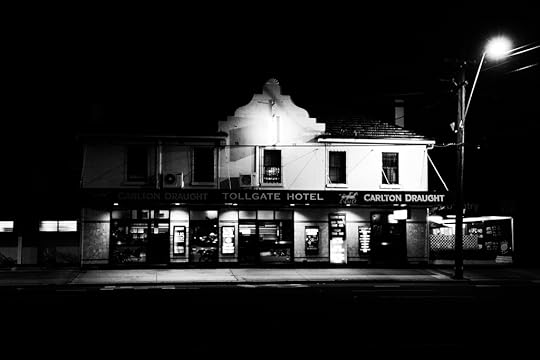
The Tollgate Hotel, Northmead (North Parramatta)


Fading Egalitarianism

While the politics of the working class was based on egalitarianism, that of the middle class is based on aspiration and the acquisition of wealth (or the symbols, badges, logos and marques of wealth).

Even as it is about to die, there is some old style leftist romanticism in the clientele of the Cross:

"Money is shit. Piled up it stinks. Spread out, it’s good fertilizer."

Perhaps there is one time when we are all equal:

"In the meantime it was night, and the different classes equal in sleep."

However, there is a growing sense of inevitability that the traditions of the Southern Cross will not survive:

"The Cross is the past pretending to promise the future…It does not contain the future: that is up the street somewhere, over the hill, around the corner, in the brains of young children, in a pattern of words and objects that no one has recognised yet."

No Place for Women

It’s true, the Cross is no place for women.

Lance (itself a synonym for a penis) goes by the nickname "Meat Man", because of the extent of his physical endowment.

Still, he comes across as a gentle soul who sentimentally decides to document the culture of the Cross in writing.

A bit of a pants man, he speaks tenderly of his sometime girlfriend, a self-employed business woman, as "my darling":

"At her place I made love with her as if I couldn’t be sure I’d ever make love again. As if I was dying tonight and she was going to die tomorrow."

Note that he makes love "with" her, not "to" her.

Still in his mid-twenties, he has much to learn from other women. One tells him:

"You just wait for me. You don’t know how to make love. The more I see of men, the more I like golf."

Although these are the words of another character, he relates to them:

"...I felt humiliated that I didn’t have this toughness that could look calmly on the death of love."

He has a soft, sensitive centre, but a hard exterior.

After the Thrill is Gone

Life at the Cross was always on the edge. You had to be on constant guard. You never knew when you might be king-hit:

"There’s always that one fist you miss, one knee you don’t see."

Still, there was a sense of excitement, of adrenaline coursing through your body:

"I was a healthy animal, I lived a reflex life of hunger, thirst, desire, aggression, revenge; but mostly thirst, with hunger and desire a good second."

However, this is the world that is under threat by aspiration and the debt that acquisitiveness brings with it:

"As I passed I thought of the loss of the characters who made it a pub to be nervous in, to be excited in, to be expectant in, to be wary in, to be drunk in. Now they, its spirit, were gone…I saw a host of young kids leaving off shooting butterflies and learning to drink well and play bad pool."

You have to ask whether we have woken up in a world that is unreservedly better than the old world of the Southern Cross.

No doubt it is for women, but is it any comfort to know that we share the same chains?

Tonight I wasn’t planning on having an alcohol-free night. I’ll probably have a drink at home, where I’ll be relaxed and comfortable and safe.

But something in me will yearn just a little for the Pearl, the Story Bridge and the Southern Cross.

So it is that I’m grateful to David Ireland for putting this yearning into such beautiful words.
Profile Image for zed .
606 reviews157 followers
August 1, 2016
I have read 4 of David Irelands books in the last year and am an unabashed admirer. I recall writing in my review of his The Unknown Industrial Prisoner that I related to a few of the characters in the book from working experiences in factories etc. In the same way I can relate to many of the character's from the Glass Canoe. I have worked with these blokes, I have had the occasional beer with a few of them.

The life that David Ireland wrote about is not as present in Australian cities such as Sydney anymore. Certainly not in Brisbane where I live. In the 1970's though, pubs and their people, Tribes is the label Ireland uses, were common. Plenty of blokes had a regular where they became a tribal fixture, part of the pubs furniture, a subculture. This book is written about that subculture in a Sydney suburban pub called the Southern Cross. It was written at a time that this subculture was being forced to change and also to move. The book in fact highlights that change in some subtle ways that highlight the wonderful observations of the author. As an example the narrator, Meat Man, uses a mixture of Imperial and Metric measurements when telling his tales. All drinking is Imperial. Schooner glasses are 15 ounces. Pot glass consisted of 10 ounces of beer. We even get blokes drinking 5 ounce beers. This is the old lifestyle of the tribe. Drinking for a past they know. But when Meat Man goes to work on the golf course all is metric. He even at times talks metric when driving his car.

For me personally this has been a look into a past world I only caught a glimpse of in my youth. A male mono cultural world, a world that back then was collapsing even if I did not notice that change. Over time this world has almost certainly disappeared in the capital cities of Australia’s states. Those that remember are now old and I suspect unhappy with the present multicultural Australia. The pub they knew is “trendy” and serves “craft” beers. They are even family friendly and are almost like restaurants.

Ireland’s book could now, many years after writing, be considered a historical recognition of that subculture and that in my opinion is very important. Yes it is alcoholic, misogynist and violent with some characters being racist. But all this existed and I for one am glad that Ireland brings life to that world through this superb novel.
Profile Image for Kris McCracken.
1,899 reviews62 followers
August 9, 2013
At the time of its release – 1976 - The Glass Canoe by David Ireland was a Miles Franklin Award-winner and widely acclaimed. Time though seems to have diminished the esteem in which Ireland’s work is held, to the extent that his name sparks only mild recognition among readers today.

Reading the book today, I can see why people prefer to avoid thinking about Ireland’s vision of Australia. This is a book infused with class, filled with ideas seemingly unfashionable to today’s audience. However, this is class without ideological rigidity, expressed in more expressionist tones rather than social realism.

This is an incredibly vivid, brutal book. Yet it constantly astounds the reader with scenes of real lyrical beauty. He does so with a great deal of honesty about a side of Australia that rarely features in our popular notion of ourselves. There is no political correctness in the depictions of men, booze, language and attitude. What makes all this even more startling is the stylistic expression: brief vignettes that experiment with form and narrative structure.

The introduction to this most recent edition (released only a couple of months ago after spending a few decades out of print) sums it up nicely:
It's art, not entertainment; action, not plot. It's the lurking dark beast of fear and beauty at the core of Australian life. It is all we know, and all we seek to put behind us, and all the literary world has struggled to evade and overcome.
It is almost unthinkable that a modern publisher would dare to send The Glass Canoe, stuffed as it is with words of sexism, with prejudice and with brutal, escalating unending violence, out into the world of literary festivals and promotion tours.
I agree with this, which is itself a sad indictment of modern publishing. The Glass Canoe is the least judgmental of books. It depicts horror and beauty. It casts the world of rootin’ and fightin’ every Saturday night into poetry and records it for prosperity.

What I like most about it is the attempt to give literary voice to a certain tribe of Australians. A tribe in a certain time and place that is oft denied or overlooked. Alky Jack – the homeless drunkard with a Socialist heart - lectures the bar,
‘Never be ashamed of being an Australian,’ he'd say. ‘There's plenty just as bad as us in the world.’ ‘Anything can happen. We started off in chains, we do our best when we're not pushed, we pay back a good turn, say no to authority and upstarts, we're casual, we like makeshift things, we're ingenious, practical, self-reliant, good in emergencies, think we're as good as anyone in the world, and always sympathise with the underdog.’
Ireland captures this view, allows the reader to savour it, and subverts it straight away. There is love and irony in almost every word, and for those of us with some experience of the Australia captured in the book it's hard not to feel that there is something of Australia is in your hands. Perhaps it’s an old Australia, an Australia that we might well like to see the back of (although if you know anything of the drinking culture in this country I wouldn’t be certain of writing the obituary just yet).

This book will not be to everyone’s taste. The casual sexism and racism will deter many, to their loss. I couldn’t recommend it more highly myself.
Profile Image for Benito.
Author 6 books14 followers
October 3, 2013
Just loved this book. Devoured it like a schooner after mowing a summer lawn. Now, my girlfriend tells me it's misogynistic. I disagree. Some of the characters are sexist dinosaurs by today's standards. I mean, it's a book about a racist, sexist, homophobic world - 1970s Australian pub culture. It'd be mendacious to paint it as anything but. However the narrator's romantic beer goggles looking back lend the book a poetry that I only wish more Aussie bar flies harboured today. But what would I know...
2,841 reviews75 followers
May 23, 2024
3.5 Stars!

“I went to the bar to get us a small fleet of glass canoes to take us where we wanted to go.”

Depicting the harsh, gritty lives of not so young(ish) men and women in the Sydney suburbs, where drink is the common glue that binds them and the universal currency they trade in. This is a kind of the literary equivalent Billy Joel’s “Piano Man” but via Jimmy Barnes with a pinch of Peter Carey.

Ireland’s writing is spiky and spare filled with real Ocker terminology which isn’t always fun to read or easy to understand, but of course that’s what gives it such authenticity, and with Ireland coming from a similar background, he certainly knows his characters or people very like them.
These chapters are often mere vignettes and snapshots, put together they slowly begin to form a convincing bigger picture of complex repression, quiet desperation and toxic masculinity.

I've probably read countless books like this, which explore places just like this is many parts of the world and this isn't necessarily one of the better ones. Initially this seemed a little shallow and one-dimensional and I wondered where it was going, but as we got deeper into it and the characters began to reveal more of themselves then I could see what Ireland was doing and how well he was doing it.
Profile Image for Jon Clay.
21 reviews2 followers
November 2, 2022
Tough Guy Book Club - October 2022
A fascinating insight into social and class in Australia, focusing on our most holy of locations - the pub. Interesting Australian Gothic themes placed throughout some typical goon behaviour and the prophetic ramblings of Alky Jack. Not to mention that bloody keg...
Profile Image for David.
638 reviews131 followers
June 28, 2010
I'm a famous writer in Australia.

The "glass canoe" of the title is Meat Man's beer glass, which takes him and his drinking buddies on journeys to the questions we all ... sorry, I can't finish that sentence. Anyway, this is about Australian idiot savants, some with larger than average penises, getting drunk. Whilst they don't say anything very interesting, they manage to not be too annoying or pretentious. They also do a fair bit of fighting, shagging, etc. I quite liked it. Some of it didn't work (the kids witnessing a car accident and behaving as if they were watching TV. I guess that might have been edgy in the 70s). But I quite liked Meat Man, going on about his little mysteries and his massive cock.
Profile Image for Nancy.
1,277 reviews54 followers
January 27, 2018
#MagicSquareChallenge
Finally finished this quirky book by a renowned Australian author.
The book won the Miles Franklin Award 1976.
Cheeky, barfly humor....but David Ireland had difficulty
sustaining my reading pleasure. Ups and downs...and some good laughs!

Review

Profile Image for Chiel Groeneveld.
86 reviews3 followers
November 4, 2022
*spoiler free*

There are things to like and dislike about this book. It's a collection of stories and characters from a pub in Sydney in the 70s. A pub that's decidedly working class drunks and so are the tales and woes.

It sometimes feels a bit Bukowski here and there, but then without a real storyline or arc. But maybe that was the main idea behind this novel.

The main character Meat is telling the story and he is telling the stories as he has seen and remembered them, without opinion or judgement on any of the characters, which is his one redeeming factor, and also one of the redeeming factors of this book.

I didn't mind the read, but it's not a book I'd recommend. There are better ones like this out there.
Profile Image for John.
193 reviews28 followers
November 8, 2022
Three and a half stars. I am not convinced about the style of the book, but inventively written, with some quite unforgettable scenes.
Profile Image for Milan Romić.
29 reviews
November 2, 2022
It's a strange one, while I didn't love this book I certainly liked it a lot more than expected.

Everything about the book is a contradiction, as in, the characters are all deadbeats - but likeable, the writting style is scattered - yet makes sense, the subject matter is vulgar - yet very poetic in it's own way.

The book stands the test of time and worth a read but it's certainly deeper than I thought it would be and adds another one on the shelf that proves time and time again that Australian literature is very underatted.
Profile Image for Geoff Wooldridge.
919 reviews1 follower
February 16, 2018
Let me start by saying that I really liked this book, and I feel that I have discovered another great Australian writer whose work I have not read before.

But I do wonder about the breadth of its appeal today. Firstly, I can't imagine that many women would enjoy this novel, with its blue-collar male environment set in the front bar of a rough pub where the only women welcome are barmaids and prostitutes.

Secondly, I wonder if anyone but an Australian, or perhaps a British man, could relate to this tale of booze and skiting that is so quintessentially Australian in its character.

And thirdly, I wonder whether anyone born after the 1960s would recognise, or find believable, the hotel environment that Ireland describes, which has now all but disappeared except maybe in a few backstreet pubs in working class suburbs.

None of this is to diminish or any way denigrate the fabulous quality of Ireland's spare, visceral and sinewy prose and the brilliance with which he has captured the ambience, culture and glorious characters of the time and place of which he writes.

The fact that I am an Australian male born before 1960 means that I have seen it, experienced it (up to a point) and can appreciate the literary achievement in this novel which was awarded the 1976 Miles Franklin prize.

Ireland sets his novel in the Southern Cross Hotel in a working class suburb of Sydney. The characters who inhabit this pub, seemingly for many hours a day on most days of the week, are true boozers, who love to travel in their imaginations to places unknown via their glass canoes (beer glasses).

Some hold down a job, some play sport and have some sort of meaningful life and human relationships outside of the front bar, and others are devoted alcoholics and degenerates who are almost never sober.

The story is narrated by Meat Man (real name Lance), whose nickname is a none too subtle reference to the alleged size of his manhood.

Through a series of very short, sometimes only half a page, chapters, Meat Man introduces the reader to the multitude of characters he drinks with and describes some of the crazy escapades and shenanigans they get up to, both inside and outside the bar, some of which are legal and some which are not.

There are too many characters to mention them all, but one who stands out is Alky Jack, the local alcoholic resident philosopher. One really fine example of Ireland's brilliant and evocative descriptive prose, which he uses sparsely, comes with this introduction to Alky Jack. "Behind his eyes were stores of scenes and images. A lot of the images were words. His bottom eyelids had come loose and swung out, red and full of liquid. His hair was ashes, hands crawling with frogskin, face dried out like plums bathed in caustic, left in the sun and wrinkling into prunes. When he turned his head, the back of his neck wrinkled like a tortoise."

If I had one complaint about the many excesses described in this story, it would be about the female characters.

By today's standards, it is probably misogynistic, certainly disrespectful and demeaning. But it can be argued that Ireland captured, fairly accurately, the attitudes of the time amongst this class of males.

But the scenes involving sex were generally exaggerated to the point of being comically grotesque, and virtually all women were portrayed as being voracious, kinky and sexually insatiable.

Even Meat Man himself, who had a steady female companion. who he referred to only as "my darling", and on whom he cheated sexually at every opportunity, described his "darling" as being so 'eager' that it defied reality.

But this is a novel worthy of a major literary award, despite my reservations about the breadth of its relevance in the 21st century.

Ireland sums up beautifully the world these men are content to inhabit, despite any disdain from more genteel elements of society, in the novel's penultimate paragraph.

"I went to the bar to get us some more glass canoes to take us where we wanted to go. I thought of the tribes across Australia, each with its waterhole, its patch of bar, its standing space, its beloved territory. It was a great life."

Profile Image for Lisa.
3,796 reviews492 followers
September 8, 2014
David Ireland, AM, born 1927 and author of ten novels, has the rare distinction of having won the Miles Franklin Award three times, for

The Unknown Industrial Prisoner in 1971
The Glass Canoe, in 1976, and
A Woman of the Future in 1979.
There isn’t very much about him on Wikipedia, which - as Nicholas Rothwell suggests in the introduction to the recently reissued edition of The Glass Canoe* - might be because Ireland went out of literary fashion, because the literati has abandoned his brand of realism.

The Australia that Ireland wrote about still exists, says Rothwell,, but is

safely cordoned off, far from where books are read, and the books that once portrayed that other Australia are no longer seen as central to our literary life.

Ireland’s world in The Glass Canoe is ‘stuffed … with words of sexism, with prejudice and with brutal, escalating, unending violence’ incompatible with the Establishment’s ‘other, gentler books, with attitudes that did more to polish the moral virtues of the reading class’.

But now the days when Ireland was admired, and celebrated, not just as the hard voice of the people but as the chronicler of that world’s demise are gone. He hasn’t published anything new for ages.

When I posted a Sensational Snippet from The Glass Canoe a couple of days ago, I discovered that there are David Ireland enthusiasts out there who share my fascination for this author’s writing. Now that I’ve finished the book, however, I do think it’s a problematic novel.

Implicit in Rothwell’s analysis, it seems

To read the rest of my review please visit http://anzlitlovers.com/2013/01/09/th...
Profile Image for Ian.
42 reviews6 followers
May 29, 2014
A reflective book full of the vernacular of Australian men of a certain era. The passing thoughts of a man with no imagination for his spare time other than drinking beer and getting into the occasional blue. Yet, he has thoughts, passing thoughts and insights that make the time you spend with him out of the pub almost more interesting than the parts where’s he describing his tribe swimming in a sea of beer.

Plot-wise, there isn’t much. I’m OK with that mainly because I enjoyed the writing and the random observations and dialogue so much. When the plot starts to coalesce about a third of the way through the book, it briefly intrigues but unfortunately splutters out at the end in some contrived scenes that don’t seem to fit with the whole book.

Even so, this is now a favourite piece of Australian literature for me. It is and honest and unflinching gaze upon pub culture that doesn’t shy away from the misogyny of these blokes and avoids romanticising a way of life that avoids living in the real world.
Profile Image for ZackReads.
57 reviews2 followers
May 13, 2023
Ireland's The Glass Canoe is an interesting insight into the Australian pub environment from several decades ago, full of different people's stories and experiences from the narrator's perspective. This was a great text to read with a focus on the working-class Australian, with themes ranging from violence and hopelessness, to friendship and resiliency. It was an emotional experience with many twists and turns, and the fact that this text was exclusively set in an all-male environment can both be a confronting and an interesting set of stories.

Worth the read, but I think that this text may be hard for a fair amount of people to engage with.

(Love a good keg when they're useful)
Profile Image for Ilyhana Kennedy.
Author 2 books11 followers
November 10, 2015
This book is an experience of a pub culture in Australia some decades ago. Perhaps in some places in Australia, it still exists. Drugs are the destroyers of choice as much as alcohol now.
It's a story of violence and camaraderie, of hopelessness and bliss, of misogyny and of loving respect, of both destruction and resilience. Some pages are really difficult to take in and I wished I hadn't read them.
There's no real plot to the book, just as there's no real plot to the lives of the people it describes. They just go on.
In a strange way, it's a classy piece of writing, and well deserving of the award it attracted. Great reading but not for everyone.
Profile Image for Corey.
35 reviews
October 29, 2021
This book appeals to my sensibilities, perhaps, because of how much I miss the pub.

A mixed bag of an emotional rollercoaster told through the idiosyncrasies of the pub regulars in bite-sized chunks.

Maybe a little heavy on the male machismo (in regards to drink, sex, and violence), so probably avoid if you take specific exception to that.
Profile Image for Adrian.
53 reviews4 followers
January 29, 2013
An interesting look at 1970s pub culture in Australia. It's a bit hard to understand some of the phrases - they're just a little archaic now - but overall a good read if you like episodic, slice of life literature.
Profile Image for Text Publishing.
715 reviews288 followers
January 24, 2017
‘In a flash of inspired vision David Ireland has perceived that the real centre of Australian life…is the pub…which the novelist demonstrates and enlarges upon with great verve and menace and macabre humour.’
National Times
Profile Image for Peter.
318 reviews150 followers
March 29, 2024
More irreverent working class reading material from the 1970s by the Australian ragged-trousered master David Ireland himself! The scene is an old-fashioned pub in western Sydney, the Southern Cross in The Mead (Northmead, Westmead, etc.), and the vices are alcohol, sex, and violence. As usual with Ireland, the tone is authentic Aussie battler, with here and there a touch of sensitivity and erudition thrown in for free.

By today’s standards this book is “confronting” (woke speak), but to me it is also refreshingly honest and straightforward: from the hip as it were. Many scenes are truly shocking -meant to be shocking- in a way similar to Irvin Welsh’s early books minus the drugs, although Welsh started writing about 20 years later (I wonder if Welsh has read Ireland?). Despite the vice and mayhem, Ireland still manages to write with humour and there are some great characters and metaphors (one is the title!) in this book. Of course he is not afraid to lace the narrative with some juicy left-wing politics and philosophy, either. There are also some beautiful moments in the book, mostly connected with the main protagonist’s (Meat Man) job as a green keeper at a golf course (Ireland himself apparently worked as a green keeper for a while - he must have liked it!).

Like all of Ireland’s writings, this book must have come as a bit of a bombshell to the literati in Sydney, who were ever so refeened in the 1970s. Obviously they didn’t know what to make of it so decided to throw literary awards at it! What a shame Ireland is almost forgotten, even in Australia: my local library and bookshops have no books of his and the staff have obviously never heard of him. To be perfectly honest, neither had I until I unearthed his masterpiece “The Unknown Industrial Prisoner” recently. I think that’s partly because his writings don’t conform to our contemporary concept of modern Australia, where much of the old working class (“what working class?” I hear you cry) culture has now been “gentrified” (as they say disingenuously). But don’t be fooled: it may not have a voice any longer but it’s still lurking there beneath the surface in all its monstrous political incorrectness and general crassness!
Profile Image for Tom Mooney.
917 reviews409 followers
June 28, 2018
THE GLASS CANOE by David Ireland.
This isn't really a novel but a long string of vignettes about hard drinking, fighting, shagging and the codes of silence among drinkers in a Sydney pub in the 70s.
While I didn't dislike the book, I did dislike the characters; while the writing hasn't dated, the characters have.
These people would have little traction in today's literary world. They have little in way of endearing features, are incredibly sexist and quite racist. They are obsessed with the size of their own and eachothers' cocks.
I guess it was a different time when this won the Miles Franklin but I doubt it would get published today.
It made me happy the world of pubs and boozing is in decline because the characters' lives seemed incredibly shallow and sad.
Profile Image for Thom Gibney.
158 reviews1 follower
February 28, 2023
Beers, girls and fights. David Ireland captures the thuggish vernacular of the Sydney pub scene in the 1970s and its characters like Irvine Welsh captured the Heroin scene in 1990s Glasgow.

'The Glass Canoe' is a deep dive into a world of violence, alcoholism and questionable moral relations. The most intriguing character (and the most distinct) is the academic 'Sibley' who applies an anthropogenic lens when psychoanalysing the central pub's regular patrons. I can't help but imagine David Ireland similarly taking handwritten notes taking an outsiders perspective to the comedy, tragedy and drama that plays out in the local pub.
Profile Image for Anna.
288 reviews20 followers
June 19, 2024
The writing was so good, I got hooked from the first lines. It's a beautiful book about people, friendships and love, tragic and hilarious stories. I was surprised by how many women seemed to be ok with group sex in the book, but then I remembered that all these are stories that guys in their mid-twenties are sharing with their mates in the pub, so not that credible. Lots of sex scenes though, porny, awkward, terrifying and hysterically funny. Never mind all the drinking and fighting - that was just how they socialised and kept in touch (sometimes literally :-D).
Profile Image for Brendan Brooks.
524 reviews5 followers
March 17, 2025
I devoured The Glass Canoe and enjoyed it as much as a cold schooner on a hot afternoon. I’ve always been fascinated by what I think of as Australian Pub Culture, and this novel captures a time and place that has all but disappeared. Some of its remnants I’ve both enjoyed and suffered from.

The writing is raw, unapologetic, and deeply male-centric—very much of its era—but there’s something hypnotic and beat-like about the way Ireland brings this world to life. It’s brutal, poetic, and full of characters who feel both larger than life and painfully real. I lapped up every word.
2 reviews
January 20, 2026
A thoroughly dark and entertaining book chronicling the life, misery and joy of meat man and his fellow drinkers as they live in the Southern Cross hotel. Through a series of vignettes Ireland paints an incredibly rich and complicated picture of a time gone by in Australian culture. The book is both endearing and grotesque and is somehow what I imagine these pub flies would be like. The writing is mater of fact, but beautiful and i thoroughly enjoyed reading it!
Profile Image for Wayne.
408 reviews1 follower
November 25, 2023
Who in heavens voted this rubbish the Miles Franklin Award Winner? I struggled through 100 pages of absolute crap. I only hope the next book I read from from this author "The unknown industrial prisoner " is more worthy. 2 stars for costing me only $11 from Amazon.
300 reviews
May 22, 2017
It may be a cameo of pub life in the 70s but I hope it's not representative of wider Australia - or maybe it is?
Displaying 1 - 30 of 44 reviews

Can't find what you're looking for?

Get help and learn more about the design.