

What do you think?

Winslow Homer
Briefly describes Winslow Homer's life and career, shows fourteen of his major paintings, and includes comments on their composition.
- GenresArtNonfiction
24 pages, Paperback
First published January 1, 1962
About the author
Nicolai Cikovsky Jr.
19 books1 followerNicolai Cikovsky Jr. was an art historian who became a curator at the National Gallery of Art, where he took a leading role in organizing several major exhibitions.
Ratings & Reviews
Friends & Following
Create a free account to discover what your friends think of this book!
Community Reviews
Displaying 1 - 5 of 5 reviews

February 23, 2020
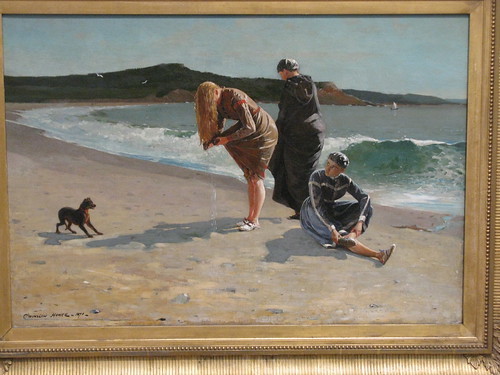
Eagle Head,Manchester, Massachusetts (High Tide), 1870
Metropolitan Museum of Art, New York City
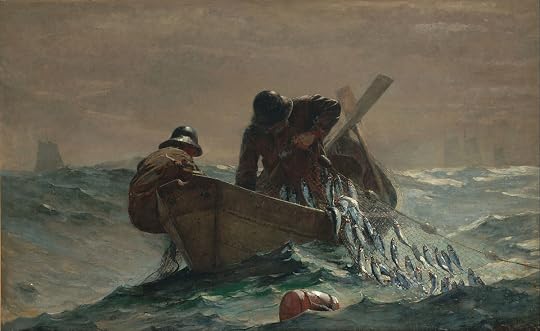
The Herring Net, 1885
Art Institute of Chicago
Winslow Homer is undoubtedly one of the foremost artists of the United States in the 19th century. He was largely self-taught. His paintings cover a wide range - from the Civil War to rural hamlets and a multitude of seascapes with the ocean and fishermen and fisherwomen as prominent subject matter.
His paintings avoid the overly dramatic. There is often an enigma about them. None of his paintings are particularly large. I wonder how deliberate this was – as he was in the business of selling his paintings to private individuals in art galleries. He was a master of both oil and watercolors.
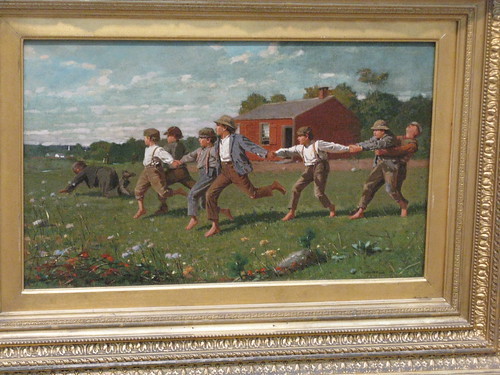
Snap the Whip, 1872
Metropolitan Museum of Art, New York City
The text is on the whole very readable (I found the chapter on the Japanese influence “Innovation in Homer’s Late Watercolors” overly technical). There are hundreds of colour illustrations of Homer’s paintings in this book with enlightening commentary. One can see a Japanese influence on Homer’s paintings. But this was also common in many European painters of the era.
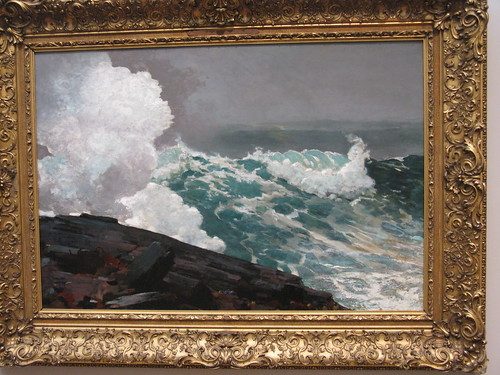
Northeaster, 1895
Metropolitan Museum of Art, New York City
In his later life Homer lived the last thirty years in the rather isolated community of Prout’s Neck, Maine (he was raised in Boston and then moved to New York City). It is speculated that he wanted to recover from a failed love affair. He was also quite sensitive to the criticism of his paintings, some of which was quite scathing. So possibly Prout’s Neck was an escape from this. He became somewhat of a misanthrope and possibly a misogynist. But it should be emphasized that several of his paintings feature strong, forceful, and active women.
He did travel extensively, leaving Prout’s Neck during the winter for trips to Florida, the Bahamas, and Bermuda. Also, he visited extensively in the Adirondack mountains of New York State and went to northern Quebec (the Saguenay river area). He went to Cullercoats, England where he was inspired to do many wonderful paintings. In fact, most of places he visited would be in his paintings.
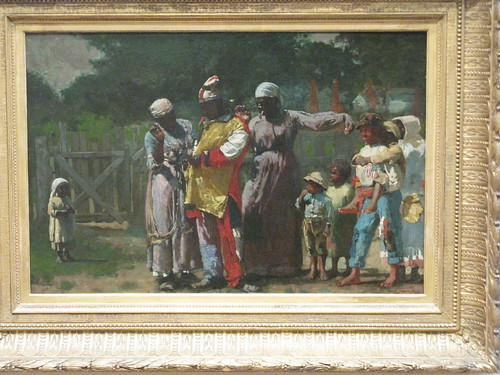
Dressing For the Carnival, 1877
Metropolitan Museum of Art, New York City
This is a wonderful book on the paintings of Winslow Homer. He was a rather secretive individual – so the emphasis is on his remarkable output.
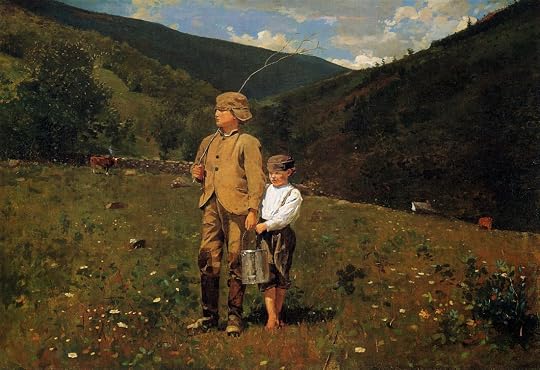
Crossing the Pasture, 1871-72
Amon Carter Museum of American Art

July 28, 2010
Decent review of Homer's art and where it stood within his life and the world around him. I really enjoyed discovering the differences in the artist's use of oils and watercolors, along with the constant themes of death and nature. Excellent beginning on my study of Homer.

April 28, 2018
An oversized beautifully printed book by the National Gallery of Art focusing on the work of American artist, Winslow Homer. I am selling my copy and listing it as "read" since it's leaving the house. If you want to learn about Winslow Homer, I'd put this book on the top five for research.

August 2, 2011
This was a nice overview of Homer's oils and watercolors, with insights on how the two media related to one another. I would have like to see some figure numbers or an art index, though, to help me find the pieces referred to.
September 1, 2015
Nice overview of Winslow Homer's work and life.
Displaying 1 - 5 of 5 reviews