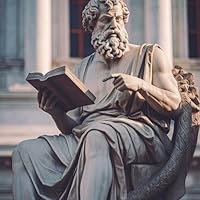
Né en 354 à Antioche, saint Jean Chrysostome est contemporain de Saint-Augustin. Son nom, "Bouche d'Or", célèbre ses dons légendaires de poète et d'orateur. Il prêcha avec ferveur la réforme des moeurs, insistant sur la nécessité pour chacun de conformer sa vie au nouvel idéal chrétien. Le grand théologien déploie ici tous ses talents de pasteur mais aussi de polémiste contre ceux qui ont la prétention de connaître Dieu, le réduisant à leurs courtes vues et à leurs faibles concepts ; il dénonce ce danger toujours actuel de "faire de l'Être un avoir". Faire du Dieu vivant une puissance ou une énergie que l'homme pourrait acquérir ou posséder, ce n'est pas être croyant mais idolâtre. Dans sa présentation, Jean-Yves Lelou met en évidence l'importance du thème de l'indicibilité dés choses divines, thème qui présidera à la démarche dite "apophatique" de toute une partie de la mystique chrétienne, et à la théologie dite "négative".
John Chrysostom (c. 347–407, Greek: Ἰωάννης ὁ Χρυσόστομος), Archbishop of Constantinople, was an important Early Church Father. He is known for his eloquence in preaching and public speaking, his denunciation of abuse of authority by both ecclesiastical and political leaders, the Divine Liturgy of St. John Chrysostom, and his ascetic sensibilities. After his death in 407 (or, according to some sources, during his life) he was given the Greek epithet chrysostomos, meaning "golden mouthed", in English and Anglicized to Chrysostom.
The Orthodox and Eastern Catholic Churches honor him as a saint and count him among the Three Holy Hierarchs, together with Basil the Great and Gregory Nazianzus. He is recognized by the Eastern Orthodox Church and the Catholic Church as a saint and as a Doctor of the Church. Churches of the Western tradition, including the Roman Catholic Church, some Anglican provinces, and parts of the Lutheran Church, commemorate him on 13 September. Some Lutheran and many Anglican provinces commemorate him on the traditional Eastern feast day of 27 January. The Coptic Orthodox Church of Alexandria also recognizes John Chrysostom as a saint (with feast days on 16 Thout and 17 Hathor).
John is known in Christianity chiefly as a preacher, theologian and liturgist. Among his homilies, eight directed against Judaizing Christians remain controversial for their impact on the development of Christian antisemitism.
A profound masterpiece of Patristic literature. In these homilies, St. John Chrysostom masterfully navigates the boundaries between human reason and Divine mystery.
Writing against the Anomoeans, Chrysostom argues that God's essence is fundamentally incomprehensible—not because of a lack of clarity, but because of the sheer transcendence of the Divine nature. His eloquence (as the 'Golden-Mouthed') is on full display here, combining rigorous theological defense with a deep pastoral concern.
What struck me most was his distinction between knowing that God exists and knowing what God is (the essence). This work is not just a historical relic; it is a vital reminder of the humility required in any theological or philosophical pursuit. A must-read for anyone interested in early Christian thought and the concept of Divine Incomprehensibility.
An excellent defense of God's incomprehensibility, with Arian Anomoeans, theological children of the heretic Eunomius as his foil. Here, we see a clear exposition of Scripture on the golden-mouth's part in his desire to protect the church against the false teaching of the Anomoeans, who asserted that they fully knew or, at the very least, could know God's essence. Peppered throughout is sound pastoral exhortation. Definitely one of the best reads of the church fathers in my opinion.
This is the answer for a question that popped up plenty of times in our minds WHY?? Why did he die young Or why did this accident happened ? Why was that kid born disabled? And so on It's mainly against anomoeans but still can be used toward many heretics and in any era