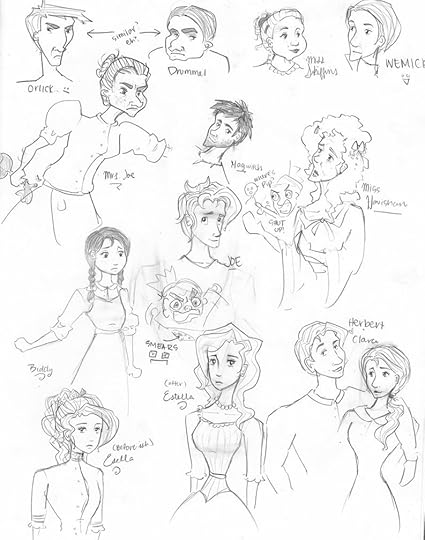
During quarantine, I read Great Expectations by Charles Dickens and I fell in love with the story. I had been searching for slightly challenging books when I came across some Charles Dickens books in a local thrift shop after I quickly checked the price of the books online I bought the books from the thrift shop, they may be old, but that didn’t mean they weren’t as valuable and the stories were just to be abandoned. I was told that there were usually two types of people when reading Charles Dickens, those who like Great Expectations, and those who prefer ‘A Tale of Two Cities’ I soon found out I prefer Great Expectations.
When you pick up an old-timey book you expect it to be dry in entertainment and quite lengthy, this was not the case at all, for a book that was written a while ago it still contains a rich story and draws the reader in for more. The first couple pages were filled with action, Dickens was not playing around while writing this piece he had painted the main character, Pip, it wasn’t just as if Pip was telling us his story, it was as if the reader was there watching as the story unfolds it really helps the reader feel the type of emotions Pip is feeling and the type of tone the author is trying to get across. The book was quite lengthy but it adds to how much the author could develop the characters, The character development was absolutely astonishing, we watch how much time passes and how much the characters change over time, Pip's expectations at first aren’t too large as at the beginning of the book he isn’t that happy with himself, but over time pip finds himself and has grown so much by the end of the book he changes very much and isn’t seen as the same person. In the book it states, “Day by day as his hopes grew stronger and his face brighter, he must have thought me a more and more affectionate friend, for I had the greatest difficulty in restraining my tears of triumph when I saw him so happy. At length, the thing being done, … I did really cry in good earnest when I went to bed, to think that my expectations had done some good to somebody.” Pip learns that he’s more than what he sets himself out to be.
Truly speaking there is not much that I would add to this book, it was extremely detailed in all the right places, it was simple yet complex, the only critic I could even think of is that sometimes Dickens would over-describe his characters so they could be remembered from week to week and month to month, once he described something in the book it was hard to forget about it. I always knew the characteristics of the characters when I opened the book up to read, I often found myself closing the book with the the “. . . a man who had been soaked in water, and smothered in mud, and lamed by stones, and cut by flints, and stung by nettles, and torn by briars; who limped, and shivered, and glared, and growled; and whose teeth chattered in his head as he seized me by the chin.”
While reading this book, I found that it would be a good fit for people who were looking for a challenging book to read, like myself, but who also may have a short attention span. There was no time in the book that I became disinterested. There was always something new that grabbed my attention as it was slipping off. Although it was a challenge, it was a challenge that I enjoyed with every turn of the page.