

What do you think?
Postmillenial Pop
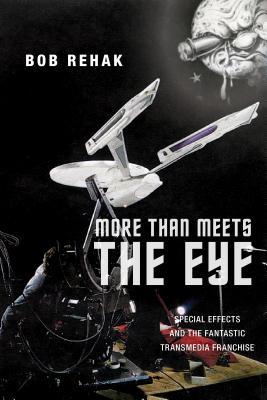
More Than Meets the Eye: Special Effects and the Fantastic Transmedia Franchise
A rare look at the role of special effects in creating fictional worlds and transmedia franchises
From comic book universes crowded with soaring superheroes and shattering skyscrapers to cosmic empires set in far-off galaxies, today’s fantasy blockbusters depend on visual effects. Bringing science fiction from the studio to your screen, through film, television, or video games, these special effects power our entertainment industry. More Than Meets the Eye delves into the world of fantastic media franchises to trace the ways in which special effects over the last 50 years have become central not just to transmedia storytelling but to worldbuilding, performance, and genre in contemporary blockbuster entertainment.
More Than Meets the Eye maps the ways in which special effects build consistent storyworlds and transform genres while traveling from one media platform to the next. Examining high-profile franchises in which special effects have played a constitutive role such as Star Trek, Star Wars, The Matrix, and The Lord of the Rings, as well as more contemporary franchises like Pirates of the Caribbean and Harry Potter, Bob Rehak analyzes the ways in which production practices developed alongside the cultural work of industry professionals. By studying social and cultural factors such as fan interaction, this book provides a context for understanding just how much multiplatform storytelling has come to define these megahit franchises. More Than Meets the Eye explores the larger history of how physical and optical effects in postwar Hollywood laid the foundation for modern transmedia franchises and argues that special effects are not simply an adjunct to blockbuster filmmaking, but central agents of an entire mode of production.
From comic book universes crowded with soaring superheroes and shattering skyscrapers to cosmic empires set in far-off galaxies, today’s fantasy blockbusters depend on visual effects. Bringing science fiction from the studio to your screen, through film, television, or video games, these special effects power our entertainment industry. More Than Meets the Eye delves into the world of fantastic media franchises to trace the ways in which special effects over the last 50 years have become central not just to transmedia storytelling but to worldbuilding, performance, and genre in contemporary blockbuster entertainment.
More Than Meets the Eye maps the ways in which special effects build consistent storyworlds and transform genres while traveling from one media platform to the next. Examining high-profile franchises in which special effects have played a constitutive role such as Star Trek, Star Wars, The Matrix, and The Lord of the Rings, as well as more contemporary franchises like Pirates of the Caribbean and Harry Potter, Bob Rehak analyzes the ways in which production practices developed alongside the cultural work of industry professionals. By studying social and cultural factors such as fan interaction, this book provides a context for understanding just how much multiplatform storytelling has come to define these megahit franchises. More Than Meets the Eye explores the larger history of how physical and optical effects in postwar Hollywood laid the foundation for modern transmedia franchises and argues that special effects are not simply an adjunct to blockbuster filmmaking, but central agents of an entire mode of production.
256 pages, Paperback
Published March 13, 2018
Ratings & Reviews
Friends & Following
Create a free account to discover what your friends think of this book!
Community Reviews
Displaying 1 - 3 of 3 reviews

August 4, 2021
...special effects have long possessed histories, identities, and continuities that extend beyond the onscreen shots and scenes in which we first encounter them.
I LOVED THIS BOOK.
I did not expect to be this enthused about Bob Rehak's 2018 contribution to NYU Press' Postmillenial Pop Series. What worked for me, as someone with no background in film or media studies, was that Rehak's focus on mega popular media properties and the popular narratives circulated about them in mainstream media provided easy points of familiarity from which he could launch his main arguments.
Popular media reports SFX within an industrial framework. It's about the biggest Holywood studios competing to provide the flashiest spectacle in conjunction with specialised companies like Industrial Light and Magic. Pulling from French film theorist Christian Metz's writings, Rehak showed that how *we* think and talk about what appears on the screen influences what is categorised as a special effect or not; and with that determination of what is "special" and therefore an unreal or fake effect, and what is seen as real and therefore authentic. Rather than rely on a seemingly easy split of SFX being whatever is done on a computer vs what is created on a film set, he prefers to think of them as"degrees of intervention" in what we see on screen. With that understanding, the reader is primed to shift to thinking of SFX as an influential narrative tool that can not only build a franchise but have life outside, travelling through different kinds of media.
One of the most interesting questions Rehak raised for me was how one thinks about authorship when it comes to a particular style or even franchise in light of the complicated process and multiple persons that enable them to come into being. I can't get into all the good things. There's much about what *really* is responsible for Star Trek's longevity. George Lucas: auteur or master of his own plagiarist realm? With a new Matrix on the horizon the chapter on that bullet SFX and why the sequels flopped is especially relevant. What do audiences want from SFX? I need to shut up but this is, by far, the coolest book I'll read this year. If this sounds at all like your thing, go get it!
I LOVED THIS BOOK.
I did not expect to be this enthused about Bob Rehak's 2018 contribution to NYU Press' Postmillenial Pop Series. What worked for me, as someone with no background in film or media studies, was that Rehak's focus on mega popular media properties and the popular narratives circulated about them in mainstream media provided easy points of familiarity from which he could launch his main arguments.
Popular media reports SFX within an industrial framework. It's about the biggest Holywood studios competing to provide the flashiest spectacle in conjunction with specialised companies like Industrial Light and Magic. Pulling from French film theorist Christian Metz's writings, Rehak showed that how *we* think and talk about what appears on the screen influences what is categorised as a special effect or not; and with that determination of what is "special" and therefore an unreal or fake effect, and what is seen as real and therefore authentic. Rather than rely on a seemingly easy split of SFX being whatever is done on a computer vs what is created on a film set, he prefers to think of them as"degrees of intervention" in what we see on screen. With that understanding, the reader is primed to shift to thinking of SFX as an influential narrative tool that can not only build a franchise but have life outside, travelling through different kinds of media.
One of the most interesting questions Rehak raised for me was how one thinks about authorship when it comes to a particular style or even franchise in light of the complicated process and multiple persons that enable them to come into being. I can't get into all the good things. There's much about what *really* is responsible for Star Trek's longevity. George Lucas: auteur or master of his own plagiarist realm? With a new Matrix on the horizon the chapter on that bullet SFX and why the sequels flopped is especially relevant. What do audiences want from SFX? I need to shut up but this is, by far, the coolest book I'll read this year. If this sounds at all like your thing, go get it!

August 17, 2018
This book discusses a fascinating topic and the author has clearly spent a great deal of time researching the subject matter. Unfortunately, the author’s writing style is dry. As a result, the information often comes across as dull. It all comes down to the presentation since the actual information and background into the making of dozens of popular movies is fascinating.

September 20, 2019
Elegantly written and theory-driven analysis of the central role played by visual effects in transmedia franchises. It lost me in the last chapter, which employs an oddly convoluted and weirdly repetitive argument to develop what feels like a rather inconsequential idea. But the book as a whole is very much worth reading for its nuanced and literate approach to effects work.
Displaying 1 - 3 of 3 reviews