An eight-block walk to school becomes an exciting safari, as water hole, desert, river, trading post, and more must be passed before the mountain (the school steps) are reached
A story about a girl's walk to school and how she sees things through a child's eye. Reminding us to stop and smell the roses before we are blind to the beauty and mystery around us everyday.
Great book! Drawings that resembles an animal is good and interactive when reading for my boy. He's very interested and i'm glad that there's pictures and animal names at the end of the book.
One of my all-time favorite picture books. I love the illustrations of "dangerous animals" right outside the door of their house and all the way to school. And the imagination of the girl as she walks give her quite an adventure. I remembered seeing this book a couple of decades ago, but I couldn't remember the title or author. Bless the reference librarian who helped me track it down, and bless those who resell older books that still have a lot of life in them.
I really enjoy Ann Jonas's "The Trek". It talks about a young girls's short trip from home to school, as seen from her eyes. As she leaves, saying goodbye to her mother, she comments that she has recently been allowed to walk to school by herself, which she almost finds surprising, considering, in her own words "we live on the edge of a jungle". However, we clearly see that she lives on a normal street in a normal city. On her journey she passes houses and parks and stores, and all of them look normal. However, with a closer look (and with help from the girls commentary), we start to see animals pop out from the scenery. White bushes turn into sheep, and bushes become bison. We even see trash bags as rhinos. Now, none of these animals are explicitly there, they always appear as parts of the natural scenery, however, for the girl, they are an active part of her trek from home to school. Eventually, she is joined by a friend, and, after crossing a perceived desert, river and mountain, they arrive at school.
Part of what makes this book so fun is that we get to see the world as the girl sees it. As I said before, the animals are not explicitly in the illustrations. Spiders are actually spikey leaves at the end of vines, and giraffes are cobblestone fireplaces. A bit of shading on some bushes turn them into gorillas, and large bulky trees appear to be elephants. This mix of the seen and the implied is a great way to show how we view the world when we imagine. We know that the things we imagine aren't completely there, but they exist as a semi-part of reality. We can see them as they are to us, but also as they are to the rest of the world. Seeing things this way helps us make more sense of what kids may experience when they play pretend. It is an interesting way to show the feel of this type of play, and I think that it captures the essence rather nicely. The text provided by the girl as narrator also helps draw us into her world. She doesn't say that she is imagining the animals. In fact, she comments about them as though they were very real. She casually comments on how crowded a waterhole is (actually a pond in a park), and what will happen when the herd of elephants gets there. When she encounters a small stream of water coming from a hose, she says "We missed the boat! Now we'll have to swim across the river." All of these simple yet descriptive sentences help draw us into her world, which is the most pleasing thing about the book.
I also appreciate what Jonas has done with color in her illustrations. The young girl and her friend wear tan clothing, which makes them look like African adventurers on safari! We can tell immediately what is going on with the characters even though we have had little exposition. This simple color choice helps us see them as we should. However, the tan clothing does cause them to blend into the background sometimes, which is why Jonas gave the girls lunchboxes. The friends' lunchbox is white, which doesn't do much to help us find her on the page. However, the main character's lunchbox is a bright, vibrant red color. This color shows up immediately on whatever page it is found and so, even if the girl's clothes and the background are roughly the same color, we can always locater her (and her friend because, well, they are always standing next to each other). More creative uses of color are found (especially in relation to the animals hidden in the pictures), but I found this use the most interesting and noteworthy.
"The Trek" is a timeless picturebook that brings delight to both young and old readers, and I highly recommend it for any library (domestic or public).
“The Trek” is a book about a little girl and how her way to school transforms into a big jungle with a lot of different animals. She has to follow this trek, be careful and observant on her way, because of her super imagination. I believe that this is something that is relevant for all children, that they compare the real world with something familiar or known and use their imagination to make things more exciting and fun, so they can remember and feel safer.
I would use this book in an elementary classroom, where we could talk about feelings, and even draw maps of their school way, and make them use their imagination to remember the smallest details and make it fun and meaningful. We could use geography and talk about the different animals she meets on her way and use maps and hands-on activities where they could create animals out of play dough and place them where they belong, along their own map to school or on the map of the World.
Ann Jonas is masterful in her illustration work. In this title the mother no longer accompanies her daughter on the walk to school. The young girl walk through the “jungle” every morning seeing all the various animals. Will you be able to see the animals? Jonas has wonderful imagination that comes alive in her art. Funtastic!!!
Did a reread of this title which originally was published in 1985, forty years ago and yes this older but goodie still holds up as a good picture book. Full of imagination and the illustrations will need good visual discrimination skills to find all the animals on the long trek to school.
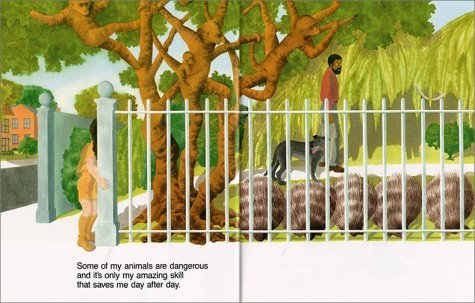
This is a cleverly illustrated book about how a girl's imagination sees animals in the forms of trees, bushes, and other shapes she sees on the way to school. While the book is great idea overall, I do not like the page where the white girl is entering a gated park where she sees friendly-looking orangutans in the branches of a tree and friendly-looking porcupines in the bushes, and there is an actual (not imagined) black man with a beard and sunglasses walking his large generally friendly-looking dog; the words on the page say, "Some of my animals are dangerous and it's only my amazing skill that saves me day after day."
I am quite fond of this, as is my daughter; it is about a girl who imagines her walk to school as a journey through various terrains. It is both a hidden pictures book, because of the various wild animals written into all the natural features (leaves, tree trunks, fruits and vegetables at a store -- all become animals) and a book about the power of imagination, how the mind can transform the ordinary and allow something which is a little bit a chore to become both exploration and a test of courage.
The city streets become a jungle, then a desert, as a child forges her way to school, observing and avoiding all the wild animals posing as trees, chimneys, fences, and even fruit.
The illustrations are great! There are animals hiding in the background that the children will have fun trying to find.
This is a great read aloud book for k-2. This would also be a good independent reading book for early readers.
It really is a jungle out there, or so one little girl believes as she "sees" loads of exotic animals on her trek to school. There's not much of a story here, but it is a lot of fun picking out the wild creatures in the author's illustrations of this urban landscape.
A nice homage to the powers of a child's imagination.
The Trek is about two children on their way to school and all the different places that they made up in their mind. It describes different habitats and the animals that live there. In a science lesson on different habitats and animals is where I would use this book to further the knowledge of the kids in my class. This would be perfect for grades kindergarten through 2nd grades.
THE TREK by Ann Jonas is a picture book that was featured on the highly respected TV show Reading Rainbow. As an unnamed narrator walks to school, she sees exotic animals hidden in the illustrations. The stones of a chimney form a giraffe; the branches and limbs of a tree become gorillas; and watermelons (one cut open) look like a hippopotamus. Toddlers to ten-year-olds will enjoy searching for these and many more creatures in this imaginative book.