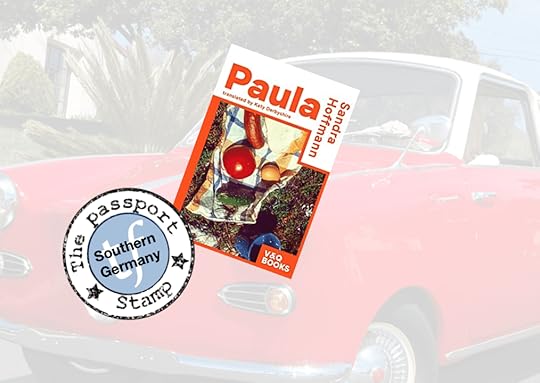
Paula muss einmal eine glückliche Frau gewesen sein, bevor ihr Bräutigam im Krieg stirbt. Eine Frau, die irgendwann aus Angst und Scham zu schweigen beginnt, die nie preisgibt, von welchem Mann das Kind stammt, das sie alleine großzieht, bis der Schutzraum des Schweigens zum Gefängnis wird, in dem Liebe und Empathie verkümmern. Ihre Tochter und ihre Enkelin werden nie erfahren, wer ihr Vater, wer ihr Großvater war. Sandra Hoffmanns Memoir "Paula" liest sich wie ein Familienroman. Mit Courage und Zärtlichkeit erzählt sie das Leben ihrer Großmutter, die ihr erdrückend nahe war und von der sie doch so wenig weiß. Der Macht des Schweigens setzt sie die Kraft der Sprache entgegen.
Another book that I discovered thanks to the Borderless Book Club. This was a quiet book, about silence in a family, but also coming of age and inter-generational relationships. There were so many beautiful passages and I think many moments I felt as though my own grandmother was on these pages.
Excerpts: I see my grandmother shrug. Then she reaches into her apron pocket again. It happens almost automatically, as it always does when she feels insecure. . So the only point of prayer is that it replaces words that are hard to bear with devotionals, and these are only good for lifting curses you believe yourself to be plagued with. . Silence is carried down generations. When everything that has to be said is not said, and everything that would be better left unsaid is spoken.
I read Paula as part of the Borderless Bookclub. Although relatively short (143 pages), it was not a book to read quickly. This autofictional tale is Sandra Hoffmann's attempt to understand and come to terms with her grandmother, Paula, a woman who was smotheringly close to her but yet remained distant and in some senses unknowable. Many families have secrets. Paula has never revealed the identity of the narrator's grandfather. who finds comfort in the rituals of her Catholic faith. The story involves the narrator trying to piece together who this woman was, from memories, conversations and photographs.
The story is beautifully crafted, the prose precise and crisp, with some lovely sentences and paragraphs.
I wouldn't be surprised to see this as a contender for the International Booker Prize longlist
A young woman tries to understand her family's silence. It's centered around the Second World War and a grandmother's guilt. Taut writing about memory. I couldn't put it down. Maybe it connected so strongly because there was a lot of silence in my own family about the war and its aftermath.
Favourite quote: "I have pushed photos to and fro, sorted and arranged them anew. I have filled in the gaps along their white margins with writing. I wanted to give her, Paula, my grandmother, the life story that she couldn't tell." page 64
That's exactly what I'm trying to do with my own mom's life story.
Another title from V & Q Books, who specialise in ‘remarkable writing from Germany‘.
Paula is the grandmother in this story, who has been part of the author’s childhood and early adulthood until she dies in 1997. This is very much a fictionalised biography set firmly in the latter half of the twentieth century. It underlines that every family unit is made of quasi jigsaw pieces and when larger elements are missing, there can be quite an impactful ripple effect through the generations.
The writer and chronicler deftly shows how a child, growing into an adolescence, needs to understand her heritage and make sense of the gaps. Gaps, if left open, will inevitably be filled by a child’s imagination. The ever present hole in this particular family drama is the lack of grandfather, and her grandmother Paula will not divulge who he was. For the writer this almost becomes a quest to put together clues – maybe joining the dots of what is left unsaid or through photos that she happens to discover; however, building up a picture in this way can never fully make a whole and comprehensible family map, resulting, in this instance, in family therapy and an eating disorder. Secrets in the family can have devastating consequences.
Paula remained ‘stumm’ in response to the inquisitive little girl’s questions, she focussed on her housewifely duties and job as a cleaner. The writing style underlines the stream of consciousness as the writer casts around her to try and find answers, but little, if anything, is forthcoming.
The backdrop of the era and the German childhood is beautifully brought to life. The family travelled in the early days in a Gogglemobil. The child would watch Bonanza, a popular American TV programme. The 1970s was also the time of terrorism and the Baader Meinhof (Red Army Faction) gang and ‘wanted’ posters were pinned in every Germany village and city (and once one of the perpetrators was caught, a designated person would mark the captured enemy of the state with a red cross).
Her Grandmother pickled and bottled all the while, wearing a distinguished apron every day (bar Sundays) and was a devout Swabian Catholic. Paula went to her grave with her secrets and silence intact.
It is a truly affecting story and in order to really appreciate it I think it would be helpful to have some familiarity with the German language and knowledge of German culture. It is beautifully translated by Katy Derbyshire.
I loved reading Paula as an example of a masterfully realised translation and as a story. I resonated with some of the key plot points of the book ~ my devout Catholic grandmother was nonverbal for years before her passing ~ and reading about this kind of character felt cathartic and emotional. The portrayal of a relationship between a grandmother and a grandchild along with its misunderstandings and resentments is beautiful for its authenticity. I would love to read this in the original German one day.
I read this book for Borderless Book Club and despite the fact that is a short book it was eternal for me.... Took me days and days to finish it. I stop reading because of this book. I know I can abandon a book but been so short I decide that I finish it, maybe it gets better. It never did. I was unable to feel interested for the characters or the story, nothing really push me to read it. Is a forgettable reading that can be a great story but it just never took off. I had no sympathy for any of the characters and I am still angry with myself for non abandoning it in page 40 or earlier.
It took a little while to fall into the rhythm of Hoffmann’s stream-of-consciousness writing, however, the underlying premise of the story (which exposes the trauma experienced by the narrator’s grandmother) kept me there. It’s character driven, and offers insight into how trauma is ‘protected’ by families, history and shared silence. I am always fascinated by how German people my age ‘experience’ the legacy of WWII, and this story contributes yet another perspective.
Paula is Hoffmann's grandmother, a woman who maintained a programmatic (a guilty? a shamed? an imploring?) silence throughout her childhood, most pointedly on account of Hoffmann's mother's parentage. A devout Catholic never going anywhere unfamiliar without her rosary, kept in a handbag or under her skirt, she was an initially beloved, then a hated and repressive, figure for the author, who would wish her dead, or make a V-sign behind her back, then privately atone at the supper table reciting Hail Marys and Our Fathers. 'Thine be the kingdom, the power and the glory' was the part she could not get wrong, stumble over, on the pain, in her schooled imagination, of some awful fate befalling 'Oma'. Forty-five years after his last contact with the family, her grandfather (she can only register 'her mother's father) calls from the hospital where he is in extremis, but her mother (who carps at her grandmother; who finds fault with the cooking and is silent with her mother in turn) doesn't want to know. The narrator's father, a Protestant, is absent working sixty hour weeks as a 'Sunday father' and figures notably slightly in her psychic landscape.
Hoffmann becomes a writer in part because she wants to understand how someone, how Paula, could keep 294 photos in shoeboxes but have no desire to narrate the story of her life. Paula's fiance dies a hero's death in 1943 on the front. Her mother is born later. There are two other men in the photos, apparently from before the fiance, who seem in significant relationships with Paula--or her photographer's eye looks infatuated. Her mother has skin colouring unlike the rest of her family--was her father a Moroccan serviceman in the French army that liberated them from the Nazis, or a 'gypsy'? Paula dies without any revelation.
The book is honestly and correctly close to the bone for the author (more than for the translator), but does not really find any language, any effects or devices specific or distinctive enough, to make what matters to the author matter to readers. One understands the knot of ambivalence brought about by the sight of the rosary under Paula's skirt for the teenage Hoffmann, her urge to escape, her compulsion to repeat--but these to some degree remain someone else's trauma.
for me this book was a bit too 'artsy' and a bit too all over the place. the character perspective and the era kept changing, and I couldn't keep up with it. I did wonder if that was because of the translation, but I'll never know I guess. there were lots of themes however, that I found really interesting and relevant when looking at 3 generations of women in one family. particularly loneliness, family trauma being passed down, and the desire to avoid turning into your mum. I thought the writer began to explore these topics in a really honest and authentic way, and I recognised a lot. but I felt like the changes interfered with me being able to really interact with these ideas.
An autofiction leaning completely to the memoir side of that genre, this is one of those books that puts the oppressive silence of families into deceptively simple but painfully accurate prose.