Das große Finale der bildgewaltigen Comic-Saga, die auf dem Leben des legendären WK1- Fliegerasses Manfred von Richthofen beruht. Im abschließenden dritten Teil begegnet der mit der Gabe der Hellsichtigkeit ausgestattete Pilot nicht nur neuen Herausforderungen und Feinden, sondern schließlich auch seinem Schicksal ...
Pierre Veys was born April 7, 1959 in Cambrai, in the north. After graduating, he spent a year studying biology, but quickly turned to screenwriting, news and gags. His influences are from the authors Jack Vance, Michael G. Coney and Yves Dermèze (Paul Bera).
Pierre Veys est né le 7 avril 1959 à Cambrai, dans le Nord. Après son Bac, il fait une année de biologie, mais se tourne rapidement vers l'écriture de scénarios, de nouvelles et de gags. C'est un auteur polygraphe. Il dirige et écrit pendant deux ans pour une troupe de café-théâtre appelée MacPochtron And The Cuitos Brothers qui donnera trois spectacles : Sous les caveaux, la plage ! ; Les poivrots se cachent pour vomir et Docteur F. Il écrit des sketches pour Jean-Marie Bigard. Il travaille aussi pour la télévision : il écrit pour Philippe Bouvard (France 3) et pour l'émission La Classe (France 3) dans laquelle il est également acteur. Il réalise des nouvelles et des gags pour Fluide Glacial dans La Gazette de Frémion, ainsi que des scénarios pour Spirou. Intéressé par la BD depuis vingt ans, Pierre Veys ne trouve pas de dessinateur qui puisse s'adapter à ses scénarios, jusqu'au jour où il rencontre Nicolas Barral chez Fluide. Ils s'attaquent alors avec humour à un mythe, à l'un des sujets les plus sacrés de sa Grâcieuse Majesté : Sherlock Holmes himself ! Le premier tome de la série Baker Street parait aux Éditions Delcourt en avril 1999 sous le titre Sherlock Holmes n'a peur de rien et avec la bénédiction de la Société Sherlock Holmes de France qui lui décerne d'ailleurs un prix. Ses influences se situent auprès des auteurs Jack Vance, Michael G. Coney et Yves Dermèze (Paul Béra). Veys est aussi passionné de musique et apprécie tout particulièrement Steve Hackett, Jean-Claude Vannier ou bien encore Les Innocents. Il avoue également vouer une affection toute particulière pour l'Écosse, la forêt, la pluie et les déserts humains...
For all the trilogy: this is an excellent aviation comic from World War I and about the life (only partially) of ace Manfred von Richthofen. Two complaints: the story has an absurd fantastic element that hinder in the whole script and I do not like the hasty final in this third comic, and more if it implies that the series has finished. To highlight the wonderful drawings by Carlos Puerta, every image is captivating by itself.
In the end, the 'fantastical' part is a bit too much. In this third album there is too much to tell. It is a bit of a shame that the contents were not better arranged or distributed between the three albums.
Even so, the drawings are excellent and it is worth the read.
Veys and Puerta continue their alternative telling of Manfred Von Richthofen’s life, and his singular abilities, in this third volume where we at last get to see the Baron settling into his very conspicuous bright red plane. Now recruited to a new fighter squadron with an emphasis on pushing back against the enemy Richthofen is in his element, but he’s also squarely amongst other pilots from his past who despise him, so now the threat is double-sided. Fortunately, Richthofen’s edge allows him to snatch away any perceived advantage his colleagues think they may have, but that then creates its own set of problems, and there’s still the question of enemy planes to deal with amongst it all.
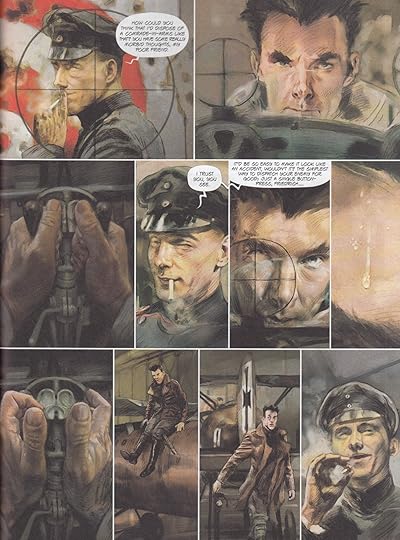
Really enjoying this now. In the first few pages of the first volume the digital painting and manipulation was so starkly different that I was unsure it suited this sort of work, and if I was persuaded by the end of that book that it worked I’m utterly sold on it now. It manages to bring a cinematic quality to the panels, especially the scenes in the air which thrum with atmosphere and tension. Definitely worth a look at.
I really like the artwork but the plot leaves a lot to be desired. The idea of Manfred von Richthofen having supernatural power was a bit far-fetched and it wasn't well developed. I mean, his superpowers were over-present in the first volume, almost absent in the second and here they were . Well, that and his arrogance. Really, I felt no pity for him and he sort of deserved the ending he got. One less psychopath in the world.
Weird ending, though. I mean, I would have expected .
Well, this series was worth reading more for the artwork. The photography-like images and extremely realistic planes did it for me.
This conclusion to the Red Baron trilogy is a little longer than the first books (64 pages vs. 48) and fails to stick the landing. The series suffers as a whole from a certain choppiness, and despite having more pages to work with and in a more linear chronological sense than the first two, this one didn't flow either.
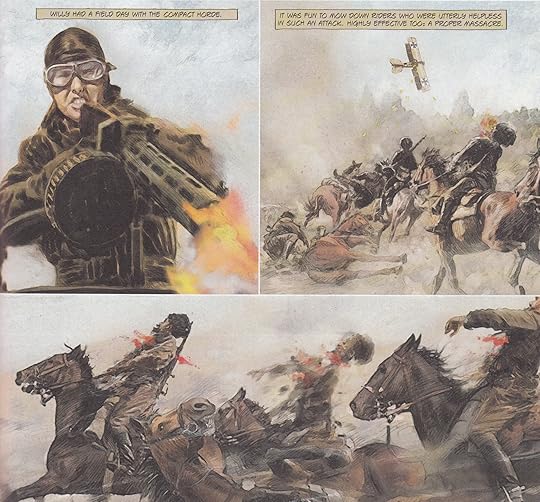
It opens in 1916 on the Russian front, with Manfred von Richtofen still learning his trade -- including a bombing run on a train depot, and an ambush of a mounted Cossak unit. Eventually, he's in another unit where he gets to pilot an Albatross, but also is stationed with his old schoolboy nemesis Prince Freidrich (presumably Prince Freidrich Karl, who was a WWI pilot in real life).
More than halfway in, the book takes an odd shift to the perspective of a British tank unit -- odd in that I don't recall any other instance of the story leaving Richtofen. This is all so that he can come along and rescue the day, only instead of intuiting the enemy's intent as his premonition superpower has worked in the past, this time he literally reads the thoughts of one of the tank crew -- allowing him to find the weak spot to destroy the tank.
The premise of his superpower is already silly enough, but to have the mechanics of it change near the end of the series is a major misstep. The story quickly moves on, and now he's destroying a submarine... which again, just seems kind of silly and pointless. The story comes to a tepid conclusion as he's part of an escort group trying to get a zeppelin back to safe territory and is undone by something he apparently couldn't use his superpower to discern. I don't know -- by this point, I'd ceased to care any more.
All in all, the Red Baron seems like a good subject for a fictional treatment, and there are some sequences of aerial combat art that are great, but on the whole, this series is a narrative disappointment.
Agora, no ar, Richtoffen começa a tornar-se lenda. A sua capacidade assassina revela-se, aos comandos de sucessivos aviões. O seu segredo mantém-se, a sua capacidade de sentir a agressividade dos inimigos e com isso antecipar as suas ações. Para tornar mais eficaz essa sua capacidade, decide pintar os seus aviões de vermelho, para despertar reações nos inimigos. No entanto, tem uma relaçáo complicada com alguns dos seus camaradas de armas. Neste terceiro livro da série, exploram-se algumas façanhas de combate aéreo, magnificamente ilustradas. É o lado visual que torna a série interessante, num estilo realista com um tratamento impressionista da cor.
Pierre Veys and Carlos Puerta bring us what a very loosely told story of the fighting life of Manfred von Richthofen, as he becomes the infamous Red Baron of WWI. The writing is pretty thin no works in a pointless subplot about how Richthofen has some kind of telepathy that gives him an edge in combat. Too bad Veys spends so much time on that, since he otherwise crafts an interesting take that suggests Richthofen was some kind of psychopath who happened to be what Germany needed when war broke out. But the real star of this series is the artwork by Carlos Puerta, which is simply exquisite and deserves 5 stars on its own.
Narrative: *** I learned a bunch- especially about planes and other vehicles of the Great War.
Visual: ***** His painting is astounding! Did anyone else keep seeing shades of Hollywood faces from the 1930s-50s? I thought I was seeing Cary Grant talking to Clarke Gable amongst the British soldiers- then I got a few other impressions I couldn't remember the names for.
Den flygande cirkusen avslutar Pierre Veys och Carlos Puertas vackert målade berättelse om den berömde flygaren Manfred von Richthofen, Röde baronen, som påbörjades i Jaktpiloten och senast fortsatte i Stridsflygaren. Veys och Puertas iscensätter en påstådd och närmast övernaturlig förmåga hos von Richthofen att läsa andras tankar och väver detta samman med hans historiska bedrifter.
Jag har under seriens gång haft reservationer angående Puertas fotorealistiska estetik och dess statiska effekt på det visuella berättandet, och i detta sista album som knyter ihop säcken blir handlingen även mer fragmentarisk än tidigare. Den metaforiska säcken knyts förvisso samman, med en tydlig avslutning, men känns det ändå som att den intressanta idén som fått mig att hänga kvar genom alla tre albumen inte fullt ut har fått komma till sin rätt. Slutet känns därför en aning rumphugget.
Jag ångrar inte att jag läst serien på något vis, men jag är även mycket nöjd med att ha valt att låna album två och tre på biblioteket.