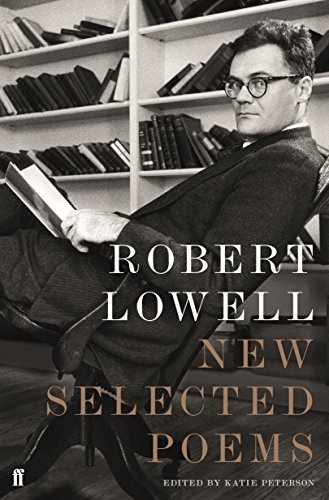
'THE BEST AMERICAN POET OF HIS GENERATION.' - TIMEGathered on the occasion of Robert Lowell's one hundredth birthday, New Selected Poems offers a fresh and illuminating representation of one of the great careers in twentieth-century poetry. The renowned and controversial author of many books of poems, plays, and translations, Lowell was one of the United States' most honoured poets, winning the Pulitzer Prize in Poetry in 1947 and 1974, the National Book Award, and the National Book Critics Circle Award. His ongoing interrogation of his family legacy, his personal struggle with manic depression, and his mastery of the tradition of poetry in English formed the groundbreaking autobiographical foundation of Life Studies (1959) and the books that followed it, including For the Union Dead (1964), Near the Ocean (1967), History (1973), and Day by Day (1977).Katie Peterson's incisive selection of Lowell's poems draws attention to 'the perishability of life, its twinned quality of fragility and repetition, as framed by the structured evanescence of daily consciousness.' Lowell's own intense dramas and struggles are the substrate he drew on in his restless search to make sense of, and fix, shape-shifting experience - not his, but ours. As Peterson says, Lowell was 'constitutionally immune to any stultifying permanence either of form or of spirit.' Her brilliant new reading of Lowell shows us his work constantly breaking, renewing, transforming, as he strives restlessly, over and over, to find an elusive unity.
Robert Lowell, born Robert Traill Spence Lowell, IV, was an American poet whose works, confessional in nature, engaged with the questions of history and probed the dark recesses of the self. He is generally considered to be among the greatest American poets of the twentieth century.
His first and second books, Land of Unlikeness (1944) and Lord Weary's Castle (for which he received a Pulitzer Prize in 1947, at the age of thirty), were influenced by his conversion from Episcopalianism to Catholicism and explored the dark side of America's Puritan legacy.
Under the influence of Allen Tate and the New Critics, he wrote rigorously formal poetry that drew praise for its exceptionally powerful handling of meter and rhyme. Lowell was politically involved—he became a conscientious objector during the Second World War and was imprisoned as a result, and actively protested against the war in Vietnam—and his personal life was full of marital and psychological turmoil. He suffered from severe episodes of manic depression, for which he was repeatedly hospitalized.
Partly in response to his frequent breakdowns, and partly due to the influence of such younger poets as W. D. Snodgrass and Allen Ginsberg, Lowell in the mid-fifties began to write more directly from personal experience, and loosened his adherence to traditional meter and form. The result was a watershed collection, Life Studies (1959), which forever changed the landscape of modern poetry, much as Eliot's The Waste Land had three decades before.
Considered by many to be the most important poet in English of the second half of the twentieth century, Lowell continued to develop his work with sometimes uneven results, all along defining the restless center of American poetry, until his sudden death from a heart attack at age 60. Robert Lowell served as a Chancellor of The Academy of American Poets from 1962 until his death in 1977.
Selections of poems from Lowell's entire body of work that gave a taste of how his writing evolved over time. The editors introduction was interesting and I think the editor made a good choice including the autobiographical sketch of his childhood, it put a perspective to many of the poems with Lowell's own words. Lowell does a good job of capturing a place, a time, a feeling with his words and this book had an overall New England feel to me as a Midwesterner. I received a free copy of this book through Goodreads First Reads Giveaways.
I love poetry. Who doesn't? I received this book free for an honest opinion. It has been awhile since I have read a great selection of poetry. Sometimes it is hard to find something that really grabs you. This book has a wonderful collection of poems, that you won't regret reading. I hope you enjoy it as much as I did.
Lowell refuses to write normally weighted poetry, that is, poems that induce confusion and emotional complication in the beginning and middle sections, with a climactic knock-out memorable ending. His poems always leave you wondering what's going on, where the umph was supposed to go. His most memorable ones (at least most anthologized), "Skunk Hour," "Mr. Edwards and the Spider," "For the Union Dead," are closer to meeting those unspoken criteria. Yet they're all pretty obviously skillful, and many are very interesting. By the end of his career, Lowell is writing hundreds of blank(ish) verse sonnets. There are worse ways to live.
I only gave it four stars, instead of five, because the meaning of many of his poems is simply beyond me. I often did not understand his allegory or references. "For the Union Dead" is, of course, great.
A sizable selection of the whole with highs and lows both represented. The “confessional” idea that one’s own woes are worth the reader’s time is fully on display, but generally more deftly handled than by his followers.
3.5--I only read 'Skunk Hour' and 'My Last Afternoon with Uncle Devereux Winslow'. Didn't really like either, though the pain in Lowell's confessions gave me a jolt. Looking forward to reading more about him, though, especially 'For the Union Dead'.
26/4/2021 edit: Having gone back to his poems I now realise that Lowell is a hidden genius whose works I quite like. His last volume of poetry is in particular very touching. This shows just how rubbish my tutor is in choosing texts for us to read lol