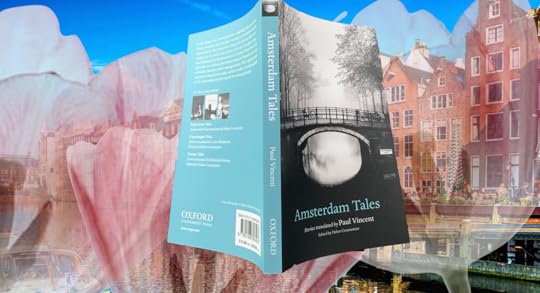
In this volume Paul Vincent presents a compelling collection of prose fiction, memoirs and anecdotes centring on Amsterdam from the seventeenth to the twenty-first century. His selection offers a rare insight into the history and culture of the city. The subjects range from Rembrandt to the persecution of the Jews in World War 2, from barricades in a working-class district during the Depression to a writer's unhealthy obsession with a massage parlour. These eighteennewly-translated tales give the reader, and the traveller, a tantalizing glimpse of the Amsterdam that lies beyond the tourist guidebooks.
Helen Constantine read French and Latin at Oxford. She was Head of Languages at Bartholomew School, Eynsham, until 2000, when she gave up teaching and became a full-time translator. She has published volumes of translated stories, Paris Tales, and French Tales and edits a series of City Tales for Oxford University Press. Paris Metro Tales will be published in March 2011. She has translated Mademoiselle de Maupinby Théophile Gautier and Dangerous Liaisons by Choderlos de Laclos for Penguin and is currently translating Balzac’s La Peau de Chagrin for OUP. She is married to the poet, David Constantine and with him edits Modern Poetry in Translation.
Everybody with an open mind and heart will have their own story of their visit to the beautiful, vibrant city of Amsterdam. I'd like to add mine to the collection, one that's - believe it or not - a true story. Here goes:
Some time back, I considered writing a novel. Then, as if in a dream, a miraculous happening: a radiant goddess spoke to me in Amsterdam. She told me exactly what my novel should be: Chapter One: Recount my meeting with her on a bridge in Amsterdam. The remainder of the novel, so spoke the goddess, should be 101 chapters, each chapter consisting of a book review I've written with passion and enthusiasm, a book review extolling the depth and beauty of literature, the magnificence and excitement of literature . That's it, no more, no less. She told me to call my novel: The Goddess of Amsterdam.
Pondering this advice, I wonder how such a "novel" will be received. Surely among the most original formats . . . but I suspect I'll hear the refrain: "You can't do that and call it a novel!"
Amsterdam Tales is an eclectic collection of eighteen short stories and essays set in Amsterdam ranging from the 17th century through to the present day. The collection is expertly edited by Helen Constantine and beautifully translated by Paul Vincent. It offers a fascinating insight into aspects of Amsterdam life over the years…
The eighteen authors are very diverse – not only in time, but also in the subject matter they choose to write about. They range from Gerard Brandt (‘Joost van den Vondel goes into Hiding’: 1625) right through to Robert Anker (‘Pain in the Spleen’: modern day). The first is the story of a man who wrote supposedly subversive literature in the 17th century and the latter is the story of a night watchman conned by thieves. The sixteen in between range from a man railing against trams (W Otto’s ‘An Opponent inveighs against the Tram’ ), to a story of ice skating on the Amstel (Herman Heijermann’s ‘Amstel’), to the strange tale of a school mistress (Jacob Israël de Haan’s ‘The Black Cat’), to a story of Jewish survivors set at the end of the war (Frans Pointl’s ‘Amsterdam 1945-46’), to a commentary on Arab immigration into Amsterdam (Pieter Olde Rikkert’s ‘Who’s Afraid of Allah Akbar’), to man living opposite, and with an unhealthy fascination for, a massage parlour in the red light district (Thomas Herman van Voss’ ‘Massage Parlour’). I have picked only eight of the eighteen stories to mention. The rest are just as interesting and just as diverse. A truly fascinating collection. Before each story in the book there is a full page black and white picture to illustrate it – they in themselves make fascinating ‘reading’.
Amsterdam Tales says a lot about the type of city that Amsterdam was and is. It is a city with a strong immigrant tradition – Jews fleeing from various waves of persecution through to more modern immigration from the Middle East. It is a city full of tolerance (as, indeed, are most Dutch people) and diversity. The book is great way to cover part of its history in a very human way.
A book you can dip in and out of. Highly recommended.
This book was a waste of time. I am not sure how, having so many good short stories about Amsterdam, the editors chose the least interesting of all. I also think that the problem of the book might lie in its translation: the stories are translated as if they were office reports, not pieces of literature. I also found it interesting that, out of fifteen stories, the editors decided to include just one female author in it.
The only two stories that I enjoyed reading were “Single to Amsterdam” by Remco Campert and “Massage parlour” by Thomas Heerma van Voss.
I think it is a great idea to have a book with short stories that paint a picture of a city, as a sort of travel companion, but this one in particular one doesn’t make the cut.
An appealing potpourri of stories, some fictional, some factual, all set in Amsterdam or its immediate environs, extending in time from the early 17th century to the present day. Featured within these pages are some of the city's most famous residents (Rembrandt, Spinoza), the heyday of Dutch colonialism, the city's famed days of sorrow under Nazi occupation, and its infamous brothels, massage parlors, and plentiful drugs. All this in the space of less than 200 pages, but therein is the main problem with the book: its brevity is belied by its ambition, and so in the end what you get is at best a primer, at worst a hodgepodge.
Glimpses of Amsterdam emerge through each of the short stories and vignettes that make up this book. A picture of the city emerges that is not the usual tourist image but instead real life Amsterdam.