

What do you think?

Approaches to Social Research
Thoroughly revised and updated, the third edition of this successful text offers a wealth of new research examples and references, accessible diagrams of essential concepts and processes, and extended coverage of core methods and recent developments. Ideal for introductory methods courses, as
well as for advanced undergraduate and graduate courses, Approaches to Social Research strikes an important balance between specific techniques and the underlying logic of social inquiry -- the how-to and wherefore of research.
Opening chapters draw students into the subject by illustrating the practicality of the study of research methods, outlining the scientific and logical foundations of social research. The text then follows a typical research project beginning with research design, measurement, and sampling,
proceeding with data collection, and ending with data processing and analysis. The authors provide a balanced treatment of the four major approaches to research -- experimentation, survey research, field research, and the use of available data -- bringing the material to life with numerous examples
drawn from both classic and current research. While advocating a multiple-methods strategy that treats the approaches as complementary rather than as mutually exclusive, it furnishes a detailed account of the process as well as the advantages and disadvantages of carrying out research with each
approach. Extensive substantive examples and a clear exposition make complex issues accessible to students with no background in social research.
well as for advanced undergraduate and graduate courses, Approaches to Social Research strikes an important balance between specific techniques and the underlying logic of social inquiry -- the how-to and wherefore of research.
Opening chapters draw students into the subject by illustrating the practicality of the study of research methods, outlining the scientific and logical foundations of social research. The text then follows a typical research project beginning with research design, measurement, and sampling,
proceeding with data collection, and ending with data processing and analysis. The authors provide a balanced treatment of the four major approaches to research -- experimentation, survey research, field research, and the use of available data -- bringing the material to life with numerous examples
drawn from both classic and current research. While advocating a multiple-methods strategy that treats the approaches as complementary rather than as mutually exclusive, it furnishes a detailed account of the process as well as the advantages and disadvantages of carrying out research with each
approach. Extensive substantive examples and a clear exposition make complex issues accessible to students with no background in social research.
640 pages, Hardcover
First published January 1, 1988
Ratings & Reviews
Friends & Following
Create a free account to discover what your friends think of this book!
Community Reviews
Displaying 1 - 7 of 7 reviews
November 17, 2017
A good guide for research students at graduate level. However it lacked additional information as it relates to more practical guidance and examples for real world situations. Gave a vast wealth of knowledge on theory relating to qualitative and quantitative data collection.

July 31, 2022
Don't let this be your only text (as it was in my masters program). You will not learn stats, just overall research design.

August 7, 2013
2 Stars for the wealth of information this book contains.
Venting:
The missing 3 stars is due to the poor presentation of these details. At times, I thought I was looking at a Matrix while trying to solve the Da Vinci Code. This is saying a lot considering that I love to decipher problems and piece together puzzles. My Cell Physiology text was more helpful in comparison, and that's an anomaly considering that my strength is not in science.
EXAMPLE:
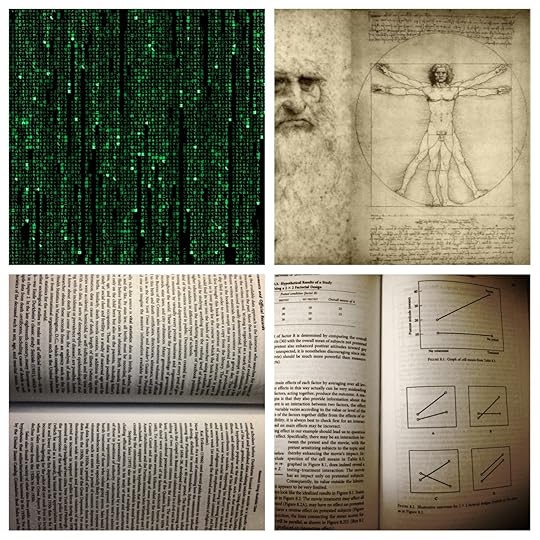
I used to believe that books should never be burned, but I retract that; I would burn this one.
Productive Comments:
A new edition would be more useful to accommodate visual learners. Preferably with tables and graphs that didn't look like my 5 year old cousin could have drawn. A textbook on research design shouldn't read like a never ending novel with hardly any distinctions between topics. I was shocked to see it even had a single space between themes. Research textbooks are better understood with clear and detailed diagrams, outlines, and tables, as well as properly constructed/organized sections.
Camaraderie:
To my fellow Sociology geeks ...
We hate, with passion, any professor who chooses this uninspired text as a required reading and lacks the ability to deliver the information sufficiently to compensate for it.

June 13, 2011
I was assigned this textbook for a class of Quantitative Methods of the Social Sciences. It's actually a pretty good book for those that want a clearly explained methodology on how to approach thinking about research design. Although some of the concepts seem obvious when they are explained, it is amazing how many studies exist without taking into consideration the many items that are articulated in these chapters.
The book is rich with examples as it explains the why's and hows of proper design. Many different types of analysis are introduced with the pro's and con's of their application.
The book is rich with examples as it explains the why's and hows of proper design. Many different types of analysis are introduced with the pro's and con's of their application.

July 16, 2012
This was one of my course books for Statistics. Although I don't enjoy the subject, the book was very easy to read and understand - it makes Statistics more sufferable for those of us who don't quite enjoy it :)

September 10, 2016
All in all, this book is incredibly well-structured and it is a joy to read. It guides the reader step-by-step towards understanding what social research is all about. A great resource for students studying research.
November 16, 2009
Used this in Columbia. Excellent!
Displaying 1 - 7 of 7 reviews