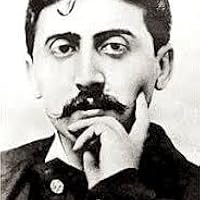
Переиздание сборника эссе Марселя Пруста (1871–1922), дополненное эссе «Рембрандт». Данные тексты во многом являются реакцией Пруста на теории Рёскина, которого писатель переводил на французский. При этом в размышлениях автора много места уделено функциям музея, наблюдению за искусством, понятию достопримечательности и др. В этих текстах серьезно и глубоко прописаны эстетические позиции, на которых стоял Марсель Пруст и которые, собственно, и потребовали в дальнейшем романного, а не только эссеистического выражения.
Marcel Proust was a French novelist, best known for his 3000 page masterpiece À la recherche du temps perdu (Remembrance of Things Past or In Search of Lost Time), a pseudo-autobiographical novel told mostly in a stream-of-consciousness style.
Born in the first year of the Third Republic, the young Marcel, like his narrator, was a delicate child from a bourgeois family. He was active in Parisian high society during the 80s and 90s, welcomed in the most fashionable and exclusive salons of his day. However, his position there was also one of an outsider, due to his Jewishness and homosexuality. Towards the end of 1890s Proust began to withdraw more and more from society, and although he was never entirely reclusive, as is sometimes made out, he lapsed more completely into his lifelong tendency to sleep during the day and work at night. He was also plagued with severe asthma, which had troubled him intermittently since childhood, and a terror of his own death, especially in case it should come before his novel had been completed. The first volume, after some difficulty finding a publisher, came out in 1913, and Proust continued to work with an almost inhuman dedication on his masterpiece right up until his death in 1922, at the age of 51.
Today he is widely recognized as one of the greatest authors of the 20th Century, and À la recherche du temps perdu as one of the most dazzling and significant works of literature to be written in modern times.
A very small but charming book, barely 40 pages, a stark contrast to the whopper that is À la recherche du temps perdu. The explanation is not hard to find: this is actually a pamphlet, a lengthy article that appeared in 1904 in the newspaper Le Figaro, and is reprinted here in book form. In it, Proust fiercely argues against a bill proposed by the socialist politician Aristide Briand (later known as Prime Minister of France and winner of the Nobel Peace Prize in 1926). Briand proposed a radical separation of church and state, thus renouncing the concordat that Napoleon had signed with the Vatican in 1801.
According to Proust, one of the consequences of Briand's proposal would be the disuse and decay of the cathedrals. He vividly outlines the great architectural and aesthetic value of those medieval buildings, which he even calls "the highest expression of French genius." But he is apparently not only concerned with the buildings themselves. He describes in great detail the Catholic rituals that take place in them, the symbolism behind actions and clothing, and so on. And he clearly states: if these things disappear, then the space (and the building) in which they are situated also loses its soul.
Proust was of mixed Jewish-Catholic descent, and was also baptized Catholic, but he was certainly not a churchgoer. Yet, Catholic aesthetics and symbolism had a demonstrable influence on his thinking and work. And this is most evident in this booklet.
That the pamphlet has now been reissued is no coincidence. A heated debate about “laïcité”, which is one of the core values of the French Republic, still rages in France. The rise of Islamism and terrorist attacks have fueled this, but there has also been a Catholic revival going on for years, certainly not spectacular, but noteworthy. And I suspect the reissue should be seen in this context. Aside from that, it's quite enjoyable in itself, if only for Proust's refined style.
у меня даже нет силы и смелости сказать что пруст мой любимый писатель потому что это определение подразумевает какую-то цельность и конечность тогда как самое ценное в прусте это именно бесконечная ежесекундная любовь которую ты испытываешь читая каждое его слово поэтому скажу только что пруст тот писатель который принес мне в жизни больше всего счастья и приносит и я точно знаю продолжит приносить. эти предроманные эссе не исключение в них он только стоит на пороге своей большой любви и предчувствует предсказывает ее и это дарит ему спокойствие и легкость. вот эти ощущения здесь самые главные а в целом текст конечно сверкает радостями как будто специально для меня написанными и я могу говорить о них бесконечно но зачем если можно просто чувствовать.
Top-tier coffee table book (in the best sense of the term). I find myself eager to weave much of Proust's language, and his predisposition to be surprised and drawn to awe when encountering invitations of the divine, into my own experience of liturgical aesthetics and its freely shared heritage.
"Never has a sight comparable to such a giant mirror of knowledge, of the soul, and of history been presented to man's eyes and understanding...This artistic accomplishment -- the most complete ever, since all of the arts collaborated in it -- of the greatest dream to which humanity ever rose; this mansion is grand enough for us all to find a place in it. The cathedral, which shelters so many saints, patriarchs, prophets, apostles, kings, confessors, and martyrs that whole generations huddle in supplication and anxiety all the way to the porch entrances and, trembling, raise the edifice as a long groan under heaven while the angels smilingly lean over from the top of the galleries which, in the evening's blue and rose incense and the morning's blinding gold, do seem to be 'heaven's balconies' -- the cathedral, in its vastness, can grant asylum both to the man of letters and to the man of faith, to the vague dreamer as well as to the archeologist. All that matters is that it remains alive and that France should not find herself transformed overnight into a dried-up shore on which giant chiselled shells seem marooned, emptied of the life that once lived in them, and no longer able even to give to an ear leaning in on them a distant rumor from long ago -- mere museum pieces and icy museums themselves...Things keep their beauty and their life only by continuously carrying out the task for which they were intended...Oh! all of you in your stained glass windows in Chartres, in Tours, in Bourges, in Sens, in Auxerre, in Troyes, in Clermont-Ferrand, in Toulouse, ye coopers, furriers, grocers, pilgrims, laborers, armorers, weavers, stonemasons, butchers, basket weavers, cobblers, money changers, O ye, great silent democracy, ye faithful obstinately wanting to hear the Office, who are not dematerialized but more beautiful than in your living days now in the glory of Heaven and the blood that is your precious glass: no longer will you hear the Mass you had guaranteed for yourselves by donating the best part of your pennies to building this church. As the profound saying goes, the dead no longer govern the living. And the forgetful living stop fulfilling the wishes of the dead."
Нехай вас не обмане назва збірки й есеїв (оповідань? заміток?), це аж ніяк не книжка про релігію. Це книжка захоплення Джоном Раскіним і особливо захоплення французькими соборами через очі Раскіна. Пруст розмірковує про зв'язок мистецтва і науки, релігії і мистецтва, мистецьке ядро в людині, фетишизацію мистецтва на прикладі Раскіна, рясно цитує його книжки і листи. Він детально описує одну подорож (паломництво соборами), одну людину (Раскіна), один собор (в Ам'єні), потенційні наслідки одного законодавчого рішення (він вважає, що собори втратять свою первинну функцію внаслідок відділення церкви від держави), одного художника (Рембрандта, але й тут не обійшлось без Раскіна).
Найбільше мене в цих текстах зачепили якраз слова Раскіна, якого цитує Пруст:
Если вам скажут, что я черств и холоден, будьте уверены, что это неправда. У меня нет ни друзей ни возлюбленных, это действительно так, однако я не могу читать без слез эпитафию спартанцам, погибшим при Фермопилах, и в одном из ящиков моего стола уже восемнадцать лет хранится перчатка, которая мне до сих пор очень дорога. Но если, напротив, вы вдруг решите, что я необычайно добр, вы ошибетесь точно так же, как те, кто имеет обо мне мнение прямо противоположное, единственные мои радости — это смотреть, думать, читать и делать других людей счастливыми в той мере, в какой я могу, не поступаясь собственным благом.
Tiene sus momentos buenos. Es un relato un poco complicado de leer debido a la narrativa que emplea el autor, sin embargo no estuvo tan mal. Me agradó el final sobre todo porque comprendí de una forma casi poética a qué se refiere el autor al usar ese título para su novela. Es triste realmente.