

What do you think?

The Modern Language of Architecture
Frank Lloyd Wright called Bruno Zevi â the most penetrating architectural critic of our time,â and one could ask for no better proof than Zeviâ s masterpiece, The Modern Language of Architecture. In it, Zevi sets forth seven principles, or â antirules,â to codify the new language of architecture created by Le Corbusier, Gropius, Mies van der Rohe, and Wright. In place of the classical language of the Beaux Art school, with its focus on abstract principles of order, proportion, and symmetry, he presents an alternative system of communication characterized by a free interpretation of contents and function, an emphasis on difference and dissonance, a dynamic of multidimensional vision, and independent interplay of elements, an organic marriage of engineering and design, a concept of living spaces that are designed for use, and an integration of buildings into their surroundings. Anticipating the innovations of postmodern architecture, Zevi argues forcefully for complexity and against unity, for decomposition dialogue between architecture and historiography, finding elements of the modern language of architecture throughout history, and discussing the process of architectural innovation. Sumptuously illustrated, and written in a clear, accessible manner, The Modern Language of Architecture will long remain one of the classics of architectural criticism and history.
232 pages, Hardcover
First published January 1, 1973
Ratings & Reviews
Friends & Following
Create a free account to discover what your friends think of this book!
Community Reviews
Displaying 1 - 5 of 5 reviews

November 21, 2019
A sound, sharp and unrelenting attack on architects building structures consisting entirely of boxes and right angles.
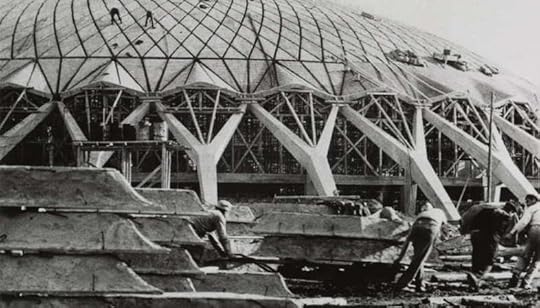
Palazzetto dello Sport, Rome - Pier Luigi Nervi (1960)
Matching Soundtrack :
AC : Revelations - Desmond's Journey: Part III - Escape OST
-------------
J'aime beaucoup l'idée de base de Bruno Zevi.
Posons-nous la question du pourquoi en architecture. Dépassons l'architecture des boîtes accolées les unes aux autres, obsessionnellement, par pur mimétisme, degré zéro de l'architecture.
Pier Luigi Nervi Petit palais des Sports, Rome - Pier Luigi Nervi (1960)
Voilà les pistes que l'auteur propose pour dépasser nos fameuses boîtes à chaussures :
1) Faire l'inventaire des éléments d'architecture, puis les re-sémentiser. (Pourquoi ici un empilement, pourquoi ici une séparation, pourquoi cette orientation pour la fenêtre ?)
2) Cultiver l'asymétrie, la dissonance. Être capable de s'affranchir de la façade, qui n'est pas inévitable en architecture, rendre la façade non finie.
3) Jouer avec la tridimensionnalité des volumes. Dépasser l'enfermement de l'homme dans des boîtes à toutes les échelles. Partir des piliers, non du modèle de la boîte. Comme dans cet espace de bureaux :
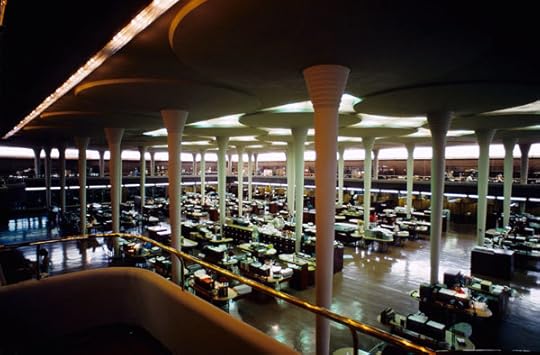
Johnson Wax Building, New York - Frank Lloyd Wright (1939)
4) Temporaliser l'espace,
5) et le réintégrer dans son territoire.
Bruno Zevi remarque l'influence directe de l'architecture dominante sur l'esprit contemporain. Ainsi, nos boîtes traduisent certainement le besoin obsessionnel de sécurité, le refus de l'indétermination, de la relativité, la peur de la maturation.
L'architecture, c'est comme une musique, l'histoire des villes, c'est comme une langue vivante.

Taliesin West, Scottsdale, Arizona, Etats-Unis - Frank Lloyd Wright (1937)
Matching Soundtrack :
AC : Revelations - Desmond's Journey: Part III - Escape OST
Palazzetto dello Sport, Rome - Pier Luigi Nervi (1960)
Matching Soundtrack :
AC : Revelations - Desmond's Journey: Part III - Escape OST
-------------
J'aime beaucoup l'idée de base de Bruno Zevi.
Posons-nous la question du pourquoi en architecture. Dépassons l'architecture des boîtes accolées les unes aux autres, obsessionnellement, par pur mimétisme, degré zéro de l'architecture.
Pier Luigi Nervi Petit palais des Sports, Rome - Pier Luigi Nervi (1960)
Voilà les pistes que l'auteur propose pour dépasser nos fameuses boîtes à chaussures :
1) Faire l'inventaire des éléments d'architecture, puis les re-sémentiser. (Pourquoi ici un empilement, pourquoi ici une séparation, pourquoi cette orientation pour la fenêtre ?)
2) Cultiver l'asymétrie, la dissonance. Être capable de s'affranchir de la façade, qui n'est pas inévitable en architecture, rendre la façade non finie.
3) Jouer avec la tridimensionnalité des volumes. Dépasser l'enfermement de l'homme dans des boîtes à toutes les échelles. Partir des piliers, non du modèle de la boîte. Comme dans cet espace de bureaux :
Johnson Wax Building, New York - Frank Lloyd Wright (1939)
4) Temporaliser l'espace,
5) et le réintégrer dans son territoire.
Bruno Zevi remarque l'influence directe de l'architecture dominante sur l'esprit contemporain. Ainsi, nos boîtes traduisent certainement le besoin obsessionnel de sécurité, le refus de l'indétermination, de la relativité, la peur de la maturation.
L'architecture, c'est comme une musique, l'histoire des villes, c'est comme une langue vivante.
Taliesin West, Scottsdale, Arizona, Etats-Unis - Frank Lloyd Wright (1937)
Matching Soundtrack :
AC : Revelations - Desmond's Journey: Part III - Escape OST

July 1, 2007
Zevi was a wonderfully cranky Italian architect-writer (born 1918) who set out to create a lanugage of modern architecture to compete with that of classical architecture. This new language may not help you describe a Frank Gehry building, but it goes a long way in helping put it in context. You'll never look at a T-square and symmetrical architecture the same again.
February 16, 2009
the 7 invariables which Zevi outlines in this book are compelling and from my perspective a good start at defining a modern vocabulary for architects. there's much more to add, since this was published in 1978, but it's a great start. just excuse Zevi for his sometimes ridiculous tirades (at one point he makes a case that symmetry, homogeneity, and homosexuality are all tied together. i shit you not.).

August 9, 2026
A great in-depth, yet subjective , polemic against the Beaux Arts tradition. In areas it certainly falls short, but even when it does, it helps you understand and glimpse the mind of the modernist even better.
As someone who will soon graduate under a loose, modernized Beaux Art Architecture school, this was extremely interesting, i might even say titilating to read. This is coming from someone who's done a number of Analytiques. Yes, I feel as excited about the new frontier, about designing in the fourth dimensional-anti-perspective as these early modernists probably felt at the decline of the Victorian era. No one tell my professors.
Well, that isnt to say it's a complete takedown of tradition. In fact, much of the referenced (and beautifully photographed/printed) buildings in this book are old as can be. Michealangelo, Borromini, even Vignola find praise in this book. I've learned that the modernist tradition isnt necessarily a complete rejection of "old" architecture, but a specific, "Classicist" (Beaux Arts) architecture. Which i feel inclined to agree with Zevi on.
The most flawed area, that is extremely outdated, is the chapter (5) where he describes technologies. He, and probably the whole modernist movement, couldn't have been more wrong about computers aiding in the creativity of architecture. Anyone who's spent one semester on Revit can tell you this. And as for the T-square creating too many right angles, what does that say about AutoCad? I enjoyed his illustrations in this book, but the frightening one was the one showing a robot putting together models based on what the (woman) secretary wrote down from what a (male) architect dictated to her.
I also didnt understand quite what was meant by some of his terms. Decomposition was one, even after the whole book I was pretty unsure what it meant.
Other than that I had fun reading this and think it was enriching to my education and the way i think of architecture.
As someone who will soon graduate under a loose, modernized Beaux Art Architecture school, this was extremely interesting, i might even say titilating to read. This is coming from someone who's done a number of Analytiques. Yes, I feel as excited about the new frontier, about designing in the fourth dimensional-anti-perspective as these early modernists probably felt at the decline of the Victorian era. No one tell my professors.
Well, that isnt to say it's a complete takedown of tradition. In fact, much of the referenced (and beautifully photographed/printed) buildings in this book are old as can be. Michealangelo, Borromini, even Vignola find praise in this book. I've learned that the modernist tradition isnt necessarily a complete rejection of "old" architecture, but a specific, "Classicist" (Beaux Arts) architecture. Which i feel inclined to agree with Zevi on.
The most flawed area, that is extremely outdated, is the chapter (5) where he describes technologies. He, and probably the whole modernist movement, couldn't have been more wrong about computers aiding in the creativity of architecture. Anyone who's spent one semester on Revit can tell you this. And as for the T-square creating too many right angles, what does that say about AutoCad? I enjoyed his illustrations in this book, but the frightening one was the one showing a robot putting together models based on what the (woman) secretary wrote down from what a (male) architect dictated to her.
I also didnt understand quite what was meant by some of his terms. Decomposition was one, even after the whole book I was pretty unsure what it meant.
Other than that I had fun reading this and think it was enriching to my education and the way i think of architecture.

October 25, 2023
Great discourse on architectural history. I particularly enjoyed the discussion on how symmetry was a key way of expressing fascism. Other interesting topics included spatial syntax, classism vs. anti-classism, composition of space, integration of buildings in an urban setting, structural engineering interfacing with architecture, and so on.
Displaying 1 - 5 of 5 reviews