Now in his late eighties, the Croatian-born, France-based photographer Frank Horvat (born 1928), a pioneering fashion photographer and one of the first professional photographers to use Photoshop, can look back at around 70 years of activity and a dazzling career.
With this volume, Horvat furnishes us with a personal insight into his long life. This autobiography-in-pictures reveals personal moments from all phases of his we see his family and his friends, witness the arc of his extraordinary career, and encounter the great themes of humankind, such as birth and death. These are everyday images, but the quality of the photographs speaks for itself. In the appendix, Horvat comments, often at length, on each of the pictures.
So a GR-reader finds it appropriate to grant this book one single star without a word of explanation? To provide a counterweight, I’ll rate it five stars, although it may in effect only warrant four and a half. Agreed, you will find pictures of garbage bags, shrubs, cats, pigeons, puddles and dirty handkerchiefs in this book. A photo of traces of roast beef in a frying pan. And lots of snaps of friends and relatives too. The book is, at first glance, a family album. Then we notice that it draws an inner contour of a photographic career that spans seven decades, and counting.
Horvat is the real thing. He knows we know that he is very well able to produce artful pictures. He did that, with bucket loads, in the 1950s, 60s and 70s when he was one of the most prized photo reporters and fashion photographers. But here, in this book, he is exposing his true, most private photographic gaze. It's unpretentious and genuine. As Paul Graham wrote at one point: "Or is that [offhand snapshot] just a lucky observation, some random moment caught by chance? Maybe. Is it an intuitive expression of liquid intelligence? Exactly. Or the distillation of years of looking thinking seeing photography. Definitely."
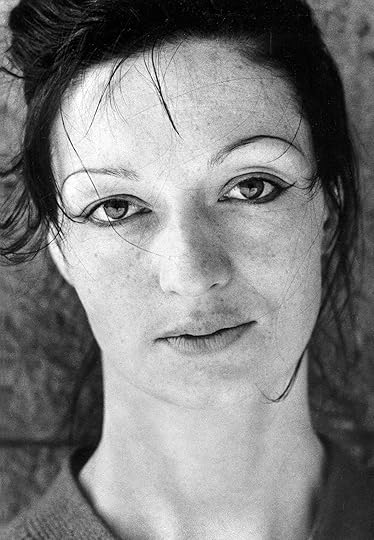
The most obvious way to make sense of this book is the longitudinal view. The pictures are sequenced chronologically. As one turns the pages, one sees human lives unwind at record speed. Parents, wives, children, grandchildren. It's very moving. There is the famous portrait of his first wife Mate, in 1959, looking frazzled and fragile in the lens. Horvat remembers: "It wasn't one of our best days. We had quarreled, as often. But I had to make a test with a new lens, and she agreed to pose. While she was still upset and still looking at me with a mix of resentment, pain and affection." Later the couple broke up. Three hundred pages and 48 years later the image appears again, now mounted to a hospital door in the background, with Mate, in bed, and her (and Horvat's) son Marco taking their leave from one another. On the opposite page is a picture taken at Mate's funeral. Again her younger persona, terribly distant and alone this time, stares the viewer in the eye. Nobody in attendance, apart from the photographer, seems to notice her anymore.
Pictures are interspersed with short, wry comments by Horvat himself. He is an excellent raconteur. These observations give context and depth to his career, and to the many personal projects that he pursued over the years. He is also very articulate in discussing his ethos and approach as a photographer. How and why would you photograph your own hands? What about capturing an image of a sculpture? How to take a portrait of a tree? An unavoidable motto theme is the female element. FH adores women and it shows. Throughout his life, he explored them photographically and plumbed the depths of the sexual drive that pulled him toward them. It makes for a great number of memorable but hardly glamorous portraits and nudes.
There are fallow intervals when creativity seemed to flag. But Horvat kept on shooting, even if only garbage bags or pigeons in the garden. It is precisely this kind of persistence and lack of pretense that separates artists from wannabes. This book is more than a warts-and-all family album. It is in effect an instruction manual for photographic searchers who are not satisfied with producing eye candy but want to capture the texture of a real, lived life.
Mate, 1959
Note: many of the pictures included in the book can be viewed via Frank Horvat's website Horvatland. Not as nice as having a book in your hands, of course. I must admit that the paperback version of this Photographic Autobiography has not been well produced by Hatje Cantz. The dust jacket of my copy has completely detached from the text block.