Jump to ratings and reviews
Rate this book

Russia Against Japan, 1904-1905: A New Look at the Russo-Japanese War

Rate this book
The Russo-Japanese conflict was recognized, in its time, as introducing a new era of warfare, involving millions of men and weapons of mass destruction. In the decade which elapsed after its end much was written about it. The First World War marked a second stage in the development of twentieth-century-style total war, and so overshadowed the Russo-Japanese War that little further study was made of the latter. Subsequent books on this subject were for popular readerships, and mainly recycled the knowledge and beliefs of the pre-1914 years.This book aims to present a short account of the war, stripped of the legends that successive journalists and authors have attached to it, and at the same time present new angles and interpretations based on hitherto unused Russian-language sources and on the specialized monographs of the few scholars working in this and related fields. While not claiming to be definitive, it does provide a fresh start for the study of this war, whose importance justifies a clear-headed examination, casting light on Russian military and naval tradition.The distinctive psychology of Russian generals and admirals is well illustrated in this book, and the conclusion that the former were for bureaucratic reasons happier in defense than offense, and that the latter thought in military rather than naval terms (regarding battleships as fortresses that, under pressure, they could surrender of demolish), has implications for the understanding of subsequent Russian and Soviet history.Among the incidental implications is that during this war the British and American press sank to such a voluntary and involuntary level of distortion that its performance in subsequent wars can only be regarded as an improvement.Here and there in the book explanations for subsequent Russian and Japanese behavior can be glimpsed; not the least of these is the circumstance that at the end of the war Russian generals and officials felt cheated of certain victory while exactly the same intense and long-term frustration gnawed at Japanese public opinion. It was really an unsatisfactory war for both sides, the innumerable dead winning nothing worth while; in this and many other ways the Russo-Japanese War was a dress rehearsal for the First World War.

183 pages, Hardcover

First published May 1, 1986

Loading...
Loading...

About the author

John N. Westwood

37 books4 followers
Dr. John Norton Westwood, b.1931, is an honorary member of the Centre for Russian, European and Eurasian Studies at the University of Birmingham, England. He has been an honorary research fellow at Birmingham since 1976.

He has written extensively on Russian and Eurasian issues. He also writes on steam trains and international railway history.

Ratings & Reviews

What do you think?
Rate this book

Friends & Following

Create a free account to discover what your friends think of this book!

Community Reviews

5 stars
5 (38%)
4 stars
6 (46%)
3 stars
2 (15%)
2 stars
0 (0%)
1 star
0 (0%)
Displaying 1 - 2 of 2 reviews
Profile Image for Charles.
621 reviews132 followers
March 8, 2025
A brief, military and political history of the likewise short Russo-Japanese War of 1904-1905.

description
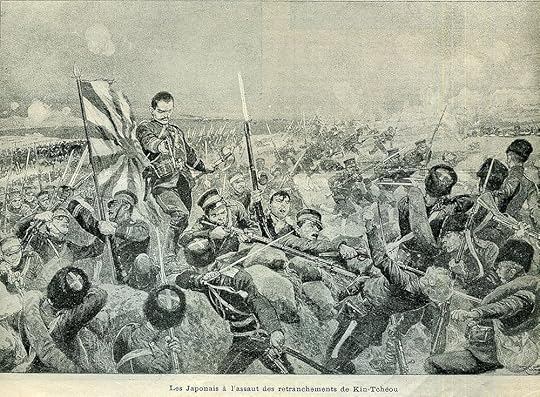
1904 Period graphic “Japanese assault on the Russian entrenchments”.

My dead tree version was a slender 283-pages. It had a US 1986 copyright. This book included: a Map, Footnotes, Photos, Bibliography, and an Index.

John Norton Westwood is a British historian of Russian Studies. He wrote more than 10 books on Russian military and diplomatic history and separately on train transportation and technology. This is the first book I have read by the author.

This was an intermediate work. It is recommended having a background knowledge of late 19th and early 20th century military and diplomatic history. Familiarity with East Asian geography and the culture of the European Belle Époque would also be helpful.

TL;DR Synopsis

Russia Against Japan was a 38-year-old history of a war occurring 120-years ago. The result shook the European Great Powers: Great Britain, Germany, France, United States, Russia, Italy, and Austria-Hungary, of the time. It was the first time an Asiatic power had defeated a European power in the ‘then’ modern warfare.

The conflict started over competing Japanese and Russian interests in carving out Manchuria and the Korean peninsula from the foundering Chinese Empire. This was part of what was known as the Scramble for China.

Amidst the collapse of the Imperial Chinese Empire in the first years of the 20th Century Imperial Russia expanded Southward out of its Far East provinces into Manchuria seeking Chinese markets and raw materials as well as extra territorial concessions to speed the development of their Far Eastern possessions. It should be noted that the single track Trans-Siberian railway was the single connection for men (and women) and material of European Russia to and from the Russian Far East. It took two weeks for an officer courier traveling 'Express' 7x24 to get from Moscow to Mukden, Russia's Manchurian rail hub. There was also a telegraph, when it worked. This expansion included the adjacent Korean peninsula, likewise a Chinese territory.

While the modern, regional Great Power of Japan was willing to tolerate a weak Imperial China bordering the Sea of Japan, another ‘Great Power’ was unwelcome. In addition, the markets and raw materials of Manchuria and Korea were just as valuable to Imperial Japanese development as Imperial Russian.

Negotiations between the Japanese and the Russians over Spheres of Influence broke down. The Japanese made a Surprise Attack on the Russian Asiatic Fleet at their Chinese base, Port Arthur (now the Lüshunkou District, in the city of Dalian, China) and troop landings on the Korean peninsula. ("Surprise Attacks" should be recognized as acceptable in early 20th Century Japanese diplomacy?)

The war consisted of three major fleet actions (Battle of Port Arthur, Battle of Round Island, and Tsushima). A siege (Siege of Port Arthur). In addition, there were several major ground engagements in Manchuria (Battle of Nanshan, Battle of Liaoyang, and Battle of Mukden). The Russians did not account for themselves well. They lost all the naval engagements. With the Japanese success of the Siege of Port Arthur, Japan had sea control of Bohai Sea, Korea Bay, Yellow Sea, and Sea of Japan. While the Russians accounted for themselves well on the ground, the land war was a continuous retreat northward across Manchuria. However, Japanese losses were heavy and debilitating in their victories.

The Japanese connived a peace settlement with the aid of the American president Theodore Roosevelt. Despite being in a militarily stronger position, and steadily reinforcing the Russians were war weary due to lack of successes. In addition, internal unrest in European Russia detracted from the war effort. They conceded Manchuria and Korea to Japan. The Japanese despite successfully hiding their relative weakness, and substantially achieving their territorial goals in the peace, did not receive the indemnification they sought. This economically hampered the weaker power and its recovery which extended for decades due to the World War and Global Depression.

Westwood’s book was a standard military and diplomatic history. It was more European and Russian-centric than Japanese, likely due to language issues with Japanese sources and a surfeit of English and European language sources. The organizational behavior of the Imperial Russian Navy and Army was well covered. The Imperial Japanese Navy and Army less so. Most important was the description of how the military technologies, including practices and procedures evolved from the earlier example of the American Spanish American war, and the Great Power colonial conflicts after it, in a short period of time to presage those of the imminent World War.

The Review

I became interested in the Russo-Japanese war after reading The Russian Baltic Fleet in the Time of War and Revolution, 1914–1918: The Recollections of Admiral S.N. Timirev (my review). Timirev, an Imperial Russian Navy officer, early in his career served on the ground in the Siege of Port Arthur after his ship was lost. It was a formative experience. He described a lot of honour and glory in that defeat. However, that didn’t ring true in my memory of that siege. That is why I read this book.

To Timirev’s credit, junior naval officers, and sailors, according to Westwood, accounted for themselves better ashore at Port Authur’s fortifications, than at sea under command of their naval leadership. Timirev aside, what I found most interesting was Westwood’s insight into the organizational behavior of the Imperial Russian Navy and Army. It had not changed greatly over two World Wars, and is still discernable today in reports from the Russo-Ukrainian War.

This book was not completely what I expected. However, it was: brief, credible and in places entertaining.

The book’s prose was good. Good copyediting left the book well-groomed. The prose level was correct for an intermediate-level military and diplomatic history. Organization was chronological, with naval vs. ground sections being interleaved. To his credit, the narrative could occasionally be ironically humorous in places, should you have a feel for British irony. For example:
The Russian officers were very different from the Japanese. In terms of courage, they were perhaps equal, but in terms of energy and initiative. They were a mixed lot. Some were highly trained in military academies. Others were army officers because in their youth this seemed an honourable career for incompetent sons of the nobility.
An issue I had was Westwood used period Chinese, Korean or English transliterations and names for places. Oddly, I cannot recall a single Chinese person being mentioned, although several Koreans were mentioned? Place names have changed mostly in China. For example, Seoul remains Seoul in Korea. Chemulpo is now Incheon in Korea. Mukden is now Shenyang in China. Mentioned previously, Port Arthur is now Chinese Dalian.
Technically it was spot-on. Which is to say, a background in late 19th and early 20th military process, practice, and armaments was needed. For example, a familiarity with pre-Dreadnought naval architecture and defensive use of Maxims with "interlocking fields-of-fire" in fortifications was assumed. Note Westwood, did not address the effect of the war on Chinese (at all), Japanese (superficially) or Russian (somewhat) specifically. The effect of Russian and Japanese internal politics was briefly covered. For example, the war was near ruinous to the Japanese fiscal economy. The narrative very occasionally included anecdotes, although they were all military in nature.

The description of high-level strategy, operations, and tactics of Russians and Japanese, was well handled. I found interesting the evolution of the use of: cavalry, artillery, and infantry, between the First Sino-Japanese War (1895) for the Japanese, and the colonial wars fought by the Russians. For example, the Russians took too long to adapt to Japanese counter-battery fire and deploy to use indirect-fire to preserve their artillery.

Both the climate and the geography of Northern China, and their effect on events were sparsely covered. Climate was only to the detail of the season. (Winters were very cold.) In general, the terrain of a particular engagement was included, but the larger geography of Manchuria, except for the few roads and railroads was neglected. Contemporary maps were of little use. The period geography of Port Arthur has been swallowed-up in urbanization. Except for the shape of the harbour, its barely recognizable on Satellite maps. Likewise, Liaoyang, and Mukden are hard to fit to the 1904 description.

Footnotes were numbered in-line and found in the back. They were equally split between literary citations and amplifying information. There were very few footnotes.

There were 16 pages of small B/W photos. They were good. There were the usual Victorian, Generals and Admirals with their fruit salad on display. The ground war photos of both sides were well chosen. The great majority of naval photos were Russian ships.

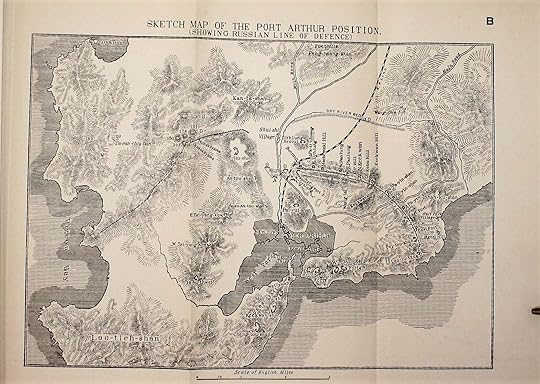
Military history is about maps. There was one, large scale map. It was a line map. It included place names, rails, and major roads, but other than coast line, no terrain features. Its presentation and annotation barely supported the narrative. A map like that below would have been greatly appreciated.

description
Sketch Map of Port Arthur Position (Showing Russian Line of Defense)

The Bibliography contained no reference younger than 1966, with most from the very early 1900’s.

The Index was brief, with a mixture of references. I noted that Russian ship names found in the theater were scrupulously noted, while Japanese ships were almost absent.

Westwood’s narrative was about: men, nations, and organizations in contention. Typically, technology is included. However, for so pivotal a conflict, he has very little to say about it in the narrative. He did cover the generals and admirals very well.

Entering the conflict, the Japanese were better prepared than the Russians for this prelude to Modern Warfare, although not by much. The Japanese were armed and trained to European state-of-the-art standards. They had recently defeated the western-armed and trained Imperial Chinese armies and navy in the First Sino-Japanese War (1894-1895). This introduced them to modern warfare. However, despite the arms and training the Imperial Chinese were not a European opponent. Japanese military doctrine while advanced was not yet completely developed.

The Russians had not fought a major war in decades. The Russian army was experienced and proficient in the small, colonial conflicts (insurgencies) with tribesman along its southern borders. The Russian navy had not fought a major engagement since the Crimean War (1853-1856). However, being a European power, it was forced into the high-stakes arms race of the competitive Great Powers. As such, Imperial Russia had a: large, well-armed, albeit inexperienced in modern warfare army and navy. Still, Russian military doctrine was crucially undeveloped for modern war.

Westwood did a very good, in-depth examination of the organizational behavior of the Russian military. Interestingly, the Imperial Russian generals and admirals were more likely to be described in conflict with each other, than with their Japanese opposite. In contrast, the Imperial Japanese Navy and Army hierarchy appeared to be more top-down and hierarchical. There were no internal conflicts in the Japanese command, the way it was endemic in the Russian command. I cannot be certain if this was due to the lack of Japanese sources incorporated, or it was purely cultural/organizational?

It should be noted that it was only in 1868, that feudalism was abolished in Japan. The largest portion of the Japanese army and navy command at all levels in 1904 were of the Samurai-class. The oldest of which would recall wearing armour.

Likewise, substantially all the Russian officer corps of both services came from the Russian nobility. It wasn't until the huge expansion and casualties of WWI that the officer corps of European armed forces became democratized.

Most importantly, the leadership and the doctrine of both sides was severely flawed. None of the Japanese generals was a great general. Neither were their admirals. On the other hand, the Russian both naval and army commands were rent with dissent, conflicts in command and politics.

Japanese success in the war was due to: embracing modern techniques of warfare, relatively-quickly evolving them, a relentless aggressiveness, and a willingness to take casualties. This doctrine paid dividends in the beginning of the conflict, but left the Japanese armies spent and hollowed-out command-wise at its end. Had peace come later, the outcome of the war could have been different?

Russian doctrine was very different. It was heavily influenced by the politics of the Imperial Russian court and the service. Westwood, describes it as Russian generals and admirals:
were more frightened by failure than death. Moreover, they were able to justify their attitude with real arguments.
As such, the Russians were successful on the defense, brilliant in retreats, but would habitually sacrifice the initiative in combat in favor of their predilection for defense. (Wars are not won by being perpetually on the defensive.) As such the Russian war in Manchuria can be seen as a prolonged withdrawal to the North, with few offensive actions. The siege of Port Arthur, being a good example for both army and navy behavior. In addition, the Russians were much slower than the Japanese to innovate in the unfamiliar type of warfare. This was despite having superior armaments to their opponent.

The naval aspect of the war likewise presaged WWI. The Russians and the Japanese were initially closely matched. However, the Japanese seized the initiative early, and never relinquished it. At all points the Japanese were executing an offensive along interior lines from nearby Japan. Vladivostok was the Russian main naval base in Asia with connections to European supply. The timid Russian naval command let its ships get bottled-up in remote Port Arthur where they were content to stay. When finally forced to relocate because of the progressing siege they were defeated by the better-trained Japanese who had not been languishing at anchor. The survivors of the Russian squadron were sunk in Port Arthur harbour by Japanese army artillery. A second Russian fleet thrown together from the Baltic squadrons sent to the warzone suffered a similar fate. A combination of: poor leadership, rules-of-war and neutrality, the limitations of coal-fired steamship naval technology and extreme distance provided the final military defeat of the Russians at The Battle of Tsushima.

Westwood scrupulously named the important characters in the conflict. The Europeans being better documented than the Japanese. Interestingly, he described the Russian court politics that led to the emphasis on Siberian and Pacific Maritime province development. Unfortunately, he could not provide the same level of detail on Japanese covetousness of Korea.

Summary

The Russo-Japanese war of the last century was forgotten in the greater calamity of WWI. However, it was earthshaking in that an Asiatic power had defeated a European power on a somewhat-level playing field.

Japan rose in status from a minor power to the lower ranks of the Great Powers and received the colonial trappings of a Great Power in Manchuria and Korea. Note this ascent eventually led to the Great Pacific War (1941-1945).

Russia lost status as a great power, by demonstrating its weakness and backwardness, despite its enormous size in territory and population. It also resulted in a re-orientation of Russian resources from the Russian Far East to European Russia.

The greatest strength of this book was its brevity. Its greatest weakness was it was unbalanced between the copious amount of detail on the Russian war in comparison to the Japanese war. For example, Russian Lieutenants were mentioned my name in the Port Arthur siege, while no mention of any Japanese officer below the rank of general appeared.

Westwood’s analysis was solid, it was also very mainstream. He was particularly good at conveying the points of military and political high-level influences.

This is a worthwhile read for someone who already has a background in early 20th Century military and diplomatic history and China. With that background, it is a quick history with a fair amount of period detail on the beginning of the end of Europeans in China at the beginning of the 20th Century and the shift toward Japanese power in the region.

Readers interested in a longer and more contemporary book, I liked, might read The War of the Rising Sun and Tumbling Bear (1988) by R. M. Connaughton
.
Profile Image for Jim.
154 reviews5 followers
June 12, 2019
A concise look at an important war that unfortunately, many in the Western world seem to have forgotten entirely. At the beginning of the book, Westwood provides a short history of the years preceding the war and the geopolitical situation of Asia at that time. Both Russia and Japan desired hegemonic influence over the region, particularly over China and Korea. It seems that war between the two nations was inevitable, the political battles over regional influence were large enough to lead to armed conflict. The middle and latter portions of the book detail the land and sea battles of the war. For an American reader such as myself, it was interesting to learn that Japanese units at the Siege of Port Arthur used Banzai charges against entrenched Russian positions, a tactic that would be repeated against our Marines in the battles of the Pacific theater.

An interesting point Westwood made at the end of the book, is that instead of working out a peace deal with Japan, the Russians could have no doubt continued the land war until they found themselves victorious. They certainly had the manpower to do so, which would be a major factor in propelling themselves to victory in the Second World War. However, Tsar Nicholas II and his government were dealing with major political turmoil. The growing anti-war movement, Red agitation, and big strikes by factory workers took the political will out of the war. The exact same issues would repeat in 1917, taking Russia out of the First World War.

Overall, this book is a good introduction to the Russo-Japanese War. Make no mistake, the war was a wake-up call to the Western world. Europeans would learn that the peoples of Asia could use the tools and weaponry they created and triumph over them.
Displaying 1 - 2 of 2 reviews