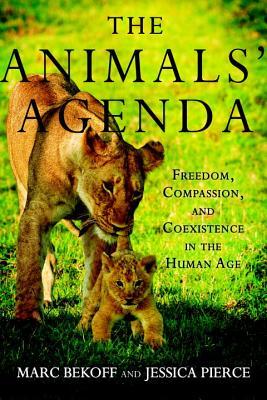
A compelling argument that the time has come to use what we know about the fascinating and diverse inner lives of other animals on their behalf Wide-ranging studies of animal intelligence and emotions have enabled us to learn ever more about what animals think, feel, and want. However, this knowledge is not necessarily translating into more compassionate and respectful treatment of animals. The Animals Agenda critically addresses our relationships with animals in factory farms, research labs, and entertainment venues, as well as our interactions with pets and wildlife, exploring what we know of their capacity not only for pain and frustration but also joy and empathy. Using the latest science, renowned animal expert Marc Bekoff and leading bioethicist Jessica Pierce argue for a paradigm shift. They demonstrate that the current approach of animal-welfare science, while offsetting some of the worst aspects of animal suffering, falls far short of promoting true animal well-being and freedom. The Animals Agenda will educate and inspire people to rethink how we affect other animals, both unintentionally and intentionally, and how we can evolve toward more peaceful and less violent ways of interacting with our animal kin in an increasingly human-dominated world."
I won this at LibraryThing’s Early Reviewers Program in exchange for an honest review. It took almost 2 months to arrive and came only 4 days prior to official publication, though it is a publication ready hardcover copy, for which I’m very appreciative.
4 ½ stars. I wanted to round up to 5 stars because of its importance but I’m rounding down, the reason being that for me it wasn’t a page-turner and there was no new information (except for some specific details) and though if I hadn’t already had the information it might have been a life changing book for me, I’m not sure if that will be true for readers learning new information from it. Which changes people make about how they relate with non-human animals aren’t stressed enough in my opinion. There was definitely not enough about veganism specifically. So many topics were covered so every topic got spread a bit thin, though each did contain a lot of information. Also, there is a hokey last paragraph. So 4 stars vs. 5 stars but I do love it and hope that it’s widely read. I’m afraid only those readers who already have great interest in the subject will read this book.
I think that it’s a really important book. I’ll even say that it’s a must read book, and I rarely say that. It’s a scholarly book and it helped me to have a background in psychology and in science, but it wasn’t at all necessary. Anyone who has even the remotest interest in the rights of non-human animals and and/or in human rights is likely to be glad that they read it. Preaching to the choir isn’t sufficient.
To give some idea of the contents, the chapter titles are:
Chapter 1: Freedom, Compassion, and Coexistence in the Human Age Chapter 2: Can Science Save Animals? Chapter 3: The Animals Whom We Eat Chapter 4: Fat Rats and Lab Cats Chapter 5: Zooed Animals Chapter 6: Captive and Companion Chapter 7: Born to Be Wild? Chapter 8: Coexistence in the Anthropocene and Beyond: Compassion and Justice for All
In my opinion there is nothing radical here, though I’m sure some of the suggestions presented are ideas not considered by many and the authors do ask us to make changes the status quo. For many I guess that’s a radical notion, but it makes sense to me, and would have even if I were a novice in the subject. The vast majority of ethical vegans are familiar with these concepts and philosophies but they might be new and food for thought information for many other readers.
For me it was a tough read at times but it was worth it, and so fascinating, especially the details new to me, and there were some in almost every chapter. It wasn’t a fast read though, but I was able to read some other books concurrently. It took me about 2 weeks to read it, not bad since I’m a slow reader. I often felt sad and angry when reading but that’s a good thing. It’s one of the best animal rights books and a crucial addition. I hope that it does make a difference. It’s unfortunate but it’s an incredibly necessary addition to the genre.
It should be mandatory reading for every humane education class (geared toward adults and maybe high school students) and also would be a good book for many college classes, especially in the biological, ecological, health sciences and psychology classes. As I said before, it’s scholarly and it’s substantial and would be fine to use as a textbook. That said, it works well as an interesting book for laypeople too.
Part of me said Well, duh! but of course it’s a necessary book, though it always boggles my mind why this is true.
It focuses on the science of well-being, very much including individual animals, and talks a lot about freedom. It’s an animal rights vs. animal welfare book, and those who read it will understand the reason for its focus.
I was scared to read the chapter about companion animals, but I overall I was pleased and agreed. My main objection (and surprised shock) in this chapter was companion animal’s human family members being called owners by these authors. Nope! Please don’t use the term owner. The word guardian is ok but companion or family member are even more ideal, in my opinion. I admit I get into the momma, daddy, sister, brother words at times with dogs and cats. So sue me.
Just a note: I was gratified to get validation regarding my feelings about Temple Grandin.
The book is extremely well researched, even though a lot of what’s reported are interesting personal stories.
This book isn't as long as it looks. The book proper goes to only page 182. (Notes pages 183-196, Bibliography pages 197-212, Index pages 213-225.)
I’m very grateful that I won this at LibraryThing. I’m so glad that I read it and read it now. Given my enormous to read shelf and my ridiculously growing on deck shelf (only my at home plate shelf is close to reasonable) I’m not sure I’d have ever read this.
Local people: I’m happy to lend it out. Please just ask.
Anyone with a shred of compassion should be disturbed by the way animals are treated within the food, entertainment, and science industries. This book takes a look at all these areas, showing us the truth of what it means to these animals - and to us human animals - as we continue the cycle of abuse.
Most of the material here isn't new, though it is presented in a new and unique way. We see that even those who claim to be studying and advocating animal welfare often come at the issue from a selfishly human perspective.
The section on companion animals is a nice addition not typically included in this type of book. The authors discuss issues such as whether to keep cats indoors or allow them outside. They also share some insightful, personal experiences. I was disappointed that this section didn't include a discussion on the pervasive and horrible abuse within puppy mills, as well as the puppy mills' connections to pet stores.
The writing style is a perfect combination of academic and conversational. I felt the emotion of the topic within the facts presented.
This is a fairly short book with a wide reach, and consequently much of the information is presented more as a brief overview than an in-depth study. The format works well in regards to keeping readers engaged, particularly for those new to the topic and/or those who don't want to get bogged down with too much heavy content.
*I received a copy of this book from the publisher, via LibraryThing, in exchange for my honest review.*
ReedIII Quick Review: A well thought out, well presented, well written, well researched, informative call to action. What is animal well-being and why should be care. Included some success stories but was a little light on how to make a difference.
The Animals' Agenda: Freedom, Compassion, and Coexistence in the Human Age summarizes current research into exactly what animals think and feel. The research shows that they have much more complex thoughts and feelings than most people realize. The authors organize these results into several chapters: laboratory animals, food animals, zoos, and pets. Within each chapter, about a paragraph or so is used to summarize each research article that the authors chose, and extensive notes and a bibliography is provided at the end for further research. There really isn't any new data here, but instead a decent summary of current science. The authors are concerned about the well-being of individual animals, not species, and it shows in their attitudes towards animal welfare scientists, who they call "welfarists" in an attempt to denigrate them. The authors agenda is extreme veganism and they espouse "freedom" for all captive animals. While I certainly agree that much work remains to be done to improve our relationship with all animals, I think they go too far. In a world of over 7 billion humans, most of whom eat meat (and aren't going to stop), industrial farming of plants and animals is a given. We really need to focus on how those animals are treated, but the fact is that animals are going to be eaten. If not by humans, by other animals. We also need to work to provide our pets the best lives possible, but giving outdoor "freedom" to cats dooms billions of birds and small mammals to death. All-in-all it's a decent book with a great list of references, but not at all based on reality.
(Note: I received this book from the publisher via a GoodReads giveaway.)
As with all of Marc Bekoff's books that I have read, I really enjoyed this book! I really appreciate that he and Jessica Pierce both present the theme of the book as exploring the whole ethic itself of animal welfare science, and each of the chapters in the book, whether it's exploring captivity in zoos or lab animal research or animals in the wild, comes back to deliberating on this ongoing theme. Not a lot of books do this in this way, where the reader is also learning, at the same time, about the many different facets of animal exploitation in our society, including the above, the farmed animal industry, and the not-so-obvious (ie. our relationships with domesticated animals who we call "pets"). The authors interweave their own personal experiences with stories of other animals, and then bring the science back into it to carefully and thoughtfully present the questions and flaws that arise in the stream of animal welfarism.
Thank you to Marc and Jessica for writing this book that I hope will open the average person's eyes to the many issues that animals exploited in captivity face these days (and the whole human value, itself, of keeping animals behind bars). The very basis behind animal welfarism ignores the notion of what the animals truly want themselves, which is to be free from exploitation altogether.
Such important subject matter told passionately and convincingly, this an excellent but not always easy read, arguing for drastically improved treatment of animals, allowance of freedom of animals, and an end to invasive human interference of animals. The authors comprehensively dive into the lengthy and damaging footprint the human race has callously left on all other animals in the world. It’s not possible to read this book and not be affected by it enough to take pause and initiate change.
I received this book from a Goodreads First Reads giveaway.
I gave three stars because, to me, it was ok (and depressing), but it discussed an important topic. It took me awhile to get through it, and it certainly had me thinking. The book discussed animal welfare, and stated that welfare is not enough, that we humans must focus on animal well-being, both individual and groups. The authors talk about the problems and ethical issues surrounding animals raised for food, lab animals, 'entertainment' animals (zoos, aquariums), and wild animals.
I learned some things I wish were not true and that stunned me. For example, being from a rural area, I've heard the rationale behind hunting deer: population control, because it is better to be hunted than to starve to death. I was also already aware of people killing wolves for eating livestock. What I learned was that killing for population control is more common than I ever knew. One owl species was being killed to try to save another owl species. The first owl species was invading the territory of the latter because humans drove them our of their natural territory. To save one species, we kill the other, even though they are just trying to live and we forced them out in the first place, causing the problem.
I've heard the "once a nuisance bear, always a nuisance bear," which is used to justify the three-strikes-and-you're-dead rule against bears coming into human areas and rummaging through garbage. What I didn't know was that the once a nuisance, always a nuisance is not true. Bears come into human areas because food is lacking in their territory and human garbage is tantalizing. However, according to the authors, when food is adequate in their territory, bears do not enter human areas. So bears are being killed because they are dangerous to humans by coming into close contact with them because they are hungry.
To me, when reading, I saw too many problems that humans have caused animals, which was the point of the book. Some population problems between various species exist because humans encroach on their territory, forcing them to move (either the animals flee themselves, or we relocate them, which is harmful to them, I did not realize that). When the animals are in a new location, they have to compete with other species and other animals of their own species, so predation occurs, such as with the owls. I have often wondered what would happen if hunting deer was outlawed, and, yes, the deer population would explode. I believe it would eventually rebalance, if natural predators, like wolves, were permitted to live and eat and if humans were hands-off. The suffering until nature rebalances breaks my heart, and humans have never been very good at being hands-off. And how can we, when our own population continues to grow? People must have shelter and food, etc. The book raises the questions of why are we more important than other species, and what gives us the right to exploit and dispose of animals because it is convenient and suits our purposes? The book is all about questioning why human needs trump those of nonhumans.
I have never liked labeling a species "problem species" or "nuisance species." They are not a problem or a nuisance, they are just trying to live their lives. But in our interpretation and for our purposes, they may be both. The book mentioned Chernobyl, the site of a tragic nuclear accident in Ukraine in 1986. I noted this myself when reading about the accident and its aftermath, and greatly appreciated the authors stating that it would seem that animals fare better in a radioactive area because it has been abandoned by humans than to suffer the effects of living near humans.
The book is a call for compassion and peaceful coexistence between humans and animals.
The more we know about the emotions and thoughts of animals, the more we realize how badly we treat them in the industry, in the zoos, in the laboratories and sometimes even in our homes. In this very well informed book, Marc Bekoff and Jessica Pierce defend an moral approach to the animal’s concerns and interests based on the notion of freedom. According to the authors, we should provide more freedom to the animals we interact with, freedom from hunger, freedom from discomfort, from pain, from fear and distress, freedom to express normal behavior etc. Freedom of individual animals matters. The book brings to the reader the results of cutting edge research on animal cognition and explores their consequences to our understanding of the harms we are causing to the animals. Their general position is clearly stated in non-technical terms. However, as the authors have ethical ambitions, they should have engaged more systematically with the philosophical literature on animal rights, at least one chapter could be dedicated to present and debate explicitly their moral position on this issue.
I am a real animal lover so this book was a wake up call. It had been a while since I had read a Marc Bekoff book. He is very good getting his point across in a way that does not make you feel guilty about having that steak. He believes in humane treatment of the animal. He is against the cages that hens are kept where they can't move around and pigs that on grated floors and can't turn around, unable the scratch themselves and are fed to the point they can not hold themselves up. Very good book. It didn't make me become a vegan or even a vegetarian. But I can choose foods that treat the animals humanely.
The first part of this book was interesting, but got less so as the book went on. An academic writing style that I didn't expect kept making me fall asleep while reading on a semi regular basis and not looking forward to picking it back up. I also found some of the author's points hard to relate to when their author bios say they live in Boulder which along with Denver are to me the places that come to mind when I think of excessive encroachment on wildlife and habitat destruction in the US. This book discusses an important topic but it just was just an ok read. I received a free copy of this book through Goodreads First Reads giveaways.
A truly compassionate look at animal well-being vs animal welfare, and starting from a place of true freedom for all animals.
"The essence of the ethology of freedom is that behavior is a window onto what animals really want and need--to be free to live their own lives, to be free from the suffering and exploitation to which we subject them--but only if we are looking the right way: straight into the eyes of the animals themselves."
This book will shake you, as all great books should, to your core. I fancied myself as an animal lover and fairly mindful of how I treated other creatures; but this book exposed my deepest hypocrisies and forced me to reevaluate my attitudes and beliefs. A truly mind blowing and soul searching piece of work.