Brian Wildsmith (1930-2016) was raised in a small mining village in Yorkshire, England, where, he says, "Everything was grey. There wasn't any colour. It was all up to my imagination. I had to draw in my head..."
He won a scholarship to the Slade School of Fine Art where he studied for three years. For a while he taught music at the Royal Military School of Music, but then gave it up so that he could paint full time.
He has deservedly earned a reputation as one of the greatest living children's illustrators. In 1962, he published his first children's book, ABC, for which he was awarded the Kate Greenaway Medal, Britain's equivalent to the Caldecott Medal. He was also a runner up for this medal for The Owl and the Woodpecker.
Wildsmith has said: "I believe that beautiful picture books are vitally important in subconsciously forming a child's visual appreciation, which will bear fruit in later life."
In 1994, the Brian Wildsmith Art Museum was established in Izukogen, a town south of Tokyo, Japan. Almost one and a half million people visited a traveling exhibition of his work in 2005. Eight hundred of his paintings are on loan to the museum.
Brian is married, has four children, and currently lives in the south of France.
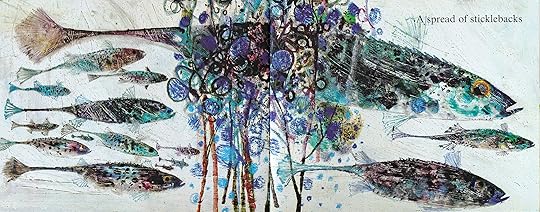
This is an absolutely beautiful book! Each double page spread features an ocean creature in it's habitat and it's collective name, a spread of sticklebacks, a herd of seahorses, I can't remember any other examples I was too busy looking at the illustrations. I wish I had seen this when my children were young, they would have loved this. Highly recommended for young ocean life enthusiasts and older ones too!
Gorgeous and mysterious illustrations of fish of all types. Lots of new vocab words for groupings of different species! It's always nice to see fish being celebrated for the unique creatures they are, rather than the more-common ode to all of the ways humans use and destroy them.
First published 1968 early in Wildsmith’s career is typical of his bold bright colors schemes and this time it focuses on fish in their various groups and gives us their collective noun for each individual species. For many years I have assumed that the collective noun for fish was “a school” that is not the case. In this title we see a leap of salmon, a hover of trout, a herd of seahorses, seventeen species in all. Someday I hope to have read all of Brian Wildsmith’s titles.