Jump to ratings and reviews
Rate this book

The Boston Castrato

Rate this book
Runner
2016 New England Book Festival Award, General Fiction

This book does for 1920s Boston what E.L. Doctorow did for New York in it grabs a city out of history, mixes in some fiction and makes it vivid. Be it the high style of Boston’s Parker House Hotel; the flagrant, fragrant set who dance attendance on the poet Amy Lowell; the scientists and shipbuilders and politicians and utter rogues who raise the city from the dirt; it all mmers into reality as an outsider leads us into its quaking heart. Raffi, a young Italian, is our guide. He left more than his country behind in Rome. Snipped by a bishop as the last castrato, he is bundled off to America when the Church takes shame. Forbidden to use his voice, other skills steal him into the society of 1920s Boston. Raffi enters the hardest quest of all--the search for a genuine love song.

292 pages, Paperback

First published October 3, 2015

Loading...
Loading...

About the author

Colin W. Sargent

5 books41 followers
On the 2023 U.S. release of Red Hands

Hunt them down!

Heedless, headstrong, and headlong love. Who knew it would doom her country, too? Intelligent, stylish Iordana wasn’t interested in communist strategies while she enjoyed spectacular privilege–unimaginable to the 20 million souls living under the iron fist of a dictatorship ruled by a murderous family she chose to marry into.

But as a member of the elite Nomenclatura during Romania's cool 1960s, she had to have her Valentin. Just as she rose in the Ceausescu clan over her parents’ objections, so she fell when the murderous dictator and his criminal partner were taken down.

“Death to the Dracu grandson” rang through the subways. An angry world chased her and her son in an effort to wipe the name Ceausescu off the face of the earth. They hunted her from Bucharest to Israel to Canada to closer than you think. She escaped to the other side of the world, only to find herself branded an illegal alien in a quiet suburb on the coast of Maine.

Where to go? Where to hide? How will he even register for school? A tiny town in America will have to do for now.


On The Boston Castrato, 2017

One of the inspirations for my writing The Boston Castrato is a recovered memory. Cleaning out my basement, I ran into a battered report card from the Ledgemere Country Day School in Cape Elizabeth, Maine. "After a very rocky start, Colin's behavior has improved and is now more in line with the norm."

About this rocky start. On the first day of school, I slipped out of class, climbed to the attic, popped through the skylight, and crawled up on the roof for a good look around. At home, my climbing pursuits had been encouraged, as my father was a B-17 pilot. But in kindergarten, I was most surprised to learn this was not the case. As punishment for giving everyone a big scare, I was forced to sit for a week at the PINK table, where all bad boys were marooned. Yes, I learned my lesson, but perhaps just not the one intended. This was my first experience with cultural castration, in this case by gender color-shaming. In one fell swoop, all the girls in the class were insulted, too.

I feel connected with outsiders, people dismissed for their culture, the color of their skin, their sexual orientation, the cut of their clothes, their dreams. I even feel drawn to smokers now, exiled and marginalized, forced to do their dirty business in the rain. Once they were people. They were stylish people! Then they were people who smoked. Now, ominously, they are Smokers. Once we've given you a label–and yes, we're all guilty of this–we've got you.

My novel Museum of Human Beings was about Jean Baptiste Charbonneau, the expedition papoose of the Lewis & Clark Voyage of Discovery who we decided would remain a baby forever. On coins, in school, on paintings, in song. How easy. We didn't even use his name. We labeled him the Papoose, which is really what he was riding in.

We use labels to make sense of the Universe, but in doing so we create nonsense.

There is a growing awareness of the tension between self-definition (by sex, by attraction, by ethnicity, by race, by age) and cosmic definition. These handles become elusive under scrutiny. Gender is not in your genitals, and sexual orientation is not in your anatomical sex organs. Raffi gives up conventional manhood by going through the most obvious transformation for the promise of celebrity. The Boston Castrato illustrates how corrosive labels can be, and how castrating, in that they make a person feel powerless. There are so many other ways your power can be taken from you, some of our choosing, some by birth, and some by circumstance.

At a dinner party, a friend (who died last year of multiple sclerosis but always kept her own naughty sense of humor, even in paraplegia) rabbit punched me with, Must everything be a joke to you? in her usual Teutonic clip. I'm experimenti

Ratings & Reviews

What do you think?
Rate this book

Friends & Following

Create a free account to discover what your friends think of this book!

Community Reviews

5 stars
26 (35%)
4 stars
17 (23%)
3 stars
18 (24%)
2 stars
8 (10%)
1 star
4 (5%)
Displaying 1 - 30 of 35 reviews
Profile Image for Alexis Hall.
Author 62 books15.6k followers
Read
December 18, 2021
I genuinely don’t know what to make of this. Err, I read it because, having read exactly one history book about a single castrato, Amazon is now like SO YOU LIKE CASTRATO HUH HERE ARE NOTHING BUT BOOKS ABOUT CASTRATI.

It was the setting of this one that caught my fancy, since I’m vaguely aware the Parker House Hotel was a real thing in Boston during the 1920s.

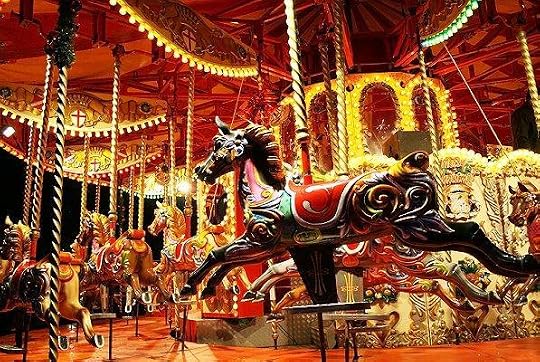
In any case our hero … protagonist? Is Raffi Peach, an Italian shipped off to American to essential hide him after a wayward priest, you know, mutilated him to preserve his voice. The book is probably best described as a picaresque carousel (is that a totally mixed metaphor?), swirling from Italy to America, from year to year, and character to character. Which kind of works? And also doesn’t? Creating something that is full of atmosphere, (self-consciously?) low on coherence.

Its got a kind of inherent queerness, because of the nature of the cast, although I don’t know how I felt a lot of the time about how that queerness was realised, especially when it intersected with race. The book is clearly very committed to the richness and authenticity of its setting, which includes a similar commitment to what might loosely be termed historically accurate attitudes. Though I will say I’m always wary about historically accurate bigotry/cruelty because things were often more nuanced than people are willing to give them credit for (for example, I read a review recently which cited historical accuracy for a reason a Duke wouldn’t be publicly known as a sodomite when you can point at actual historical figures who lived openly in their queerness). And sometimes it just feels like an excuse to be like, “oh yay, it’s okay to racist/sexist/queerphobic now!”

So yes. All very difficult in various subtle ways. On top of which I got kind of discomforted by how much textual attention was given to bodies, Raffi’s in particular. It felt a touch prurient. Oh, and his potential gf gets fridged after performance of Orpheus and Eurydice for, y’know, maximum thematic irony. Your mileage on killing women characters for thematic irony may very well vary.

This all sounding super negative, but it’s more … perplexed? Uncertain? Ambivalent? Than negative. Also I’m very aware I’m being squeamish in an out-of-my-lane kind of way. I did love the writing, and the setting, and the plot—when it finally works out what it wants to be—comes together nicely. I think? I was well into Amy Lowell though, who features strongly in the book, and was a real queer poet I’d previously never heard of. I’ve subsequently become rather fascinating by her.

Here is one of her poems:

You are beautiful and faded
Like an old opera tune
Played upon a harpsichord;
Or like the sun-flooded silks
Of an eighteenth-century boudoir.
In your eyes
Smoulder the fallen roses of out-lived minutes,
And the perfume of your soul
Is vague and suffusing,
With the pungence of sealed spice-jars.
Your half-tones delight me,
And I grow mad with gazing
At your blent colours.

My vigour is a new-minted penny,
Which I cast at your feet.
Gather it up from the dust,
That its sparkle may amuse you.


Also this book confirmed something for me that I have long suspected - which is that Ezra Pound was an almighty testicle wart.
Profile Image for Vivian.
2,931 reviews492 followers
January 31, 2016
It's so easy to be smug in a new century--you can't see what your mistakes are going to be.

This is stories with stories within a story, all summarizing life in post-WWI Boston. From the new immigrants, poor and easily displaced and lost to the Gilded Age blue-bloods dithering, falling prey to ennui or attempting to evolve. Rafael Peach is the axis from which the story is told.


At times, it's like watching a carousel, the story's participants come around and round as you wait for the music to stop. This is historical fiction with salacious on dits of early twentieth century Boston. Everyone has a secret to keep and they're all juicy from murder to cuckold to blackmail it's all dirty, dressed up in pressed clothes.


Rafael Peach, street urchin with a gift for song. He attracts attention one day and every changes. His castration by Diletti and the subsequent betrayal cuts deep as Raffi's promised career is stolen and he's hidden, and then shuffled off to America. He's growing up but his body is not changing. That sense of other is intensified and begins to cause problems with the other boys.

Fleeing the situation, Raffi learns a trade and an understanding of himself and acceptance. It is Raffi's tenure at the Parker House that alters his life's course. Raffi's fraternization with Victor and Amy Lowell's entourage leads to interesting adventures as the tilt-a-whirl is sent spinning. The unbridled decadence and showmanship as the posh try to outdo each other in outrageous acts careless of collateral damage. Corruption, murder, and extortion, another fine day in Boston as players get moved around the board, and old acquaintances meet again.

Discussions on the spectrum of sexuality touched on are fairly broad. Now is not the first time people are facing it even if it feels like it. Majority oppression merely means that we have to relearn it, again and again. But homosexuality, intersexuality, and gender queer has been around as long as people have. There are no long discussions or debates. Period appropriate terms are used, some wildly politically incorrect by our standards, but reflective of the time. Interestingly enough, those who are less common seem to be more content with their life than those who are deemed "normal".

While the short, ever-changing point of view format of the chapters was a bit disorienting it certainly added an urgency. I took a few breaks because I found it difficult to jump in and out of people's minds and sub-stories so frequently. The quotes at the beginning of the chapters are wonderful entrees, Neapolitan aphorisms that tied in with each.

Overall, an entertaining exposé of early twentieth century Boston.

Art is suppose to provoke, not just delight.
Profile Image for Jule.
819 reviews9 followers
May 4, 2016
I received a copy of this book via NetGalley in exchange for an honest review.

It is never a good idea to have the "praise from the press" section - the stuff before the novel proper - include people saying the book is like "Ulysses" and "The Divine Comedy". First of all, this may turn some people off. Secondly, it is even worse to include it if your novel does not end up living up to these classics at all. Which it didn't. Sorry.

Let's start with something positive: the language. I actually quite appreciated the beautiful and creative way Sargent wrote, and the picturesque but clear metaphors. He also had some innovative ideas, like

But.

It turns out you can take "show, don't tell" too far: to a point where the hints are so subtle and opaque that you over-read them, and then when the thing is treated as obvious, you feel like you it came out of nowhere. Also, there is no need for fancy synonyms like "the avian creature", when you have not even said "bird" once before. My biggest issue was the huge assortment of side characters, which all had their own chapters. However, I learned nothing about their motivation or personality, I just saw their daily life. Listen - write a mosaic epic novel about life in Boston, or the story of our protagonist Raffi and his struggles. Either is fine, you just have to pick.

At that point I was still willing to give the book an even 2,5 out of 5 stars - the bad plot balanced out by the good writing. Then it went downhill, and the actual rating is now closer to a 1,5.

There were such WTF-character decisions as: forcing a guy to walk into a pond to prove your power over him, letting someone force you to to walk into a pond, firing a perfect employee because his work ethic was inspiring others, having a character write a college motivation essay about his biggest obstacle in life having been losing a testicle - and having that be enough to get a full ride.

Also, dear author: naming the underground boss of the city "Stadt" - the literal German word for "city" - is a character naming choice obvious enough to compare to "Darth Vader" and "Remus Lupin". And while I will give you the car radio, which was indeed invented in the 30s, tanning beds in 1922? Sorry, they were not around until 1979. Cost me two minutes to research that.

However, that is all child's play compared to that passage starting "the bacterium considered", followed by an internal monologue from a bacterium. Also, actual conversations with a ghost (not the bacterium, a human this time). Things I did not know I don't want to read about...

Overall, I have a feeling I did not "get" this novel at all. There was too much going on, too much weird stuff, and I did not care about any of it. Again, sorry, but honest review means honest.
Profile Image for Bill.
471 reviews
January 29, 2024
Raffi is one of the last pre-pubescent boys castrated by the Church to preserve his singing voice. When the Church finally ends the practice he is given a lump sum payment, a ticket out of Italy, and commanded to never sing again in public. Arriving in Boston he takes a job at the Parker House Hotel where he eases his way into the city's high society.

The story is full of Boston history and lore, everything from the Lowell family and Isabelle Stewart Gardner to Boston cream pie and scrod. I did feel though that as interesting as all that was, too much of the novel focused on that and not on Raffi's story.
Profile Image for Tony Parsons.
4,156 reviews104 followers
November 18, 2016
1906, Naples, Italy. Raephaele Pesca (aka Raffie Peach, street urchin) was picked up & taken in by Father Diletti (choir master, The Duomo di Napoli).
Father Diletti castrated him & made him a eunuch.
He was caught in the act by Carlo (choir boy) arrested & taken away.
Fast forward; 1922, Boston, MA. Raffie is shuffled around & ends up at the Parker House Hotel.

Mr. Saltonstall was the proprietor.
Victor White took Raffie under his wing to be his assistant.
Other employees he met are: Stanley “Stan” (bellhop), Dante, Jeannie, Havelock, Stefania (embassy stenographer), Knox (bellhop), & Elizabeth.
What happened to Beatrice Favi (twin daughter, Raffie’s 1st. love)?
Who is Professor Moreschi?
What is Amy Lowell (poet), searching for?
Ending timeline: 1922, Boston.

If I could go back in time it would be to this era of time to NYC.
My Great-Great GP were immigrants.
WOP was my nickname growing up!

Warning: This book is for adults only & contains extreme violent or graphic adult content or profanity &/or sexually explicit scenarios. It may be offensive to some readers.

I did not receive any type of compensation for reading & reviewing this book. While I receive free books from publishers & authors, I am under no obligation to write a positive review. Only an honest one.

A very awesome book cover, great font & writing style. Wow, a very well written historical fiction book. It was very easy for me to read/follow from start/finish & never a dull moment. There were no grammar/typo errors, nor any repetitive or out of line sequence sentences. Lots of exciting scenarios, with several twists/turns & a great set of unique characters to keep track of. This could also make another great early 19th. Century movie, or better yet a mini TV series. There is no doubt in my mind this is a very easy rating of 5 stars.

Thank you for the free Goodreads; MakingConnections; Barbican Press; Autographed; paperback book
Tony Parsons MSW (Washburn)
9 reviews2 followers
March 24, 2016
Like snapping a dry wishbone, the magic begins instantly in Colin Sargent's resplendent new historical novel, The Boston Castrato. We witness the horrific butchering of our very young hero's potential (musical and otherwise) in a filthy, underground vault in sooty 1906 Naples; home of Vesuvius, the Catholic equivalent of inexorable hell. Though rescued a moment too late, bandaged by a conscientious nun, Raffi will recover in spite of himself, and be dispatched to the great teeming city of early twentieth century Boston, transforming from boy to almost-man, using his blade-like wits to defend, humor and launch his new identity without ever having to sing a single note again.

Self-cast as entertainer, wishful lover, savior and server, Raffi is desperate to outrun an inevitable fate. Heart broken, he weaves his melancholy way through the lives of others from mobsters to financiers to fellow immigrants and castrati,poets and painters, finding beauty in the eyes of the blind, the transexual and the lost. Outcasts all.

Much of Sargent's flair in the book lies in his linguistics, morphing from farcical humor even while illuminating the darkest personalities of some of Boston's finest citizens like poet, Amy Lowell and her Modernist coterie, to dazzling descriptions of moments caught in time, like a startled bird disturbed from its nest in a street lamp, vanishing into the night, the "azimuth of loneliness". In his vision, solitude takes many forms, has many homes, and try as one might to escape it with wealth and power, in the end one's greatest magic lies in the attempt to simply laugh at the mystery of it all.
Profile Image for Nikka.
45 reviews4 followers
December 13, 2016
I received this book in a giveaway.
The writing was lyrical and Raffi and Victor stole my heart, though there were fleeting moments where Raffi irked me. But I think that's because I wanted to help him not because he actually annoyed me or anything because I absolutely loved him. I liked when he was quippy. A good example was when Marie commented on his height and he asked, jokingly, if she had a saw. I liked that even though there were dark moments in this book it still had light, playful moments as well. Raffi was one heck of a trooper and I think he handled what was thrown at him quite well. And while I did enjoy the plot, specificially with nods to our history (both people and events), I do feel that some scenes could have been omitted and didn't further the plot in any respect. I still enjoyed reading those scenes though! I guess it was more for character development and bringing up characters into future scenes? That would be my guess but I can't say for sure. While the author's beautiful, fluid writing was captivating, sometimes it did become a little too much and at some parts was a bit so complex that it was confusing on what had happened in the scene. I loved all of the characters in this novel, particularly Amy. I would have liked for a little bit more of a character development from Raffi because it kind of happened quickly at the end but I still liked that an improvement happened regardless. Overall, it was an enjoyable read.
317 reviews
January 27, 2017
The Boston Castrato shines a different light on 1920's Boston. This story mixes fictional characters with historical personalities. The fictional Raffia Peach, an Italian immigrant who was castrated as a six year old in Naples, is forbidden to sing and hustled off to the new world. With the help of his blind friend, Victor, Raffi plans to work his way up in hotel management to become concierge at the famed Parker House. He encounters the factual Amy Lowell and an unusual assortment of characters. The Boston Castrato was an entertaining glimpse into a Boston I did not know although the streets and neighborhoods were very familiar to me.
Colin W. Sargent skillfully combines fact with fiction to create an entertaining look into an unfamiliar era.
I won this book through goodreads.
9 reviews1 follower
September 26, 2016
The really impressive achievement of this wonderful novel is that, while the author takes us into unique, often dark and exotic worlds, the reader is nevertheless able to fully identify and feel with Raffi his joys and sorrows. Highly recommended.
Profile Image for Ends of the Word.
567 reviews142 followers
December 9, 2016
This is one of the more unusual novels I've read in a while. It's hero/protagonist is one Raffaele Pesca or "Raffi Peach", whom we first meet as a street urchin and boy chorister in 1906 Naples. Padre Diletti, the choirmaster, has dreams of making the next Moreschi out of his young protege, and he therefore has the boy snipped before his voice breaks. The Church has, however, recently condemned the practice (which, in any case, had been illegal in Italy since 1870) and Raffaele's voice, rather than representing an (admittedly cruel) thing of beauty is now an aural reminder of a barbaric tradition. Raffaele is therefore ordered not to sing, and is shipped off to New York, where he is brought up in an orphanage in the Bronx. He returns to Rome where, as an employee at the Hotel Forum he, learns the tricks of hospitality and, through avid reading in the small hours, amasses a surprising treasury of knowledge. Armed with these formative experiences, he returns to America where, as "Raffi Peach", he tries to invent his life anew.

This is the premise of the novel, and over its several short chapters, we accompany Raffi as he meets fellow Italian immigrants, mingles with high society, is accepted in artistic circles with a penchant for sexual adventure, discovers love, works for a psychic society, meets (or not) his idol Moreschi, is hunted by the Mob, whilst all the while searching for the questions (sexual and otherwise) which haunt his life.

Raffi is very much the novel's strong point. He's an interesting character who is defined by the very fact of being undefined - the fact that he is a castrato makes him vaguely androgynous, he seems neither fully Italian nor fully American, he is technically from the "lower classes" but has enough cultural baggage and quick wit to make him at ease in the presence of society's elite.

In contrast, the other characters have very much of a supporting role, minor actors within the ins-and-outs of the picaresque plot. Indeed, this is very much a "choral" novel, with Raffaele as its star soloist.

Another striking characteristic of the book is its use of language. At its best, the novel shows a verbal virtuosity - some passages are a riot of metaphors and the dialogue is sometimes witty to the point of being "too studied". This approach might take some time getting into, but it's worth the effort - this is ultimately a "tall tale" told in an appropriately rich style.
Profile Image for Jackie Jameson.
437 reviews13 followers
February 28, 2019
I didn’t really like this book. I was so glad when I finished reading it. In trying to understand it, I thought of these four criteria. I read to A. Be entertained. I was just wasn’t, but hoping for some kind of ultimate pay off, I persevered. I read for B. Enjoyment. I did not enjoy this book. It’s definitely not a “light hearted” read; stumbling along trying to figure out who’s who and how they relate to the storyline was absolutely PAINFUL for me. I read to C. Learn something. The only thing I learned here was what the desert “Charlotte Russe” is and who and what it’s named after. (I Googled it.) AND last, but not the least by any means, I read to D. Be Transported...transported to another time, or place, or turned into something other than who I am.
This book, although PAINFULLY well written, as defined by a mastery of the English language, did none of those four things for me. It wasn’t BAD...it just wasn’t GOOD. I was SO glad when it ended!

I’m contemplating giving this another star, because I keep thinking about it, so that is an accomplishment in itself. It was a LOT of book, for sure. STOP 🛑 IF YOU DONT WANT A (kind of a )SPOILER—
I keep thinking, so, at the end, Raffi becomes father to Beatrice’s sister’s baby; ok; imagine that conversation 10 years down the line; Son/daughter to Raffi; “So, Dad, how did you and Mom meet, and how’d you father me since I noticed you have no testicles?” Raffi to son/daughter; “Well, son, that’s a funny story now that you ask. I was in love with your Mom’s sister first, your Aunt, but she got run over by a streetcar and I subsequently found out she was a hermaphodite, go figure, what are the odds? Anyway, I met your Mom in the hospital after I was shot by a mobster and your mom had fallen off the roof of the Underwood Deviled Ham building but got caught by the trident the devil was holding and a fireman climbed up the fire ladder and brought her down. I found out in the hospital she was already pregnant with you, so I stepped in and claimed you as my own!” Kid; “Gee, Dad, why didn’t ya just tell me the stork brought me!? That’s more believable!”
Profile Image for Skip Ferderber.
106 reviews4 followers
September 19, 2018
I wanted to like, even care, for The Boston Castrato, but the welter of subplots, the dull punch of explosive plot points, and the switch between morbid fairy tale and crime novel left me cold. Certainly the opening grabbed me. I was going to say, "grabbed me by the balls" but for a novel about a castrati that would have been too cruel and stupid a commentary. Nevertheless, its exploration of old Boston, the E.L. Doctorow-like use of real Bostonians, fictionalized for this book, gave me hope this works be an enthralling read. Certainly some of the details sing: pairs of Amy Lowell, her lover and their friends, John Singer Sargent, et.al, the bringing to life of Sargent's masterpiece, Jaleo, were fabulous creations. But when it came time for the portal of Raffi, the castrato, and his relationship with Victor, the blind room mate, the book feel flat. I'm simply didn't believe his portrayal. Without it, the book failed to deliver what the rest of the book promised. I have no idea what it would be like having my testicles removed as a child for any reason, but somehow I was not able to project myself into his passivity as portrayed in this novel. I finished it, but with sadness. What it might have been!
22 reviews
April 22, 2025
This is a weird book and not at all what I was expecting when I read the summary. It weaves togethers alot of threads only very loosely tied together - the hotel, an organized crime plot, and the poet Amy's antics. At first these threads seem disparate and unconnected, but they come crashing together in a satisfying way at the end. Mutilation is a big theme of this book - the way society punishes people for their disfigurement when its a result of society's demands that people end up mutilated in the first place, and as the main character is castrated, so is gender. People are almost obsessed with feminizing Raffi because he's a castrato. I wish the book explored these themes more deeply, but overall its a worthwhile read.
Profile Image for Mary Greiner.
749 reviews4 followers
December 31, 2016
I loved this book, and am grateful to Goodreads for introducing me to Sergeant. The writing is exquisite, the historical background fascinating, and the emotional temperature is appropriate.
Some fellas might be a bit squeamish about our protagonist's disability, but I see the tragedy as a facilitator to the rich humor. Kinda like Shakespeare, ya know?
Anyway, Sergeant's books will on my shelf next to Ian McEwan and Anthony Doerr.
Profile Image for Coleen.
1,022 reviews51 followers
July 2, 2017
I had a difficult time getting 'into' this book, and then a more difficult time understanding what was happening. The print was teeny tiny which made it hard for me to read also.

But there were interesting characters, and I managed to read the entire book, if only to find out what happened to the main character.

This book was passed to me by a reader who won it in a Goodreads giveaway.
Profile Image for Crystal.
176 reviews
February 26, 2018
This was an interesting novel about Raffi, a castrato who moved from Rome to Boston ... twice. Raffi's procedure was conducted after it was forbidden by the Catholic church and he was forbidden to sing. Raffi's life has some unexpected twists and turns and while he is trying to find his new purpose in life. Grab a libation and get ready for the show!
Profile Image for Jackie Rogers.
1,187 reviews22 followers
November 14, 2017
DNF. Got through about two thirds of this book and asked myself, why am I doing this? Started to like the main character, but when the author brought in so many others was hard to keep up. Found I wasn't getting anything out of my reading. Too many books to waste my time.
78 reviews5 followers
February 17, 2017
At times I had trouble putting it down, it was well written and extremely engaging. Recommend
89 reviews2 followers
September 13, 2017
I was thrilled to find a book written about Boston in the 1920's. But, I couldn't get into this story.
Profile Image for Tena.
855 reviews17 followers
October 29, 2017
I won this in a GOODREADS giveaway. My thanks to the author, Colin Sargent, and Barbican Press for the giveaway!
312 reviews1 follower
August 18, 2025
A fictional historical Boston book. I just visited there, and it was interesting to read about the locations. Set in 1922 Boston, it is the story of Raffi Pesca.
1 review1 follower
March 7, 2016
The Boston Castrato (Barbican Press, 2016)
Reviewed by Michael J. Chamowitz, 3-6-2016

The title both intimidates and fascinates us. Do we really want to read about a boy who has lost his manhood? Yet Colin W. Sargent draws us into his magical web of characters because our curiosity overwhelms the notion of this ghoulish act and invites us to explore with him, “what happens next”.
In his first novel (Museum of Human Beings, McBooks Press, 2008), the author took us into the American West as we travelled with Lewis and Clark to discover America. Along the way we met Sacagawea and her son Jean Baptiste Carbonnneau, dignified representatives of the Native American culture who endeared themselves to us as persons of character in contrast to some of their “civilized” travelling companions. In his most recently published fictionalized work, The Boston Castrato, Mr. Sargent continues his journey of studying the uniqueness of human beings, by suggesting that none of us are all that we seem to be and that we must be sensitive to our fellow man.
Contrasts abound in this early twentieth century story. We meet Raffi (Raphaele Pesca aka Peach), a symbol of young innocence with a beautiful voice, seduced by the morally depraved high Priest, scheming to find and control that perfect voice to honor God. But the Priest’s heinous actions emasculate and effeminize the young child. Passed from one Catholic safe house to another following the uncovering of the Priest, Raffi leads a life of learning; that using that perfect voice is an affront to God, that he is a freak, to be pitied and protected, and that those who strive to help him will suffer from their efforts.
Studious and alone, Raffi embarks on a journey of discovery. Despite his deformity, he enters the hospitality field, where the secrets of his customers become the secret of his success. A handsome tip rewards discretion and a bartender knows not only how to make the perfect drink but also how to conceal that assignation. As he becomes worldly, the world becomes his playground. Between the Americas and Europe, Raffi enhances his education, becoming fluent in the languages and concealments (and prejudices) of his customers and his patrons. Confident in himself, he books passage on a steamer to Boston to start a new chapter in his life.
With rich historical detail, Mr. Sargent introduces us to early twentieth century Boston with its high society and intellectual literati as well as to those who serve them. Raffi quickly escapes the kitchen and becomes a waiter at the famous Parker House hotel where he ingratiates himself into the circle of friends known as the Occidental Club, led by the renowned poet Amy Lowell and her actress lover, Ada Russell, known to some as the “whale and the hyena” and to others as celebrated oddities who parade through the members of dignified society for the amusement of those who belong; until of course, when Miss Lowell gleefully and shockingly sheds her clothes at a grand Costume Ball and reveals all two hundred pounds of her five foot indignity. Mr. Sargent’s humor, like Miss Lowell’s, is both revealing and unbounded.
Lest the novel not be worldly, Raffi becomes enmeshed in a crime plot, a love affair, if love is truly attainable for a castrato, and the intimate friendship of the Parker House Maître’ d, a black and blind human being of prescience and character and affection.
What becomes the lesson of this wonderfully constructed and beautifully written novel is that life holds many incongruities, that humor and comedy sustain us and that our disabilities can become our strengths. With precise dialog and colorful and accurate detail, we are transported to a time where our sensibilities were guarded and our passions curtailed. But as we accompany our host through his journey of life, Raffi shows us that respect eclipses station and that castration takes many forms and affects us all. The novel is set in the early 1900s but its lessons can be heard today.
Profile Image for Elite Group.
3,118 reviews55 followers
November 3, 2016
A new “Classic in books”?

Raephaele Pesca aka Raffie Peach; a street urchin in Naples, is snatched off the streets by Father Diletti; choir master of The Duomo di Napoli. Fr Diletti is convinced that Raffi’s voice is the purest he’s ever heard and the half-starved child is at first happy to this rise from urchin to chorister; until the fatal day that his voice starts to crack and Fr Diletti fearing that he will lose his best singer, persuades Raffi that the only way to preserve his voice, is by castration. Raffi is taken to the local butcher shop, where the priest performs the castration. The cardinal is just too late to stop this violent act of mutilation. Because Fr Diletti has committed this grievous act, it’s not just him that is punished, but Raffi as well, he is forbidden to sing.

Raffi decides that if he can’t sing, so concentrates on not only educating himself, but also to study the interaction between people. He knows that with both these tools, he will succeed.

After working in a prestigious hotel in Italy, he embarks on a trip to the USA where he finds work at the Parker House Hotel; the meeting place of the Occidental Club.

I haven’t found myself in a “is it me?” situation for quite some time, but reading this book and trying to make sense of the storyline and then reading the glowing reviews calling it the next classic has left me wondering whether I received a different version to review.

I enjoyed the beginning. The author has captured Raffi, the urchin, using his beautiful voice to be part of the choir of the cathedral. The description of the castration and the consequences of this act, are also vivid and moving,

Once Raffi embarked on his journey to Boston, making himself invaluable to the “in-crowd” who he meets through his work at the Parker House; one of Boston’s leading hotels, my interest and energy started to wane to the point where I had to question whether I read to relax or to torture myself. I had to choose relaxation and walk away from a book that had so much promise.

Treebeard

Breakaway Reviewers received a copy of the book to review.

Profile Image for Lisa DeWaard.
100 reviews8 followers
February 14, 2017
I won this book in a Goodreads giveaway. This was an interesting story about an Italian boy, Raffi, who was castrated at a young age by a bishop in order to retain his youthful singing voice. However, he is now allowed to sing. He is shipped off to Boston in the mid 1920's, where he and his friend Victor try to advance in their job at a hotel and try to write the perfect love song. The writing style in this book was very beautiful and lyrical and did an excellent job of painting a picture of what Boston was like in this era. It was a sweet story and I really enjoyed the main character. It was different than the type of book that I usually read, but it was very interesting and very well written. Definitely worth checking out.
1 review
February 29, 2016
On language alone The Boston Castrato holds a dazzling sustenance. Sargent, with the undeniable talent of a seasoned poet, effortlessly and cunningly arranges a confetti of words and metaphors in such a way that is almost unbeknownst to the reader’s conscious, creating a startling surprise at the depth and clarity of the final mosaic. The story of Raffi, a young Italian orphan with an ambitious refusal to wear the label of “outsider” with which he was branded at a young age, is also told in the manner of an artfully assembled collage of suited mob men and smarmy politicians, haughty gangs of catty intellectuals and martini-sipping privileged elite. The 1920s Boston backdrop lends a gritty glamour and nostalgic escapism, but the reader will nonetheless identify with the characters’ universal search for belonging, insider status, and ultimately, home. It is a tale of how our deepest secrets—especially those that hurt and shame us—can come to define us and the struggle to redefine ourselves on our own terms.
3 reviews
February 19, 2016

The Boston Castrato by Colin Sargent is a darkly funny novel set in the "gloriously wild transgender" 1920s. Raffi, the eponymous hero of this exotic tale, is a clairvoyant concierge at the Parker House, America’s literary hotel. Through him, the reader meets other marooned souls marginalized by their gender or skin color or ethnicity or sexual orientation or looks. Anyone who thinks fat shaming is a modern phenomenon will be startled to feel what the poet Amy Lowell feels. The storytelling in this big-hearted novel is way out in front of everything, and it builds with enormous energy to an electric and strangely moving finish.

Get to know the unforgettable Raffi. Read The Boston Castrato.
Profile Image for Sarah Walton.
8 reviews
April 16, 2016
An incredible literary creation. The author has done his duty to history by giving voice to two characters who would otherwise have faded away. Amy Lowell who took 1920s Boston and the literary world by storm (and was subsequently shunned by Ezra Pound and the imagists poets). Sergeant recreates Amy's elitist upstairs/ downstairs world, told through the eyes of a castrato, who holds an interesting world view as he is not hampered by desire. The reader is utterly immersed in the world of 20s Boston through a combination of adroit story-telling, empathic characters and the poetic language which is the style of the author. It is no surprise that Sargent is also a poet. Highly recommended.
Profile Image for April.
10 reviews
November 27, 2016
I received this book in a giveaway, and the reason that I entered was because the summary intrigued me, plus the cover was visually appealing. I was definitely excited to have been able to receive this book and read it.
This book is unique, well-written, and I found it to be very interesting. Although, there are times where I have felt that the book lacked in some areas. However, it does indeed have potential, and with minor adjustments, the story could have been better.
I really enjoyed reading this book, as it presents an interesting insight into early twentieth century Boston.

Thank you for the giveaway, and I'm glad to have been able to receive a copy of this book!
394 reviews4 followers
December 12, 2016
I won this book through Good Reads! I enjoyed this witty novel for its prose style as much as the story itself. I appreciate all the word play and verbal banter of the characters. On phrase comes to mind, "The difference between circumcision and castration is that castration is more sincere." (paraphrased) The characters are interesting and I enjoyed the relationships among them. From what I understand, some of the characters are based on real individuals who lived during that era. This book gives a glimpse of Boston life from the perspective of a unmanned man in the 1920s.
Profile Image for Heather.
95 reviews3 followers
Read
February 6, 2017
I wasn't sure what to expect with this book. Set in the early 20th century, the story follows the life of Raffi, a boy who was castrated by a bishop in order to turn him into a fabulous singer. Embarrassed by the act of the bishop, the Church bars Raffi from ever singing again and ships him off to the United States. Overall it's a delightful story of Raffi trying to become "whole" as a person. However, at times I found it confusing as there are many characters in the book, and I found it difficult to keep up with them and remember who is who.
Displaying 1 - 30 of 35 reviews