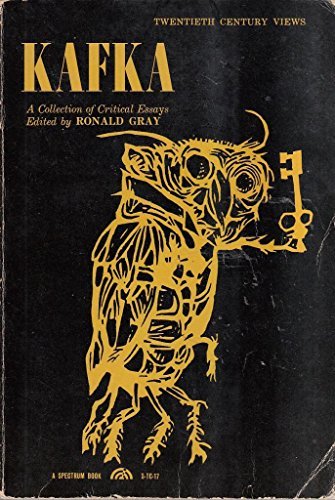
One of a series of works aimed at presenting contemporary critical opinion on major authors, this collection includes essays by Ronald Gray, Edwin Muir, Friedrich Beissner, R. O. C. Winkler, Johannes Pfeiffer, Caroline Gordon, Idris Parry, Edmund Wilson, Erich Heller, Austin Warren, Eliseo Vivas, Albert Camus, Martin Buber, and H. S. Reiss--all dealing with the biography and literary work of Franz Kafka. Designed for use by both literary critics and secondary and college teachers of English, this work would also be of value to undergraduate and graduate students of literature. Topics covered include Kafka the artist, Kafka the writer, a dissenting opinion on Kafka, Kafka's distorted mask, and a survey of recent criticism on Kafka. A chronology of important dates of Kafka's life and a brief set of biographical notes on the contributors to this collection complete the volume.
Franz Kafka was a German-speaking writer from Prague whose work became one of the foundations of modern literature, even though he published only a small part of his writing during his lifetime. Born into a middle-class Jewish family in Prague, then part of the Austro-Hungarian Empire, Kafka grew up amid German, Czech, and Jewish cultural influences that shaped his sense of displacement and linguistic precision. His difficult relationship with his authoritarian father left a lasting mark, fostering feelings of guilt, anxiety, and inadequacy that became central themes in his fiction and personal writings. Kafka studied law at the German University in Prague, earning a doctorate in 1906. He chose law for practical reasons rather than personal inclination, a compromise that troubled him throughout his life. After university, he worked for several insurance institutions, most notably the Workers Accident Insurance Institute for the Kingdom of Bohemia. His duties included assessing industrial accidents and drafting legal reports, work he carried out competently and responsibly. Nevertheless, Kafka regarded his professional life as an obstacle to his true vocation, and most of his writing was done at night or during periods of illness and leave. Kafka began publishing short prose pieces in his early adulthood, later collected in volumes such as Contemplation and A Country Doctor. These works attracted little attention at the time but already displayed the hallmarks of his mature style, including precise language, emotional restraint, and the application of calm logic to deeply unsettling situations. His major novels The Trial, The Castle, and Amerika were left unfinished and unpublished during his lifetime. They depict protagonists trapped within opaque systems of authority, facing accusations, rules, or hierarchies that remain unexplained and unreachable. Themes of alienation, guilt, bureaucracy, law, and punishment run throughout Kafka’s work. His characters often respond to absurd or terrifying circumstances with obedience or resignation, reflecting his own conflicted relationship with authority and obligation. Kafka’s prose avoids overt symbolism, yet his narratives function as powerful metaphors through structure, repetition, and tone. Ordinary environments gradually become nightmarish without losing their internal coherence. Kafka’s personal life was marked by emotional conflict, chronic self-doubt, and recurring illness. He formed intense but troubled romantic relationships, including engagements that he repeatedly broke off, fearing that marriage would interfere with his writing. His extensive correspondence and diaries reveal a relentless self-critic, deeply concerned with morality, spirituality, and the demands of artistic integrity. In his later years, Kafka’s health deteriorated due to tuberculosis, forcing him to withdraw from work and spend long periods in sanatoriums. Despite his illness, he continued writing when possible. He died young, leaving behind a large body of unpublished manuscripts. Before his death, he instructed his close friend Max Brod to destroy all of his remaining work. Brod ignored this request and instead edited and published Kafka’s novels, stories, and diaries, ensuring his posthumous reputation. The publication of Kafka’s work after his death established him as one of the most influential writers of the twentieth century. The term Kafkaesque entered common usage to describe situations marked by oppressive bureaucracy, absurd logic, and existential anxiety. His writing has been interpreted through existential, religious, psychological, and political perspectives, though Kafka himself resisted definitive meanings. His enduring power lies in his ability to articulate modern anxiety with clarity and restraint.
هذا الكتاب مهم ومهم جدا لأولئك الذين يرون في أعمال كافكا مجرد هرطقة ومبالغة في الشعور بالمسؤولية هذا الكتاب يجعلك تعي بذلك المخيخ الذي في رأسك مدى عمق ترهات كافكا أنصح به وجدا للمشككين ،لمحبيه ، حتى للذين يشفقون وكمحبة لأدب كافكا لا أجد صعوبة في تجرع أي حرف يكتبه هو أو نقاده ويكفي أن كافكا أثار الريبة في قلوب كل من قرأ له وعنه فهمه أم لا لا يهم المهم أنه شعر به ف فأحيانا نحتاج أن نشعر بالشيء أكثر من أن نفهمه حتى القارئ يستطيع أن يشعر بكاتبه المفضل !
Paused on a high note: almost every essay in this collection was good. More writers than academics here too, so kafka's work was dealt with more globally. The editor even added an essay calling bullshit on kafka and his work. Overall a good introductory collection.
book description seems to be incorrect. this is not a book by gray but includes essays by many authors, including camus, buber, heller, edmund wilson, caroline gordon, as well as gray
A merely okay collection of essays. Most of them try to interpret Kafka in a religious light, which is dead wrong, if you ask me. I don't have the book handy right now, but I think the essay called "The World of Franz Kafka" or something along those lines was the only truly spot on one.