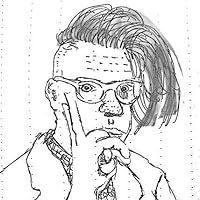
How can we learn more effectively, how can we best work on ourselves, how do we grow? That is the subject of this brief book, this short sketch by philosopher and world traveler Jens Oliver Meiert. A light treatise on personal growth, he goes over 20 paths to get to know ourselves, for “we are okay as we are, but we can always improve.”
Always had a little trouble with self-help books, they often lean upon dated Buddhist model. Also they usually hold many contradiction, for instance, in this one, it urges you to be suspicious of entertainment, because it carries "dogma" and "agenda-setting trap" (which sounds a bit of a dogwhistle to me), but it also urges people to read literature, which also carries "agendas"...
Find it all a bit confusing, like all self-help books the advice tends to spring the author's biases.
Also it does some 20 path process, but many of the paths are the same or cross over too much. "Ask questions" and "Ask yourself questions" are pretty much the same thing, just one turned inward the other outward. Also the first instruction in the book was to make a list by asking yourself questions.
Also the book tends to basically preach about what you should be doing, rather than demonstrating how.
It's hard to give a self-help book a low rating, because the intention behind them is usually from a kind place, and perhaps putting these steps into process would be helpful to some people, however I don't know if there's much I learnt from this.
This is a brief book about personal growth. It reads more like a structured sketch than a detailed guide, and that feels intentional. The chapters are short, clear, and focused on practical directions rather than long explanations.
The emphasis on assessing information carefully was valuable. The reminders to question sources, to be cautious around media, and to think critically about what we consume feel especially important today. For younger readers growing up in a fast, algorithm-driven world, this perspective can be valuable. Learning how to filter noise and choose reliable input is a skill in itself.
The idea of changing perspective while keeping the same objective. Sometimes growth is not about new goals, but about adjusting the route.
This book will not be for everyone. It does not go deeply into theory or analysis. But for busy readers, or those who prefer compact notes and prompts rather than long discussions, it can serve as a useful reminder to approach self-development with awareness.
How to Work on Oneself: A Sketch by Jens Oliver Meiert is a self-help book about personal growth. I like the emphasis on continuously working to improve oneself. Stagnation has always been a worry of mine, and I approve of any source that gives tools to avoid this. Bear in mind that a definition of sketch on dictionary.cambridge.org is “a short written or spoken story that does not have many details.” While this book contains some good advice, there is little in the way of particulars. Due to its short length, this is hardly surprising. However, the author has traveled the world and is an adventurer. I’m sure he has multiple personal accounts, which, had he included, would have enhanced the book. It is a quick book that will encourage some to read who might not, which is a plus, and the author does include a helpful bibliography for future reading. If you are looking for a concise guide on personal growth, this is the book for you.
There are so many self-help books out there these days. I’ve read quite a few myself. Where this book is different is that it tries to get to the crux of the problem – how do we actually learn and grow? What are the different methods we can use? The author presents 20 unique paths to learning, of which reading is only one. I particularly like the broadness of what is described in the book – it puts a fresh perspective on how we see ourselves. It does a good job of leaving it up to the reader what they get out of it. It is a somewhat philosophical book. You won’t learn particular skills or actionable things to do to improve in specific areas. It’s not focused on business, or health, or any specific topic. It broadly addresses the problem of improving oneself in general and gives many ways to do so that can be applied to any specific problem you like.