Jump to ratings and reviews
Rate this book

Venice, An Interior

Rate this book
An essential companion for every traveller to Venice, this is the hidden city revealed in a gorgeous non-fiction account by one of Europe's greatest living writers, Javier Marías

Century after century, the essence of Venice is unchanging. It is a place of contradictions, equal parts glamour and chaos. As a young man, Javier Marías made the city his home; since then he has left and returned many times, drawn back to its labyrinth of blind alleys, its pearly green canals, its imagined spaces.

His love affair with the city has lasted over thirty years - he has traced every inch of its endless interior, has lived among the Venetians and lived apart from them. In Venice, An Interior, Marías sets out to uncover the heart of this strange and enchanting place.

96 pages, Paperback

First published October 1, 2014

4 people are currently reading
200 people want to read

About the author

Javier Marías

134 books2,461 followers
Javier Marías was a Spanish novelist, translator, and columnist. His work has been translated into 42 languages. Born in Madrid, his father was the philosopher Julián Marías, who was briefly imprisoned and then banned from teaching for opposing Franco. Parts of his childhood were spent in the United States, where his father taught at various institutions, including Yale University and Wellesley College. His mother died when Javier was 26 years old. He was educated at the Colegio Estudio in Madrid.

Marías began writing in earnest at an early age. "The Life and Death of Marcelino Iturriaga", one of the short stories in While the Women are Sleeping (2010), was written when he was just 14. He wrote his first novel, "Los dominios del lobo" (The Dominions of the Wolf), at age 17, after running away to Paris.

Marías operated a small publishing house under the name of Reino de Redonda. He also wrote a weekly column in El País. An English version of his column "La Zona Fantasma" is published in the monthly magazine The Believer.

In 1997 Marías won the Nelly Sachs Prize.

Ratings & Reviews

What do you think?
Rate this book

Friends & Following

Create a free account to discover what your friends think of this book!

Community Reviews

5 stars
45 (19%)
4 stars
95 (41%)
3 stars
72 (31%)
2 stars
18 (7%)
1 star
1 (<1%)
Displaying 1 - 27 of 27 reviews
Profile Image for Paul Fulcher.
Author 2 books1,963 followers
February 5, 2018
Venice, An Interior, although published separately, is part of a longer book of essays by Javier Marias, collected and translated into English as Between Eternities forthcoming later in the year. (see my review: https://www.goodreads.com/review/show...)

Marias made multiple trips to Venice in the 2nd half of the 1980s for reasons he doesn't divulge in this book, but which other sources suggest was likely a love affair, and wrote "a good part" of the novels The Man of Feeling and All Souls there, so that the city became to him a temporary 2nd home.

And consequently Marias's focus in this essay, originally published in El Pais in the 1990s, is not so much on tourist Venice as life for those who live there: individuals who are not content with the mere three or five or seven days that every mortal should set aside on the vast diary of his or her biography to be spent in the one place on the world that, of left unvisited, could tarnish the worthy portrait of someone who throughout his life - however decent or dissolute - has always done his aesthetic duty!

Javier Marias is one of my favourite living authors, and I read this book on a trip to Venice, one of my favourite cities, so this was shooting into an open goal, which may explain the small sense of disappointment I had. This is very good but not great - the prose doesn't soar to the heights of Marias's novels and although it invokes Venice beautifully it doesn't manage to dethrone works such as Venice by Jan Morris as the definitive accounts

The translation by Margaret Jull Costa, recent and long-overdue winner of the Best Translated Book Award, is, of course, as flawless as ever.

Marias's most original insight is into the pyschology of the Venetians, caused by the fact that Venice, La Serenissima, remains serenely preserved and undeveloped:

The terrible certainly that something we can actually see will always be there and will always remain the same, without the admixture of unease and uncertainty inherent in all human enterprises and communities, without the possibility of a new life or of an unprecedented rebirth, of growth or explosion, without the possibility, in short of any surprise or change, means that Venetians see life from 'the viewpoint of eternity'.
...
I suppose the only way of making that certainty and that viewpoint bearable is to give in to the temptation of believing in the imminent destruction of what will doubtless survive us, and to foster the threat of total extinction. Each time I arrive in Venice, I find the population alarmed about something or other, be it an old threat or a new.


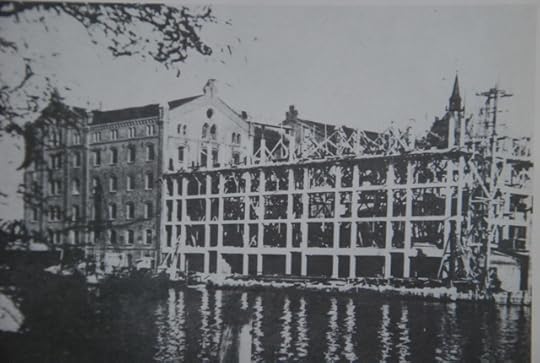
Although one of his most recommended sights rather disproves his theory that the City never changes (as the author acknowledges in a brief afterward to the English edition). He advises the traveller to venture to the end of the Zattare, and to look over to the Guidecca to see the amazing sight of the dark ruins of the once thriving Molino Stucky flour factory, closed since 1955 and which, in Marias's account, languishes without hope of redevelopment.

description

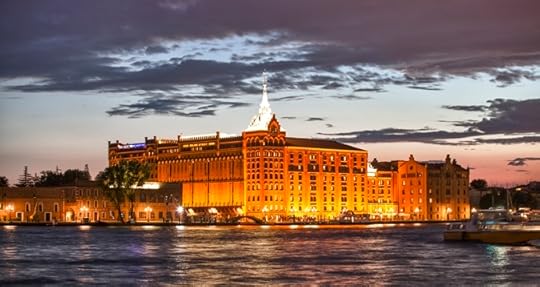
Doing so in 2017, as I did, one is instead greeted by the blazing lights of the Hilton Molino Stucky Venice Hotel, opened in 2007.

description

Worthwhile, although i would recommend waiting for Between Eternities unless the reader has (I had both) a burning desire to read anything by Marias as soon as it is published, or a specific interest in Venice.
Profile Image for Ian "Marvin" Graye.
952 reviews2,794 followers
November 19, 2022
CRITIQUE:

The Interior of Eternity

This essay was extracted from the then-forthcoming collection of non-fiction called "Between Eternities", which I haven't read yet.

The essay is divided into six parts and an author's note. Notwithstanding this structural framework, it's still quite an impressionistic perspective on a major world city (which I confess I haven't yet visited, except vicariously through several documentaries).

The essay focuses on the interiority and the eternity of Venice, as perceived by Marías.

Interiority

The interiority of the city is a metaphor based on the intuitive view that "there is no outside...It is complete in itself...It is self-sufficient...It has no need of anything outside itself." It is a "hypercity", "the City par excellence".

For a similar perspective on Venice, see Italo Calvino's "Invisible Cities".

description
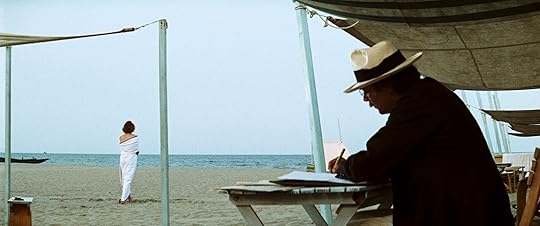
Dirk Bogarde on the private beach of the Hotel des Bains in "Death in Venice"

Eternity

Marías believes, equally intuitively, that "Venetians see life from the viewpoint of eternity", because they've grown accustomed to "the terrible certainty that something we can actually see will always be there, and will always remain the same, without the admixture of unease and uncertainty inherent in all human enterprises and communities, without the possibility of a new life or of an unprecedented rebirth, of growth or expansion, without the possibility, in short, of any surprise or change."

The past has always been there, it remains in the present (here), and it will continue into the future (here/there):

"Venice is the only city in the world whose past you do not have to glimpse or intuit or guess at, it's there before you, at least its past appearance is, which is also its present appearance. Even more exciting and disquieting is the fact that the city's present appearance is also the city's future appearance...Just as it is the only inhabited place in the world with a visible past, so it is also the only one with its future already on display."

Marías credits the city's appearance to the abundance of white Istrian stone, the origin of one of the city's principal, if not primary, colours.
Profile Image for Mairita (Marii grāmatplaukts).
678 reviews214 followers
May 31, 2023
Šī mazā grāmatiņa ir kā glāze limončello maltītes noslēgumā pēc saules pielietām dienām Venēcijā. Ja to lasa esot Venēcijā vai atvadoties no tās, tad šīs esejas nozīmēs daudz. Cilvēkam, kurš Venēcijā nav bijis, vai kuru Venēcija nav dziļi iespaidojusi (grūti tādu iedomāties), šīs esejas nenozīmēs neko daudz. Ir jābūt Venēcijas skartam, lai šo labi uzrakstīto tekstu patiesi novērtētu.
Profile Image for Gumble's Yard - Golden Reviewer.
2,213 reviews1,798 followers
May 24, 2017
Marias tells us that, for reasons he does not disclose but seem associated with a love affair, he made a number of visits to the City over a period of years, and looking back on those visits meditates on the contradictions and mysteries at the heart of a City that he calls a living museum. A short series of meditations on my favourite Cities by one of my favourite authors – and therefore unsurprisingly enjoyable but also slightly disappointingly lacking in any really original insight: except perhaps in capturing the contradiction in the inhabitants of a City which has survived so long in an almost unaltered state, being obsessed with its imminent doom – whether from pollution, over-tourism or flooding.
Profile Image for Brendan Monroe.
685 reviews192 followers
July 15, 2019
I'm 8 books behind schedule! Gosh, this isn't good! I've been traveling, and I don't read much when I travel, though I really should. I get too caught up in planning every aspect of a trip so that any time I have is spent researching online rather than reading. But now I'm 8 books behind schedule, so that's got to change.

This is a book I managed to finish on my trip. Of course, it helps that it's only 55 pages, but hey, it's a book, right? So it counts! I picked this up in the museum gift shop at the Palazzo Ducale (Doge's Palace) in Venice. They had many books, including Jan Morris' book on Venice that I've been meaning to read for some time, but this one was six euros, 55 pages, and by an author who I really want to like.

I say "want to" because my first experience with Javier Marias didn't end so well. Or, I should say, it didn't end at all because I never finished the book. It was that bad. But maybe, I reasoned, nonfiction would work out better.

Nonfiction ... this is really more of an essay on how much Marias loves Venice. There's basically an entire genre of these books now, but I love Venice too and I was currently in Venice so I would read about why Marias loved Venice and see if it was for the same reasons that I loved Venice.

Before that initial disastrous read I'd been meaning to read Marias for many years. Then, last year, I just happened to be at the Louisiana Museum in Denmark at the same time as their annual literary festival and Marias was one of the people being interviewed that day. So I went and bought the only two books the gift shop had of his in English just in order to get them signed.

I remember Marias being a rather acerbic speaker. He's got a bone to pick with all of humanity seemingly, and many of his answers that night came off as somewhat haughty and pretentious, or so it seemed to me. But there was something about him that I liked, though maybe it was just the hilariously haughty and pretentious way in which he answered some of the questions, sometimes with just a single word.

I remember, for example, the female interviewer asking him about whether he had a dog. He snorted and replied "no" so derisively that it was clear, in that single word, he found people who had dogs to be pathetic and dogs themselves to be nothing more than temporary comfort for emotionally weak individuals. Or at least, that's how I interpreted his answer.

And I liked that. I was raised with a plethora of pets, but now I don't have any. All my friends, practically everyone I know for that matter, does seem to have a dog, or maybe a cat, and I do find myself amused by what a fuss they tend to make about it.

But it's such an unpopular thing to say, what I just said, what Marias implied with his "no", that I admired him for it. I admired him for taking such a widely unpopular public stance on the sacred cow that is domesticated animals.

I mention all that just to say that Marias writes just as he spoke that night. Condescendingly, with a-none-too-subtle air of superiority. He loves Venice, and he loves Venetians, but he agrees, it seems, with what he sees as a Venetian tendency to view outsiders (that is, that not insignificant slice of humanity that isn't born in or local to Venice) as inferior and unworthy of such a city.

Maybe we're all unworthy of such a city, but try telling that to the swathes of day-trippers who plague it. Do they really appreciate the city, its history, culture, and people? Probably not.

I try to show, by reading books such as this one, that I am worthy, but I fear it's a futile pursuit in the end. The foreigner has to sacrifice something in order to truly be worthy of a place like Venice, and even years spent living there cannot make up for the great privilege, in the eyes of Marias' Venetians, of having been born there.

Love him or loathe him (my own feelings lie somewhere in the middle), one has to at least admire Marias for his candid bitterness.
96 reviews3 followers
March 24, 2021
"Veneza é a única cidade do mundo cujo passado não pode vislumbrar-se, intuir-se ou adivinhar-se, mas que está à vista. (...) Assim, como é o único lugar habitado do mundo com um passado visível, é também o único com o seu futuro já evidente."
Javier Marias viveu pate dos anos 80 em Veneza, escreve com a elegância e profundidade sobre a Sereníssima e os Venezianos. Um sedutor relato do quotidiano.
Texto originalmente publicado no jornal espanhol "El Pais"
Profile Image for Peeter Talvistu.
207 reviews14 followers
September 30, 2024
This is probably more than 4 stars.

Many of the more essay-like books about Venice seem to go on for far too long for their own good. They become meandering, repetitive and somewhat dull. This one is an excerpt from a then upcoming collection and had previously been published in the media. I think that in the end it is just the right length for a quick bite. Reading it in 2024, one does feel that it was written more than three decades ago (especially the case of the Molino Stucky, but not only), but I wouldn't say it is necessarily a bad thing: Venice is immutable, after all, as the author succinctly puts. The basic tenets still hold true and the idea of Venice as a city where both the past and the future are literally on display is a great one (along with the interior-exterior dichotomy). Having just recently returned from Venice - a city I first visited (and fell hopelessly in love with) two decades ago - I can assure you that the book/essay does manage to capture the essence of Venice and Venetianness.
Profile Image for Julie Hoegh - Editor at Bookstoker.
10 reviews3 followers
November 18, 2016
A heavenly combination of one of my favourite authors writing about one of my favourite cities: Javier Marías’ little essay on Venice. For reasons unknown (a failed love affair?), Marías spent a great deal of time in Venice in the 1980s. His reflections on how history and geography have shaped Venice and Venetians are captivating. ‘Venetians see life from “the view point of eternity” ', not surprising perhaps when you grow up in place that’s hardly changed for 500 years? The decay, the dark back alleys, the smells, the sense of doom, the colours of the water (‘blood red, yellow, white’ by day, ‘like ink’ by night) combined with dazzling beauty, Marías perfectly evokes the city's atmosphere and hands you a delicious sliver of Venice.

http://bookstoker.com/
Profile Image for J..
219 reviews44 followers
January 16, 2017
Quick Review: These magical 55-58 pages are an essay extracted from the forthcoming collection of non-fiction writing by Marías, entitled _Between Eternities_. This unique "guide" presents the interiority of Venice. In line with the Venetians' "view of eternity," Marías guides his readers through the back alleys and over the smaller canals to explore the jarring continuity, decay, sights, smells, and atmosphere away from the Venice belonging to the tourists and travellers.
Profile Image for Malia.
99 reviews18 followers
October 16, 2017
A thoughtful essay that is especially powerful when read while in Venice.
Profile Image for Alexandra Maia E Silva.
432 reviews
February 8, 2024
Acho que a beleza do livro é o de nos identificarmos tão bem com o que autor quer transmitir, o que aprendemos e claro a própria escrita
Só estive 2 dias em Veneza e mais um nas ilhas e sem dúvida várias perguntas me assaltaram na altura, como é viver aqui, sempre necessariamente escadas para fazer, para subir para descer,como é andar aqui às compras dos básicos para fazer as refeições? Como é se é preciso uma emergência? Quanto tempo demoram a chegar, obviamente que havia lanchas ambulância, eu vi, mas e chegar do cais à rua, ao beco, à casa perdida no meio do labirinto.....
Veneza é no presente aquilo que o seu passado definiu, e o seu futuro é expectável...
Não há volta a dar, somente o tempo quando chegar o momento.
Veneza como diz Javier é um interior que não precisa de nada de fora, o que cria a inacabável fragmentação ideal.
Veneza é deslumbrante e cansativa ao mesmo tempo, não sofri do síndrome de Stendhal. Mas fiquei cansada do labirinto e contudo morro de saudades. É mais fácil ter saudades daquilo que não conhecemos....
Profile Image for Hannah Contreras.
78 reviews
February 21, 2024
A curious little (emphasis on little) book that was easily slipped into my purse to be read with a spritz and some chips on the canals. Marías did not hold back in both his criticisms and praise of the city. They exist side by side, and a lot of what he has to say about the character of the city, unchanging as it is, is relevant even nearly 40 years after he wrote it. He has a lot of insightful, bite-sized takes contained within this small book, and I think it’s a great little book to take with you when you’re visiting the city because you can compare his observations with your own as you discover the city. One thing that I had a gripe with is that Marìas depicts himself as a master of the city, despite having lived there for only nine months. I would have liked more acknowledgment of that fact.
Profile Image for Celtic.
256 reviews11 followers
May 26, 2018
Disappointing; I expected more from a book advertised as "a gorgeous account by one of Europe's greatest living writers" - and certainly not the overt racism of the opening chapter. Neither does it deliver on the promise of "the hidden city revealed" - it's a very short book but I didn't feel that I learned much about Venice. I hadn't read Marías before and this doesn't encourage me to seek him out. Instead I'd recommend Corto Maltese: Fable of Venice https://www.goodreads.com/book/show/3... - a slightly surreal adventure story in the form of a graphic novel but it speaks eloquently of the essential nature of Venice and its ensuring allure.
Profile Image for brettlikesbooks.
1,248 reviews
July 10, 2019
back from my travels, so prepare yourselves for several italy-centric books. up first:
VENICE, AN INTERIOR by javier marías (nonfiction) not really a travel guide, but an observation and love letter to a city + a peek into the heart of a wholly unique place

“You simply have to see it.”

“Looking at Venice now, not only do you see it as it was one hundred, two hundred and even five hundred years ago, you see it as it will be in one hundred, two hundred, probably even five hundred years’ time.”

instagram book reviews @brettlikesbooks

Profile Image for Luke.
241 reviews8 followers
October 18, 2021
This is quite short — only 56 pages — but it evokes so keenly and succinctly the heart and soul of the city of Venice that it is no more or no less than perfect.
Marías (and by extension his translator) have a way with words to say the least, and his descriptions of Venice, its people and its presence is quintessential travel writing — in other words, one gets the sense that they must travel there immediately, while also feeling as though they have been there before.
Profile Image for Andrew.
857 reviews38 followers
July 24, 2018
55 fleeting pages...a perfect jewel of a travel book...which captures the soul of a unique city-state, hidden from most of the souless tourist hordes in its interior monologue with time & place; Venice whispers, declaims & shouts in its own way...but few can hear its melancholy, its pride & its outrage!
I loved this piece of poetry by the Spanish writer with a Venetian soul!
5 reviews
March 4, 2020
Loved this book! I would recommend it to anyone who's planning to visit Venice. It paints a moody picture of the city and invites to explore its countless narrow and labyrinth-like streets where spotting a native Venetian is as rare as being the only person in the St Mark's Square.
3 reviews1 follower
December 27, 2022
Excelente descrição sobre Veneza, um livro a ler antes de visitar Veneza
Profile Image for Austra.
820 reviews114 followers
July 14, 2023
Slikti nebija, bet nebija arī nekas baigi spešel. Attiecībā uz esejām man ir augstākas prasības. Ko lai saka, esmu izlutināta.
Profile Image for Flauschi.
148 reviews4 followers
March 17, 2025
Es tut mir wahnsinnig leid, aber mir blieb bis zum Schluss des Essays alles irgendwie rätselhaft weshalb es geschrieben wurde. Sind es Gedanken? Ist es ein heimlicher Antireiseführer? Ich dachte kurz ab eine Abhandlung über Venedig aber es las sich eher wie Mimimi Venezianer sind hochmotiviert, mimimi alles kaputt und niemanden interessiert es. Mir ist durchaus bewusst dass es 3 Venedigsausgaben gibt. Die fantasiebehaftete Ausgabe zwischen Barbiebüchern, PC Spielen und Phatasietrilogien, das heile Venedig der Instagramer und das dreckige Venedig. Ich selber kenne Venedig nur im Regen. Für mich ist die Stadt nass, dreckig und unreal und dennoch habe ich eine große Liebe für das magische, fantasiereiche Venedig und diese Liebe machen nicht mal die 31 mitunter längsten Seiten meines Lebens kaputt
Displaying 1 - 27 of 27 reviews

Can't find what you're looking for?

Get help and learn more about the design.