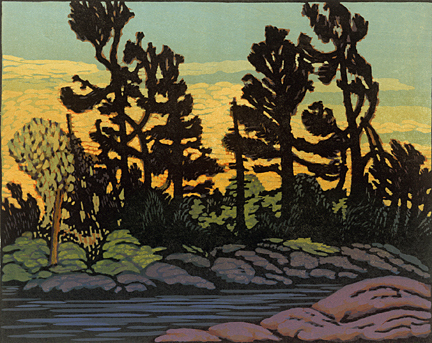
If you really want to see a woodland caribou, you might try going to a place forgotten by time. It should be a hushed place, with perhaps rocky green hills and blue water, home to loons and beaver, lichen and yellow buttercups. With every step, this gentle journey brings us to a deeper and more unique connection with nature. Phyllis Root’s mesmerizing text, together with Jim Meyer’s outstanding woodblock prints, makes the very heart of the forest come alive and reveals that if you are patient and quiet, sometimes what you are seeking will, in the end, find you.
"Picture books are performances," says Phyllis Root, quoting some sage advice she once received. "They're performances that involve a child--something both of you do. And once I started thinking of them that way, I started getting much looser about making up words and playing around with rhythm."
Phyllis Root picked up an early affinity for colloquial language while growing up in Indiana and southern Illinois, "where people actually say things like, 'I got a hitch in my git-along'!" She decided to be a writer in the fifth grade, but it wasn't until she was thirty years old that she took a writing course with an influential teacher who gave her "the tools" she says she needed. "That's when I figured out that you could learn to be a writer," she says. What followed was a series of rollicking stories that take on a new life when read aloud, among them ONE DUCK STUCK, a one-of-a-kind counting book; KISS THE COW!, an affectionate salute to stubbornness; WHAT BABY WANTS, a tale of increasingly ridiculous efforts to quiet an infant that one reviewer compared to an episode of I LOVE LUCY, and LOOKING FOR A MOOSE, a buoyant tale with a final surprise discovery.
The author does "endless rewriting" before a book is finished, but often starts out by writing her stories in her head, a trick she learned as a time-pressed mother when her two daughters were very young. For example, RATTLETRAP CAR--a joyful celebration of perseverance--began with her playing around with sounds ("clinkety clankety, bing bang pop!") and calling up bits of old camp songs.
A master of rhythmic read-alouds, Phyllis Root exhibits a range many writers would envy. Her counting book TEN SLEEPY SHEEP is as serene and lulling as ONE DUCK STUCK is rambunctious. "Counting sheep isn't always easy," she notes. "Once, while we were farm-sitting, my daughter and I had to chase down two runaway lambs in the growing darkness, then count twenty-seven frisky lambs to make sure they were all safe for the night. Luckily, they were." OLIVER FINDS HIS WAY is a quiet, classic picture book about a defining moment in the life of a small child--getting lost and having the pluck to find the way home. On the other extreme, Phyllis Root takes on no less than the whole universe in BIG MOMMA MAKES THE WORLD, a powerful, original, down-home creation myth that received rave reviews and won the prestigious BOSTON GLOBE-HORN BOOK Award. Most recently, Phyllis Root penned LUCIA AND THE LIGHT, a timeless adventure about one brave girl's quest that was inspired by Nordic lore.
When she's not writing, Phyllis Root teaches at Vermont College's MFA in Writing for Children program. She lives with her two daughters and two cats in a 100-year-old house in Minneapolis, Minnesota, and loves to read (mostly mysteries with female protagonists) or spend time outdoors gardening, camping, sailing, or traveling. "One of the things I've learned about myself," she confides, "is that when I get really stuck and can't seem to get writing, it's because I've forgotten to take time out to play."
Understated and rather poetic of the steps one would take to sail to the Slate Islands and perhaps eventually find (or be found by) a caribou, inspired by the author visit to Lake Superior. She saw a caribou.
Love Meyer's block prints. This seems to be the only book he's illustrated. http://woodblockart.com/
This is a wonderful book about the northern lands in which the caribou live. The narrative is lyrical and the color woodblock print illustrations depict a rustic, idyllic scene. The additional information provided at the end of the book explains how caribou came to live on the islands in the middle of Lake Superior. We really enjoyed reading this book together.
This story was nominated as one of the books for the September 2012 - Ecosystems reads at the Picture-Book Club in the Children's Books Group here at Goodreads. It wasn't one of the books selected, but we wanted to read it anyway.
This is a book that has almost a quite interesting title to me at least since if you really wanted to see a caribou just go north to places like Alaska where they are so common. Right? Instead what the book is exploring if you want to see a threatened woodland caribou and one that may be closer to home then leaving the country or going to the farthest northern state.
What I love about this book is the fact that it takes the reader out of their home and allows them to explore the pathways that may lead them to the caribou. It explores the land, the vegetation and the following species that may be sharing that home with an eye to someone who has actually been there. This is the essence core of a nature immersion read which I love.
The illustrations are brightly colorful to catch the land but at the same time subdued enough to give it just the right atmosphere for a quest. And the part where states a caribou may be watching you while showing one in the shadows was just a delicious frosting to this particular book.
Furthermore there is more information in the back to give the reader context about the book's meaning, to explain about the woodland caribou and how they came to be found in the spot. Thus all in all it is a great read for nature lovers who may be looking for a fast read.
The woodblock prints were the true star of this book. The story is quiet and poetic, but I gauge children's books by how much my children like them and this wasn't worth a second read to them. I don't know if it would be different for children that grew up in the geographical region the book depicts, but the plant names were unfamiliar to them (and some for me too). It made this quiet book a bit cumbersome in the reading and less enjoyable than it could have been.
The journey to look for caribou is the focus of this poetic picture book whose beautifully colored, yet simple block print illustrations complement the murmuring text. The essence of an island in Lake Superior includes the need to arrive by boat, listening for loons, watching for beaver and walking among spruce, pines, maples, balsams and birches to see lichen, moss, pearly everlasting, buttercups, asters and thimbleberries. The hidden treasure the reader discovers is both the browsing caribou calf and its mother, and the whispered name of the child in the story.
This book was so well done that I got goosebumps - on several pages. Root's writing combined with Meyer's woodcut illustrations truly captured the beautiful magic of Northern Ontario. The magic was made even more beautiful because the book the book stayed true to the real, factual magic of the natural setting in this part of the country.
I very much enjoyed the word images 'the yellow buttercups nod hello, hello' and sounds, 'the sails say roosh, roosh'. I also very much enjoyed that Root included the names of the plants and animals that one might see along the way as they look to find a caribou; there was something in the way she writes that made me feel as if I were there again, and make me a bit nostalgic for this landscape.
The illustrations are a perfect match for the, like the writing they are both gentle and powerful. Meyer uses appropriate earthy tones but punctuates the pictures judiciously with bits of bright reds, yellows, and other colours. They too contribute to the real-life magic of the book.
Overall, a wonderful book. I read this copy from the library but will likely get a copy for my shelves and for re-reading.
Lake Superior is featured in this book! Also beavers are mentioned :) A good read for little ones to learn about how to see wildlife in their natural habitat.