

What do you think?
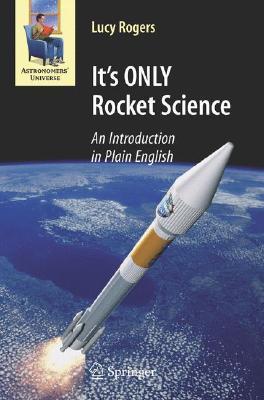
It's ONLY Rocket Science: An Introduction in Plain English
Most amateur astronomers – and many of those with similar interests but who are not currently practising observers – have only a sketchy understanding of space flight. This book provides an introduction to its mechanics. The beauty of this book, written by an engineer who is also an accomplished science writer, is that it covers the subject comprehensively, and yet is almost entirely descriptive and non-mathematical. It deals with all aspects of space flight, from how to leave the Earth (including the design of the rocket, mission planning, navigation and communication), to life in space and the effects of weightlessness. The book also includes sections describing how an amateur can track satellites and understand their orbital parameters.
364 pages, Paperback
First published December 31, 2007
Ratings & Reviews
Friends & Following
Create a free account to discover what your friends think of this book!
Community Reviews
Displaying 1 - 7 of 7 reviews
May 17, 2021
Imagine a well-organized Simple Wikipedia about rockets, their history, presence, and possible future. The book is full of terse facts, one after another, from the beginning to the end. It touches almost anything you can think about, regarding rockets and related topics. Look up the table of content. Reading it cover to cover gives you a good high-level overview of all the topics.
It is an easy leisure time reading - you do not need a knowledge of mathematics, chemistry, or physics. You do not need to do any computation on paper. But since it is rather a reference or encyclopedia, sometimes I've become tired/bored quickly.
Although, I do not feel after the reading, that I know more about 'Rocket Science’, I've learned a lot of new information and enjoyed the book, which I'll possibly use as a quick reference to recall some basic facts about the topics I was not interested in that much at the time of reading.
It is an easy leisure time reading - you do not need a knowledge of mathematics, chemistry, or physics. You do not need to do any computation on paper. But since it is rather a reference or encyclopedia, sometimes I've become tired/bored quickly.
Although, I do not feel after the reading, that I know more about 'Rocket Science’, I've learned a lot of new information and enjoyed the book, which I'll possibly use as a quick reference to recall some basic facts about the topics I was not interested in that much at the time of reading.

Read
December 11, 2019great, packed with facts. explanatory enumerations of types of rockets, types of orbits, types of satellites, types of propulsions, types of propulsion staging, schedules of pre-launch, launch, and post-launch procedures, etc.

June 6, 2025
I know that it is an "introduction". But it is a bit shallow and still you get a lot of unrelated content like humans in space and our solar system. I did not buy the book for that, only to learn about rocket flight and its mechanics. It is not a bad book by any means. Just it has a lot of unrelated content to the main topic. To learn about the universe I would purchase another book like Cosmos for example...
December 21, 2014
Could do with some better illustrations and some better typesetting, but overall it was what it says on the cover. If you have engineering background, some parts may be a little obvious but there is certainly a lot to learn from it because it is such a comprehensive text. Cheap too, for Springer.
April 13, 2015
Good level of detail, could have been edited better.

May 3, 2015
Would benefit from a bit more narrative, but does what it says on the cover.
October 4, 2015
Fairly good introduction to space systems. Lots of facts and figures. The chapter about humans in space especially interesting giving details of the life onboard ISS and Shuttle.
Displaying 1 - 7 of 7 reviews