

What do you think?
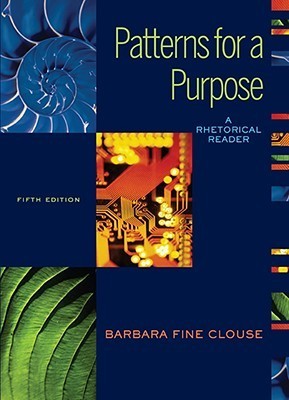
Patterns for A Purpose: A Rhetorical Reader
Patterns for a Purpose, Fifth Edition, is a rhetorical reader that shows students how to use the rhetorical patterns—either alone or in combination—to achieve various writing purposes. It continues to emphasize critical reading and thinking, to offer detailed coverage of the writing process, to provide a rich variety of writing opportunities, to emphasize argumentation and persuasion, and to provide reading selections, both classic and contemporary, that function as models as well as springboards for discussion and writing.
784 pages, Paperback
First published September 1, 1994
Ratings & Reviews
Friends & Following
Create a free account to discover what your friends think of this book!
Community Reviews
Displaying 1 - 6 of 6 reviews

August 12, 2014
I wish these textbooks would actually include essays that follow MLA guidelines. Even the student essays in this collection do not always have a Works Cited page, and I think they all should. Furthermore, because personal narrative-driven nonfiction tends to be more interesting to read, I'm glad that Clouse includes so many examples, and great ones too (including work by Alice Walker and others of her caliber) but then I have to tell my students, "No, you can't use first person when you write a persuasive-argumentative essay." What I found to be the most lacking, however, from this book was the fact it doesn't specifically cover the Literary Analysis. While it does include Critical Analysis, analyzing literature is its own particular beast--for example, you must always refer to the events in the story in present tense to honor the fact that fiction (and poetry) is timeless. I also disagree with the very first page of this book where Clouse states that critical reading and writing (essentially academic reading and writing) is more difficult than reading fiction. While it might not take a lot of thinking muscles to read a cheesy romance novel, it does take a lot of critical thinking to read books such as Mary Shelley's Frankenstein, or stories like "The Yellow Wallpaper" by Charlotte Perkins Gilman, or the poems of Emily Dickinson. In many ways, reading fiction with all its layers of meaning and allusions is far more hard to do than it is to read a straight-forward academic dissertation proclaiming that the ways in which women are protrayed in the media leads to violence against this gender.
March 14, 2020
Good read

February 5, 2012
This is a new edition of the previous text. The changes tend to be miniscule, replacing the occasional example essay, splitting one chapter into two (so all the page numbers are off), switching a sentence or two. However, they don't seem to feel the need to fix typos that have been in here for multiple editions. I do not see why this needs to be a new edition as the changes are almost entirely cosmetic and, let's be frank, put in there so the previous issue can't be resold as a used book anymore for students to get cheaper. Sickening and greedy.
I've finished it now, and while, again, the textbook is not a bad introduction to college writing, there was absolutely no reason for a new edition.
I've finished it now, and while, again, the textbook is not a bad introduction to college writing, there was absolutely no reason for a new edition.
March 16, 2009
A decent, servicable text, but the updates over the last edition are occasionally bizarre. Why do we need full color photos for a gymnast about "exercises" and an ice skate above the "critical edge" sections? I get the (admittedly tiny) joke, but really, hiking the cost of the text for the extra ink when it's used for something this silly is almost criminal.

January 5, 2010
This book tries so hard to be helpful to student writers; but, then it sets them up for failure by including, almost exclusively, essays written in the first person. As an instructor, I quickly moved away from the essays provided in the book.
August 30, 2011
I like the changes in this addition. The chapter on writing in the disciplines is especially helpful to students. Also, the expanded appendix section is great.
Displaying 1 - 6 of 6 reviews