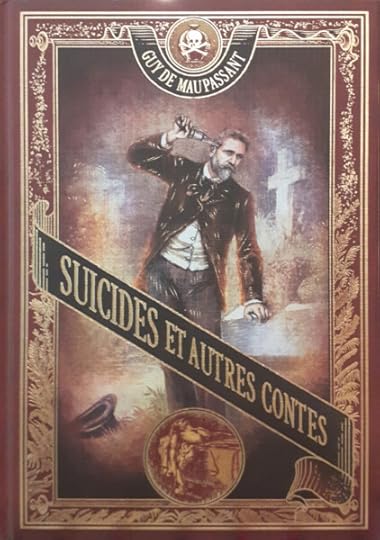
Henri René Albert Guy de Maupassant was a popular 19th-century French writer. He is one of the fathers of the modern short story. A protege of Flaubert, Maupassant's short stories are characterized by their economy of style and their efficient effortless dénouement. He also wrote six short novels. A number of his stories often denote the futility of war and the innocent civilians who get crushed in it - many are set during the Franco-Prussian War of the 1870s.
All the events of Life, which formerly had to me the glow of a beautiful sunset, are now fading away. The true meaning of things has appeared to me in its brutal reality; and the true reason for love has bred in me disgust even for this poetic sentiment: ‘We are the eternal toys of foolish and charming illusions, which are always being renewed.’
I couldn't find the French version of my reading which includes a collection titled: "Contes sur le suicide". Eight tales narrating suicide from different angles: solitude, fear, heartbreak, cruelty, social pressure and the unbearable lightness of the human being. All the stories sharing a same drama and the same relieved end, dangerously suggested by Maupassant, who committed suicide in two occasions.
Me ha tocado el corazón. Sentí empatía con el personaje. Como ex camarógrafo y fotógrafo tengo muchos videos de mamá, mis abuelos, tíos... Todos muertos. Sus voces son lo peor. Uno puede ver una foto, pero verlos en video hablando... ¡Quiebra! Incluso mis hijos chiquitos (hoy grandulotes de 30 y casi) me afectan. ¿Dónde se fueron mis bebés, esos niños? Extraño a mis hijos cuando eran niños. Me los cambiaron en vida. :)
Excelente y para analizar nuestras vidas... pero no mucho. Tenga cuidado, no lo lea con una soga o un revolver a mano.
Los recuerdos pueden trazarnos un camino tenebroso, pero está en nosotros si nos aferremos a ellos o los llevemos a lo largo de la vida como una dulce compañía
This was just what you would expect from Guy De Maupassant.I enjoyed it because I love his writing. Although it was about death it is worth reading it.
Guy de Maupassant's "Suicides" is an extremely sad story about a man who commits suicide and his reasoning which is only the beginning of understanding why and too late to understand completely.
"What terrible grief, what unknown suffering, hidden despair, secret wounds drive these presumably happy persons to suicide? We search, we imagine tragedies of love, we suspect financial troubles, and, as we never find anything definite, we apply to these deaths the word “mystery.”
“On growing older, I had become partly reconciled to the awful mystery of life, to the uselessness of effort; when the emptiness of everything appeared to me in a new light, this evening, after dinner. “Formerly, I was happy! Everything pleased me: the passing women, the appearance of the streets, the place where I lived; and I even took an interest in the cut of my clothes."
“Everything repeats itself endlessly. The way in which I put my key in the lock, the place where I always find my matches, the first object which meets my eye when Ienter the room, make me feel like jumping out of the window and putting an end to those monotonous events from which we can never escape."
Vincent van Gogh in his letters had equated good digestion to physical and mental health.
“For good digestion is everything in life. It gives the inspiration to the artist, amorous desires to young people, clear ideas to thinkers, the joy of life to everybody, and it also allows one to eat heartily (which is one of the greatest pleasures). A sick stomach induces scepticism unbelief, nightmares and the desire for death. I have often noticed this fact. Perhaps I would not kill myself, if my digestion had been good this evening."
"But all at once one envelope made me start. My name was traced on it in a large, bold handwriting; and suddenly tears came to my eyes. That letter was from my dearest friend, the companion of my youth, the confidant of my hopes; and he appeared before me so clearly, with his pleasant smile and his hand outstretched, that a cold shiver ran down my back. Yes, yes, the dead come back, for I saw him! Our memory is a more perfect world than the universe: it gives back life to those who no longer exist. “With trembling hand and dimmed eyes I reread everything that he told me, and in my poor sobbing heart I felt a wound so painful that I began to groan as a man whose bones are slowly being crushed."
"It is all over. I had gone back to the beginning, and suddenly I turned my glance on what remained to me of life. I saw hideous and lonely old age, and approaching infirmities, and everything over and gone. And nobody near me!"
"Me había remontado hasta el origen. El recuerdo era desconsolador. ¿Y el porvenir? Quise profundizar en lo que me faltaba de vida, y se me apareció la vejez espantosa y solitaria, con su cortejo de achaques y dolencias... ¡Todo acabado para mí! ¡Nadie junto a mí!"
"El revólver está sobre la mesa... Es tentador... " ¡No lean nunca las cartas de otros tiempos! ¡No recuerden viejas memorias!..."
La aparente simplicidad con la que se muestran hechos tan devastadores y que marcan la existencia -y el final de ésta- hacen de esta corta historia algo que va más allá. La premisa es clara: ¿por qué la gente se suicida? Y en respuesta se muestran los momentos previos descritos a través de una carta por quien acaba de hacerlo.
¿Serán esos sentimientos tan humanos? ¿El envejecer que lastima nuestra mente? ¿La pérdida de personas que nos acompañaron alguna vez en la vida?
This was published in Le Gaulois on 29 August 1880 in a slightly different form and entitled Comment on se brûle la cervelle [How to Blow Your Brains]
A suicide letter is found beside Robert, a 57-year-old man who has just shot himself in a depressed state of mind, as explained in his letter. The letter explains despite having a comfortable life, he still feels overwhelmed by the monotony of existence. At fifty-seven years old, he finds himself disillusioned, haunted by memories from old letters, and burdened by the realization that his future holds only loneliness and infirmity.
Suicidas es de esos cuentos que con pocas palabras logra decir muchas cosas, dignas de ser leídas y expresadas.-
"¿Qué angustiosos tormentos, qué ocultas desdichas, qué horribles desencantos convierten a esas personas, al parecer felices, en suicidas? Indagamos, presumimos al punto, dramas pasionales, misterios de amor, desastres de intereses, y como no se descubre jamás una causa precisa, cubrimos con una palabra esas muertes inexplicables: “Misterio, misterio”.
Very interesting short story. It kept my attention and my desire to find out why a man with a seemly perfect life would chose to make that final decision. The end of the story did not disappoint. One could understand in the end, why he came to the conclusion that he did. I will continue to read Guy de Maupassant's other short stories.
Este relato es realmente tenebroso porque toca un tema tan sensible como es el suicidio. Una llega a empatizar con el personaje, sentir su tristeza, su cansancio…y si bien es muy cortito, es lo suficiente como para lograr poner en énfasis todo lo que rodea este mal.
Me hubiera gustado que sea un poco mas extenso, es muy directo; pero igual se puede notar la tristeza del sujeto, es normal tomar esa decisión cuando no tenes una razón para vivir.
literally one of my greatest fears. shoutout to arkady martine who put this in the epigraph of "a memory called empire" bc this was such a good short story