Godfrey Harold Hardy FRS was a prominent English mathematician, known for his achievements in number theory and mathematical analysis.
Non-mathematicians usually know him for A Mathematician's Apology, his essay from 1940 on the aesthetics of mathematics. The apology is often considered one of the best insights into the mind of a working mathematician written for the layman.
His relationship as mentor, from 1914 onwards, of the Indian mathematician Srinivasa Ramanujan has become celebrated. Hardy almost immediately recognized Ramanujan's extraordinary albeit untutored brilliance, and Hardy and Ramanujan became close collaborators. In an interview by Paul Erdős, when Hardy was asked what his greatest contribution to mathematics was, Hardy unhesitatingly replied that it was the discovery of Ramanujan. He called their collaboration "the one romantic incident in my life."
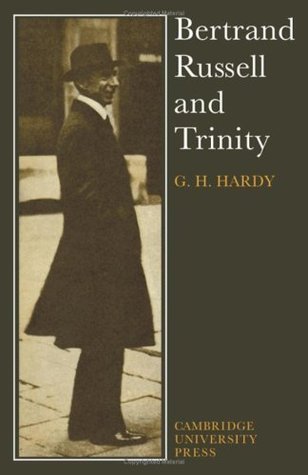
A clear and inside account of Russell's termination from his Lectureship at Trinity College Cambridge in 1916 for supporting draft resistance during WWI. The termination was based on a legal conviction. Hardy suggests the legal case would not have been pursued if Russell hadn't made his actions widely known. Better known was Russell's conviction in 1918 for criticizing the US, for which he was imprisoned for 6 months (during which he wrote Introduction to Mathematical Philosophy). Lesser known is that Trinity College re-appointed Russell to a 5-year lectureship in 1920, which he accepted but then soon resigned for other reasons. Finally he was again appointed in 1944.
Its a story of relationship between Bertrand Russell and Trinity college at one of the difficult times in history, the World War I, written by the an authorized person who has access to most of the original sources. The story begins with explaining about pacifist organizations (Union of Democratic Control, No Conscription Fellowship) and their role in conscription during the world war. It then proceeds in explaining why Trinity (council) took a stand to cancel the fellowship of one of the most famous and celebrated mind, Bertrand Russell. The last part is perhaps the unknown one to many, even in Trinity itself, the reinstatement of his fellowship and lecture post in post war era. The book is wonderfully written by G.H.Hardy, a famous mathematician of his times, a Trinity fellow himself.
This entire review has been hidden because of spoilers.
I bought this book, not long after it became available, back in 1974. Rereading books bought in one`s youth as a more mature adult is always rewarding I find, and this book is no exception. Originally written by G.H. Hardy, to be circulated to the Fellows of Trinity College Cambridge, it is an explanation of the circumstances surrounding the dismissal of Bertrand Russell from his lectureship at Trinity, in 1916, due to his defense of the ' conscientious objector' and the possible prejudice for the recruitment and discipline of His Majesties forces. G.H.Hardy went to great length to throw some light on the important and relevant details that perhaps were unclear at the time, except for the few individuals, the College Council and legal support within Trinity. This publication dates from the year of Russell`s death, 1970, and is well worth the read, for those who may be interested.