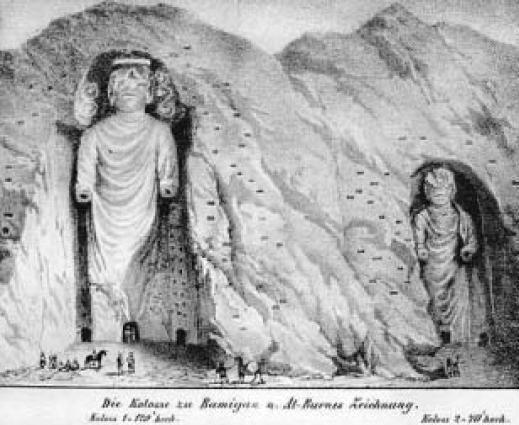
Initially, I thought this book was a fictionalized version of a legend about a Buddhist monk traveling from Afghanistan to America centuries before the birth of Jesus. However, it ended up being a travelogue, with the author tracing the route of the monk in search of any evidence that points to the truth of the legend.
Starting in Afghanistan just before 9/11, the author travels through Pakistan and into China; from China, he takes passage aboard a freighter to simulate the monk's (named Huishen) possible voyage across the sea. Finally, he travels throughout Mexico and Central America, looking for signs of Huishen's voyage and possible Asian/Buddhist influence in the old cultures of Mesoamerica.
This book had more than a little in common with 1434 by Gavin Menzies (the book about the Chinese discovering America); in fact, the author interviews Gavin Menzies late in the book and does sympathize with his theories. However, the author stops short of proclaiming that it is the irrefutable truth that the Chinese discovered America. He lays out many of the arguments and evidence, but he does seem to point that it all seems a little inconclusive, naming himself among the "lunatic fringe" of the academic community. Still, his approach made me much more open to the theory than simply proclaiming that it's all true and that future research will prove him right (Menzies' book).
The early portion of the book in Afghanistan and Pakistan is probably the best. He's traveling amongst a new culture, and he is very unsure of himself and his prospects for success. He does his due diligence as a journalist, speaking to a number of different people inside Afghanistan to get a broader view of the situation there just before 9/11 (although, he does say he did not push himself hard enough, which I found to be a wonderful kernel of truth). As he travels to China, I think he's less interested in the people and the culture, since he has already traveled extensively through the country. Also, the "interludes" from Huishen are somewhat jarring and mysterious, and maybe a little pretentious(?). Written by the author during dream-like or feverish states, I suppose they are supposed to reveal some truth about the author and his journey, but, portraying them solely as missives from the monk itself seem to force the book out onto that "lunatic fringe" a little further.