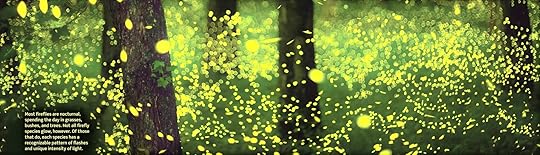
What do giant squids, mantis shrimp, and fireflies have in common? These animals, along with a wide range of creatures, are able to give off light; this is called bioluminescence. Different species use different chemistries to bioluminesce, and they produce their light for a variety of reasons, including communication, hunting, and self-defense. Bioluminescence is a unique and fascinating adaptation found in the animal kingdom. Surprisingly, about half of all known phyla (a classification for animals that share the same body type) contain some bioluminescent species. Scientists don't yet understand all facets of bioluminescence, but they have managed to harness the glow and use it in a myriad of ways. One of the most important applications involves using bioluminescence as a microscope in medical studies. For example, laboratory scientists can create fluorescent malaria parasites to track the path by which the disease is spread from a mosquito to the animal it bites. Bioluminescent proteins are also helping researchers learn more about cancer, HIV and other viruses, and complex neurological processes. In fact, bioluminescent proteins are so useful to twenty-first-century medicine that two groups of scientists, one in 2008 and the other in 2014, were awarded the Nobel Prize in Chemistry for their work with these proteins and related technologies. Even artists and fashion designers use bioluminescence in their work to create glowing, light-sensitive paintings and clothing lines. Author Marc Zimmer, a world-renowned specialist in fluorescent proteins, takes readers on a glowing journey into the frontiers of bioluminescence.
Marc Zimmer is the Jean C. Tempel ’65 Professor of Chemistry at Connecticut College and the author of Glowing Genes (2005), the first popular science book on jellyfish and firefly proteins; Illuminating Diseases (2015); and three books for young adults. His writing has appeared in USA Today and the Los Angeles Times, and he has been interviewed and quoted in the Economist, Science, and Nature. His book Solutions for a Cleaner, Greener Planet has been longlisted for the 2020 AAAS/Subaru SB&F Prize for Excellence in Science Books.
The State of Science will be released on July 20 2020.
It's funny how weeks ago I become so curious about the desire to find out more about Bioluminescence with my friend @librorayna. In luck, God has helped me to discover this amazing nonfiction book called Bioluminescence: Nature and Science at Work by Marc Zimmer at Libby. To tell my fellow followers, I'm not usually enticed to read such a book because I'm not students of science but one day it just happened.
It took me 2 weeks long to finish it by going back and forth, reread multiple times, taking notes, and googled everything that was mentioned. I believe this reading won't do its real justice without surfing the internet for a few footages of the research. For me, the hardest part to read is about DNA sections but don't worry other chapters are easy to read.
I'll say it's the best nonfiction book I've read this year!!!! MashaAllah 👍. Who knows right? The light that was illuminated by organisms, animals, or sea life such as Crystal Jellyfish can be a main and vital source for researchers like scientists, biologists, and chemist to discover how to detects the way virus, disease, and parasite move inside the human body that can be seen ONLY with the help/used of Green Fluorescent Protein (GFP) — which was able to produce after jellyfish protein was taken; and of course by injecting it to other living life such as mice that was also been given a portion of the particular virus.
GFP turns out to fasten the lab research as then it replaces the conventional microscope into a super-resolution microscope called a fluorescence microscope. It's something humans can't even imagine capable of doing if not after the discovery done by the 3 scientists including Osamu Shimomura in 2008. We probably see it as a beautiful light but it was more than that. It's a great gift from God to nature and back again for the benefits of humankind. 🤯
With the discovery of Green Fluorescent Protein(GFP), scientists can work a way to produce a cure for Chagas disease, Malaria, HIV, Cancer, Heart disease, Anemia, and probably able to help towards fast discovery for those who suffered from limb loss, etc. The scientists still have a long way but let's pray so that it's possible.
This is a beautiful book. I started reading it on my black-and-white ereader and quickly realized I was missing out, so I read it in full color, large image size on my computer. The pictures are breathtaking. A large fraction of bioluminescent creatures are deep-sea creatures -- hence the nasty ugly picture on the cover. Yes, fireflies would've been cooler. But there's some wicked cool creatures down deep, and they do weird things.
There are some good little stories in here about the process of science and how we know what we know about creatures that glow naturally. It's brief but very informative.
But only the first half or so is about creatures that bioluminesce (okay, maybe a little more than half). The last couple chapters are on how we use bioluminescence in research and what it has helped us learn. There's a section of quarum-sensing in bacteria, which is fascinating and I had never heard of it. We can also trace just about any gene through an organism by making it glow. Really intriguing stuff.
So even though you've probably not thought a lot about glowing animals, there's some really neat things to learn in here. The publisher calls it a junior science book, and it's certainly accessible to junior high school students. Things are explained well and there are great pictures. But it isn't dumbed down or oversimplified. I would say something like 6th grade and up. All the way to adulthood. I bet you'll learn something from it.
This book is full of exciting facts about bioluminescence, a topic on which I had limited knowledge. If you are unaware, bioluminescence is highly crucial to a wide variety of scientific pursuits. Zimmer does a great job of giving a primer on the various ways scientists study and use it. The photography is the highlight, full of bright and eccentric creatures. The only fault of this book is that it felt as if it were written for a younger audience. I would have loved to have gotten a deeper dive into each topic. However, I would recommend it overall.
I was snorkeling recently in an Atlantic Ocean bay on the Caribbean island of Antigua and the water was murky at times, from boat wakes and my own stirring up the sand at the bottom, and I watched in amazement as I could still see glints and sparks of bioluminescence from the fish, like I was a marine creature myself allowed for just such moments, to see truly and clearly. How can someone be unmoved by these little glimpses of wonder?
Brief with great illustrations, this book was a an answer to a question that came up, about why on god’s green earth, we spend money studying such phenomena; I understand the why of the question, when so many are suffering and starving, but I ache at the short sightedness of it; we study because it is a layer of the universe that lights us up, and because it can help our pain and suffering.
Some things of wonder:
• Bioluminescence is when a chemical reaction in a living organism produces light. Phosphorescence is when a molecule anywhere absorbs light energy of one wavelength and later returns it to the surroundings at a lower energy wavelength, like glow in the dark ceiling stars. • Biofluorescence is only visible to marine animals and is similar to phosphorescence, but returns the light quickly. Mantis shrimp that can grow to 1 foot long and use a patch to alert each other to their strength. • Pliny the Elder wrote in 70s CE about a clam that squired phosphorescent green slime when it was scared, and anyone who ate it had glowing green lips. • Hotaru-gari, firefly hunting, made fireflies a metaphor in Japanese poetry for passionate love and hearts on fire. • Fireflies are actually beetles. • There are 2,000 species of firefly and they are found on every continent except Antarctica. The intensity of firefly light is species specific; six thousand common European fireflies combined make the same brightness as a candle; only 40 South American fireflies are need to make the same brightness. • The Hawaiian bobtail squid has trillions of bioluminescent bacteria living in its light organs that blend in with the colors of lighter waters above the squid as a type of camouflage. The squid and the bacteria can live without each other, but thrive together. It is unknown how, but the squid only lets bioluminescent bacteria live in its photophores, and they will eject bacteria that don’t produce enough light. They are born lightless, but in a few hours, bacteria find a way to the baby squid’s light organs, and the light organs then develop a lens, light detectors, a reflector and a shutter. The light organ of a single adult squid can harbor up to one trillion bacteria. • Bioluminescence evolved about 542 million years ago, when species with eyes first appeared on Earth The crystal jellyfish has been around for five hundred million years and have fluorescent proteins that can be isolated and injected into other cells like a 21st century version of a microscope to discover how HIV is transmitted (T cell nanotubes) or how malaria affects cells or to detect cancerous stem cells. • The artist Hunter Cole works with bioluminescent bacteria in petri dishes to create living art. In the Italian Renaissance, Caravaggio had used crushed fireflies to create paints with special light qualities.
From the depths of the ocean to the enchanted forests, this book unveils the captivating world of bioluminescence, where living organisms emit light.
My favorite part of the book was about the symbiotic relationships between bioluminescent organisms and their habitats highlights the delicate balance of nature
I read this book for the first time for one of my science project. And I must say;
The author has crafted a remarkable book that celebrates the beauty, complexity, and scientific significance of bioluminescence, captivating readers with its compelling narrative and profound insights into this extraordinary phenomenon.
Good concise book on bioluminescence as well as biofluorescence. Explains the chemistry behind both and different ways different animals use and achieve bioluminescence. Also has some fun (and not so fun) facts associated with both. I feel like I learned a lot for such a short little book, and the quality of the images are very good. Highly recommend to anyone interested in this subject who doesn't already know a lot about it!
Short read about bioluminesce in living things and in science
This book is quite short and leaves a lot to be desired in describing the living things that display bioluminesce. It does redeem itself some at the end with brief and astounding descriptions of how GFP is being used in science. Overall, worth a quick read.
A good introduction read of how bio-luminescence is utilized in modern technology. A short read, it is very manageable to the "non-science" types who are curious about what makes a firefly light up at night.
So interesting!! Felt like it got a littleeee bit off-topic at the end but I had no clue fireflies were so cool. Also, i must spend the next 6 hours researching angler fish
Illuminating! Ba dum tsss…. Ok anyway, this was a great read full of beautiful visuals with a wide and sweeping overview of bioluminescence and its role in making the world better.
Bioluminescence: Nature and Science at Work by Marc Zimmer is a children's non fiction book for confident readers about the science of bioluminescence. What do giant squids, mantis shrimp, and fireflies have in common? These animals, along with a wide range of creatures, are able to give off light; this is called bioluminescence. Different species use different chemistries to bioluminescence, and they produce their light for a variety of reasons, including communication, hunting, and self-defense. Bioluminescence is a unique and fascinating adaptation found in the animal kingdom. Surprisingly, about half of all known phyla (a classification for animals that share the same body type) contain some bioluminescent species. Scientists don't yet understand all facets of bioluminescence, but they have managed to harness the glow and use it in a myriad of ways.
Bioluminescence: Nature and Science at Work is a deeply researched and well explained book. The science of bioluminescence is something scientists are still studying and exploring, they do not fully understand the hows and whys of it. However, this book gives interested readers a comprehensive look at what we do know and understand, and how we came to know it. The exploration of using bioluminescence as a microscope, bioluminescent proteins, and the creatures that use bioluminescence is fascinating and explained well here. I found the book to be fairly dense and would recommend it for older readers and adults, since it is reasonably advanced. This is not for new or easily discouraged readers. I found the explanations and photographs to be interesting, understandable, and engaging.
Bioluminescence: Nature and Science at Work is a well organized and very informative read. I do not think it is for the casual reader, but more for older children and adults that already have some interest in the subject. It is still an engaging and interesting, but more involved and detailed that I was expecting, which is just what a dedicated researcher will be looking for.
Author Marc Zimmer, a world-renowned specialist in fluorescent proteins, takes readers on a glowing journey into the frontiers of bioluminescence.
This non-fiction book about bioluminescence was very interesting from the start. It explains in detail how different insects, deep sea creatures, and other organisms give off natural light. It explains the chemistry and the process very well with lots of real-life pictures. I really enjoyed the pictures, because I already knew a lot of the facts that were in this book, but I had not seen some of these creatures before. For example, it was really cool to see the angler fish with its bioluminescent dorsal fin! All the pictures really make the book come alive.
I was not able to read this book at one go. It was hard to read the small print and absorb so much of the details in one sitting. I enjoyed reading it over several days. But, I would have liked it better if it came in slightly larger print and less detail. Maybe more charts and graphs, to show what the writer was trying to say, would have been a better idea to keep my attention going.
My favorite part of the book was the descriptions of the angler fish, the crystal jellyfish and the Hawaiian bobtail squid. Also, although I already knew the basics about how bioluminescence works in the firefly, it was very interesting to read why and how it uses this light. Same with all the other creatures – it was great to figure out how come creatures use the light to communicate, as defense, for camouflage or even to scare predators away!
I gave this book 4 stars, because I would have liked it to not have so much detail. It would have been nice if each chapter had some bullets with important points, so that if I wanted to, I could refer to the end of the chapter to see what it covers. But it did make up for all that by having really interesting and beautiful pictures, so I could make sense of what I am reading. I did need help from my mom to understand some of the chemistry – that is not a bad thing, but I would say this book is not for very young readers. I am 7 years old and loved it because I love science and nature and love reading everything about it. But ideal age in general for this book might be around 8 years and up. Review by Dhruv K., age 7, North Texas Mensa
Gorgeous photographs are the highlight of this book. However, the bright chartreuses pages paired with the black text hurt my eyes. I understand that it was meant to be a bit of a visual demonstration of the topic, but I still did not appreciate it. Lots of accurate information about bioluminescence in nature as well as how it can be used in science and daily lives. Solid addition to a collection, especially if this is a part of curriculum.
So much information and amazing pictures to compliment the text. Really loved and enjoyed learning more bioluminescense and underwater life. No it wasn't the funnest read but non-fiction rarely is and didn't expect it to be. Great for students wanting more information in what is a fascinating subject. arc from NetGalley
Bioluminescence is a interesting book about florescent proteins in animals. Firefly for example... This protein is produced for many different reasons, hunting, communication and also self defense, just to name a few. Scientist have discovered ways to use this amazing ability. Let's hope somehow this ability can help in the field of medicine.
There were no characters in the book but animals were described. Some of the animals described were the firefly, Noctiluca scintillans. The Noctiluca is a glowing bacteria which many animals have in their systems to make them glow. Raphael Dubois discovered bio-luminescence. The genre of the book is non-fiction. It is one book not a series. I liked the book I am into things that have science in them. The book was enjoyable and I learned many facts. The author writes well and I would read more of his books. The book tells many ideas about bio-luminescence. It tells how it is done, why organisms do it, and how humans have used it for our benefit. I think the author is for grades 5 and up because there are some words that younger kids might not know.