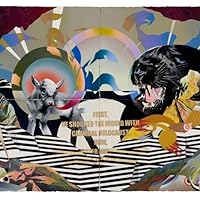
This is a poetically charged work of autobiographical retrospection, speculative memory and an artistic alternative to common constructions of identity. The influences include traditional songs, ceremonial undercurrents, dream vehicles, disparate landscapes, chemical vapors, relative longings and belief in the possibility of healing again and again even after death.
Poetry is always challenging for me to understand, especially when the author is highly introspective and when the overall mood of the collection is sombre. While the construction of modern American Indian identity is highly interesting to me, Gordon Henry's The Failure of Certain Charms disappointed me because of a recurrent, if not overwhelming, emphasis on decline and death.
The contemporary reservation life that Henry captures appears broken and sad. Each section of the collection begins with a "calendar of wasted seasons" -- a twist on the "moons" used to mark time in various Native cultures. Instead of natural events such as the ripening of strawberries or the falling of autumn leaves, Henry's calendar notes the "expired license," "telephone creditors," "evaporated milk," "dripping faucet," "cold school," "knocked over yield sign," "fighting drunken white boys," "missing relatives," and "lost watch" (pgs. 3, 21, 67, 103). At least 3 of the poems in the collection portray funerals and several more refer to declining health (for example, see "When Names Escaped Us" and "Insulin Syringe Blues"). Blame is squarely laid upon whites' assimilation efforts. As we see in "Beyond the Refuge," "The Second Door," "Letter to the Agency Superintendent," and "Letter to the School Superintendent," the education systems imposed on Native people are particularly responsible for confused identities and unfulfilled dreams.
Judging from "Blue Thunder Boy Healing Song" which ends the work, redemption can be found in Native lifeways, but unfortunately this revelation seems much more subtle than the darkness which appears in most of Henry's poetry. Hope is present in poems such as "Profile of a Black River Member," which portrays a man who attends a Ghost Supper (a dinner to honor deceased relatives) as "something better" than dating a city councilwoman, and in "Oshawanung Manido Equay," where a wing feather is offered by a being who "can't fly" but somehow will. Moving forward, I am eager to see if Henry's personal and poetic journey will lead him beyond the misery portrayed in The Failure of Certain Charms.
Significantly, Gordon Henry's work has compelled me to think more deeply about how I make sense of texts, how my responses can (negatively) influence American Indian writers, and how my promotion of some writers/works over others can shape other readers' experiences of American Indian literature. Particularly in "Third Door," he reveals the destructive influence critics have on Native writers, especially when they demand that such authors include certain characterizations, themes, or turns of phrase. Thus while I am not a huge fan of The Failure of Certain Charms, I must acknowledge that my review may reflect more of my own intolerances and shortcomings as a reader than Henry's faults as a writer. Regardless of how one personally responds, this book certainly deserves to be read. Brokeness, funerality, and struggle are uncomfortable, but they are realities that must be observed and acknowledged.