

What do you think?
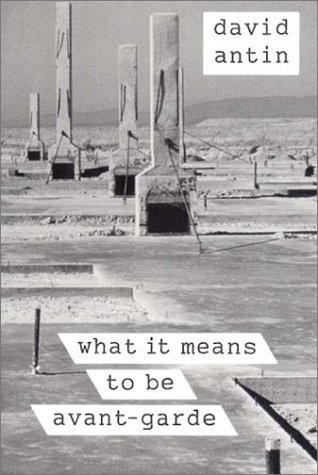
what it means to be avant-garde
what it means to be avant-garde is David Antin’s third collection of “talk poems” published by New Directions. As in his earlier talking at the boundaries (1976) and tuning (winner of the 1984 PEN/Los Angeles Literary Award for Poetry), Antin’s brilliant improvised disquisitions at once challenge readers’ expectations even as they instruct and entertain. A poet, performance artist, art critic, and professor of visual arts, Antin, since his college days in New York in the ’50s, has been at the cutting edge of the avant-garde. The avant-garde? Yes, if by this is meant not an image of fashion but the place where art and life intersect, imparting to both a greater urgency––if is meant the place where experience and knowledge find their deepest expression, where the idea of a universal language can find shape, where the price of art is life itself, where the fringe is the very center of existence.
- GenresPoetry
207 pages, Paperback
First published January 1, 1993
Ratings & Reviews
Friends & Following
Create a free account to discover what your friends think of this book!
Community Reviews
Displaying 1 - 5 of 5 reviews
August 23, 2017
ever since i heard of the idea of antin's talk-poems i was v taken with the idea. it took me several years to actually get around to reading them and now that i have i see they are somewhat different than i thought. i'd had in my head a sort of improvisational imagistic philosophical thing where in fact it's more like storytelling with something like that imagistic-philosophical sensibility imbued into the structure of the pieces, the movements between musings and narrative, the choices of stories, those sorts of things. the memorable parts as it turns out are basically stories—the most interesting euro-levantine-dwarf-linguist-artist-poet in the world; the uncle calling after twenty years and promptly getting hit by a car; the father-in-law who was a rising star in hungarian literature at just the worst possible time; a story about dementia (basically) turning into a meditation on duration. somehow the word fulsome comes to mind: generous, unpretentious, ingenuous, intelligent.
This entire review has been hidden because of spoilers.
January 22, 2008
Antin's experiment is to talk in front of live audiences, holding forth, telling stories, making things up (narrativally, but the things are generally those he seems to have thought about a great deal ahead of time), and allow the flow of the moment to become the spate of time that gives the improvisation its shape. The result are story-talk-poems that always go in surprising directions and interest one, as Antin is a kind of postmodern genius of the architectures of thinking, culture, and social interaction. Great, and like no one else.
February 14, 2008
The one David Antin book I might recommend over all others, if only because I enjoy the story about the poetry reading at the Fillmore East. This guy is genius in action.

Want to Read
July 27, 2009Not sure if this is the guy that wrote 100 brothers, but if so- one of the most original writers i have ever read.

January 24, 2010
the fringe : me :: the bible : parishioner
Displaying 1 - 5 of 5 reviews