This was a very grim read. Seriously, don’t let the pulpy cover fool you. This book is not pulpy at all. In fact, it's almost too much. The horrors that were inflicted on the Armenian people from the Turks, the Kurds and the Chechens (or as it’s spelled in the book, Tchechens) is unfathomable.
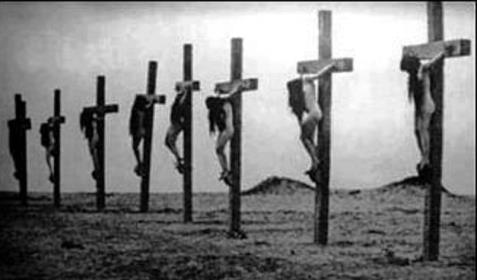
You may be wondering why I would read something like this. To be honest, it was a photo, which basically had the excerpt, Armenian girls crucified during the Armenian Genocide.
The thing is - this picture didn’t look real, yet it looked very old. It turns out it’s a movie still from the old 1919 silent film Auction of Souls, also known as Ravished Armenia which tells the horrific story of Aurora Mardiganian (originally Arshalouys Mardigian) who survived the genocide. Of course, like most films from that era, Auction of Souls is pretty much gone. There are only 24 minutes left of the original 90-minute film, which is a shame. However, there is still the book, so I decided to track it down.
One of the things I wanted to know -- did the Turks really crucify young girls? It seemed so cruel, so unnecessary. Actually, the truth is much worse. While this happens in the book, Aurora said in an interview 70 years later that what happened was actually an impalement. She stated that "The Turks didn't make their crosses like that. The Turks made little-pointed crosses. They took the clothes off the girls. They made them bend down, and after raping them, they made them sit on the pointed wood, through the vagina. That's the way they killed - the Turks. Americans have made it a more civilized way. They can't show such terrible things."
This actually makes sense. Didn’t Vlad Tepes learn about impalement from the Turks? They tortured these girls so the other girls in the camp would be submissive. The writers changed it to crucifixion so they could emphasize that this was happening to Christians. That way they could earn more relief money, which was actually a very good thing. Lots of money was given to Armenian relief from the United States.
However, there is always a dark underside. Aurora was exploited. She was only given .05 cents for every book, which she didn’t fully receive, and she was paid little for starring in the movie. Reenacting the horror that she went through was very traumatic and strenuous for her. She broke her ankle jumping from one building to another, but even though she was injured, they insisted on still filming. Her press obligations became so much, she couldn't fulfill them, so they hired seven look-alikes. At this point, Aurora threatened suicide and had a breakdown. She tried to sue her guardians, escaping to New York. Here this poor girl was suffering from PTSD, and here movie makers are trying to make money off her.
The book was written by H.L Gates and comes from Aurora’s narration of what happened to her, which was then translated. It took three days for her to tell the tale because she had to take breaks because the memories were so painful. Consequently, the book isn’t completely accurate. Some of the dates are off, which makes sense. After all, Aurora was only 15 years old when this happened to her. Also, little things like Aurora talking about the American Flag with such profound reverence comes across as pure propaganda.
Yet there is a lot of truth in this story as well, because some of this stuff a writer couldn’t make up. Stuff like the sick game of swords that the Chechens play with their captives, and the horrific way the soldiers of the Kasab Tabouri (or Butcher Regiment, which was composed of Turkish convicts) drove crowds of people over a cliff. This book is brutal, make no mistake.
So what are my thoughts on this book? For one, this really didn’t happen that long ago. I know it’s a hundred years, but that’s really not that long a time. Also, this was definitely a planned massacre. The way the Turkish forces came in and immediately slaughtered all the Armenian men shows this. The Young Turks (who were the group in power at the time) also sent out a proclamation to their people:
“During the process of deportation of the Armenians if any Moslem resident or visitor from the surrounding county endeavors to conceal or otherwise protect a Christian, first his house shall be burned, then the Christian killed before his eyes, and then the Moslem’s family and himself shall be killed.”
So while the Turkish government likes to deny it, I don’t think they have much ground to stand on. They were just hoping to cover it up due to the war, and in many ways, they succeeded.
This book also made me think of ISIS. There’s a reason that the Syrian Kurds are fighting so hard against them. It’s because ISIS is just as vicious as The Young Turks were. It wasn't that long ago when Saddam Hussein enacted the Kurdish genocide in Northern Iraq.
This phenomenon of genocide is a horrific thing. However, I feel as a people, we can make sure nothing like this happens in our home countries. Genocides cannot happen if people refuse to cooperate. During WW2 in Denmark, the Danish quickly understood Hitler’s intentions and at grave risk to themselves, simply refused to co-operate when required to hand over their Jewish citizens. Similarly, the Italian army flatly disobeyed Mussolini’s orders to round up Italian Jews and hand them over to the Nazis. This unified resistance was too great for any retribution to take place. People do have the power to stop this is they come together.
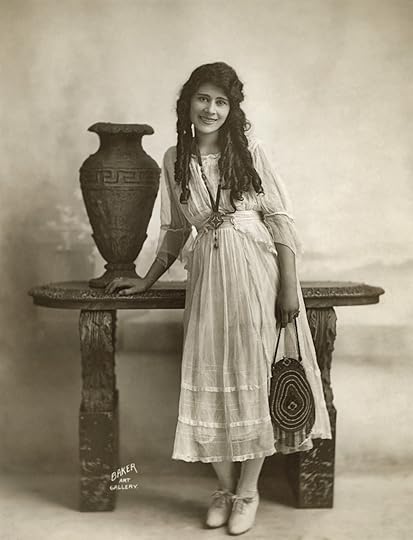
Last but not least, I want to quote something from Aurora. Here's a picture of her.
“I have often wondered since I came to America where life is so different from that of my country, if any of the people whom I meet could imagine the suffering that I faced while I lay in the moonlight, my hands fastened and my feet haltered to a restless horse.”
To be honest, Aurora, I can’t. Your story is too horrible for imagination. I think about the things I complain about, like work, money, the government, and crazy drivers. I actually have it great. This book showed me that my worries are few and I live a nice peaceful life with my family, lots of food and a warm place to sleep. I need to learn to appreciate that more.
I would encourage folks to read the updated edition that I did, released in 2014 I believe, which has award-winning filmmaker Atom Egoyan's crucial introduction. It provides an essential context for the story of Aurora Mardiganian, the doubled trauma of being a genocide survivor and then having to re-enact it and re-live it for a film production, the mistreatments she endured, her frayed mental state and decline. It's a crucial story that not enough people know about.
This is a good and painful memoir. It is amazing Aurora survived at all and then went on to portray herself in an early movie. Watch PBS season 26, episode 11 to learn more about her life after the movie. It includes an interview with her. That along with this book helps readers to learn that genocide, sadly, was never a “one and done” part of history. It is a long and continuing part of the world that needs to end.