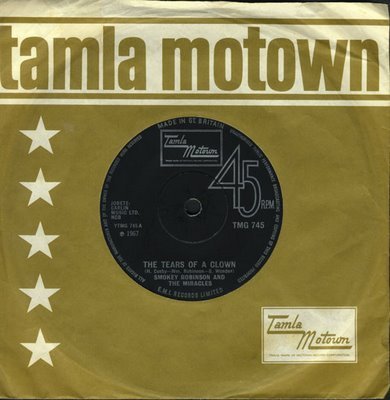
Tamla Motown is a name that’s gone down in music history. Yet few realise it was, in fact, a label that never existed in America, but was formed by Berry Gordy in 1965 to release US recordings in the rest of the world, the Detroit-based soul Svengali having set up a series of labels to service the home market. The 45rpm seven-inch single was the stock in trade, and many of the soulful ‘three-minute symphonies’ to bear the Tamla Motown label remain classics today. The period between 1965 and 1976 saw the likes of the Supremes, Four Tops, Temptations, Marvin Gaye and many more make their indelible mark on the music scene. This book provides a complete discography of Tamla Motown’s UK singles, telling the stories behind each in fascinating detail. Terry Wilson’s painstaking research means that even soul experts will find facts they weren’t aware of as he takes a popular music phenomenon and, for the first time, examines it from a UK perspective. Artist summaries, plus sections on statistics, facts and feats and an index of tracks, make this the first definitive guide to the UK output of Berry Gordy’s legendary US labels.
RIP Mary Wilson 1944-2021 Member of The Supremes 1959-1977
This was the first female group to get a No 1 album in America Sixth act in the list of most number one hits in USA Includes a streak of five consecutive number ones, including four in one year
I know you can't compare oranges and aardvarks but the run of singles from Where Did Our Love Go up to I'm Livin' in Shame (1964-69, 20 singles) is a contender for the best sequence ever and Mary Wilson was on every one.
*************
Original review follows
*************
This book is where love, technical musical analysis and pop sociology is fused in the white heat of unfettered OCD fan obsession into sheer beautiful poetry. There is gaucherie by the bucketful, Terry Wilson hacks, sweats and plunges through his pages, he does not glideth as the swan upon the lake, no natural stylist is he, no, he worries and stops and starts and backtracks and ponders rethinks and he has this mission to let no fact about a Motown single released in the UK escape and if one does he will be like Robert de Niro in Midnight Run, he will track that fact down and handcuff himself to it and drag it bodily and cram it into the boot of his car and drive back to the paragraph it escaped from and shove it back in. And he will footnote that it escaped and tell you when and where it was recaptured. What a great book.
Why is this book the story of UK singles ?
In America Berry Gordy had a fistful of labels in order to avoid resistance from radio stations when he began to inundate them with new releases; in the UK and Europe from 1965 there was one label only, Tamla Motown & so hence it became a kind of filter which Terry Wilson believes is a great way to make a coherent story out of what would otherwise become an unreadable 5 volume encyclopedia.
Velvet underground Oui! Marvelettes Non!
According to Terry, and I am not going to disagree with him, Motown has been ill-served, almost ignored, by the critical mainstream of white rock writers. Well, it's just black pop music, it's stuff to dance to, part of those golden 60s. And since Motown couldn't make albums to save their lives (The Supremes Sing Funny Girl never features on your 100 greatest rock albums) until Marvin Gaye showed how in 1971, here is a demonstration of Elijah Wald's point that whereas political History is written by the winners, musical history is written by the losers – so the acts who never sold records and the records they didn't sell (Velvet Underground, Astral Weeks) are now the pinnacle of the accepted canon. So Terry believes that Motown was at least as important as the Beatles and the Stones. The critics like to think that the album is the thing, that it's a statement. I am not disagreeing but it gives them a problem with artists who work in genres which don't do that, like country and like Motown. But the 3 minute single has the intense concentrated virtues of the sestina, the sonnet or the haiku – you have to have a good intro, you have to have a hook line, and a great chorus, and a strong title would be good, and a pithy sax break while you're at it. And watch that red light. We're on a clock here.
Dolphins and rainbows – yes, absolutely
There's a thing about genre here. I think the attitude to Motown is the same attitude to genre. The line goes something like – "all those Motown records sound the same, but they did one or two really great ones" (Reach out I'll be There, You Can't hurry Love, I Heard it through the Grapevine for instance). The image is of a school of dolphins swimming around and one or two of them suddenly leaping out of the ocean and getting themselves noticed.
The same could be applied to, say, blues or doo wop. Almost identical records, and occasionally one distinguishes itself.
The same could be said for literary genres, say, who dun its or spy fiction or romance or hard boiled detective stories.
For The fans of the genre, and I guess you either are or you aren't, the tiny differences are EVERYTHING. We love all the dolphins and know their individual names, and not just the pushy ones who leap up out of the water with the sun casting shimmering rainbows around them.
Dolphins and rainbows now. Back to Motown.
Skulking in the Shadows of Gm
Some examples of Terry's professor of Motownology style :
On I Guess I'll Always Love You by the Isley brothers :
Salvaged from Martha Reeves' Heat Wave is the stepwise ascent into the chorus which, with the song's key transposed from Eb to C shifts through Dm/Em/F/G (compare th bridge passage at 0:35 with the lines Has high blood pressure got a hold on me/Or is this the way love's supposed to be? From the original).
On The Hunter gets Captured by the Game by the Marvelettes
Most remarkable is Robinson's creatively picturesque chord progression, starting out with a plunging leap from an open Dmaj7 to a guarded Bb, before skulking through the shadows of Gm – F#7 – Em run, padding through its creeping rhythm with the stealth of a stalking lioness. Containing too, a jazzy five chord dash from a low Em to a tottering Bm, the sequence perfectly depicts the act of entrapment, one of Robinson's most cunningly devised musical sequences.
ihearttunes
I discovered many great records I didn't know by youtubing my way through the first half of this book, but I have to say plainly that you can draw a big line under Cloud Nine by the Temptations, released in August 1969 – that was the new style, and I profoundly dislike it. Motown needed a new grittier funkier style, the swinging, upbeat four square floor filler stuff had really been done a lot, a lot, in the previous six years, I completely agree. It's just that I really don't like the tuneless one-chord funky workout stuff that follows. I like tunes! Where did our tunes go? Baby baby? Stop! In the name of tunes!
The big change was also precipitated by the sundering of Holland-Dozier-Holland and Berry Gordy. HDH practically were the Motown hit factory. Alright, HDH plus Smokey robinson plus Stevie Wonder plus the brilliant snake pit musiciams whom Berry gordy so assiduously worked to keep anonymous in case they realised they could walk out and get better jobs somewhere else.
The danceable is the political
As well as the music, Terry Wilson can't help but run up against Motown politics – the internal variety and the external. Berry Gordy's Hitsville was right smack dab in the middle of the race riots, so called, of Detroit 23-28 July 1967 – yes, the summer of love for some people but not the 43 people killed in that particular riot. About 7000 people were arrested. Now that's what I call positive policing.
In 1968 Berry Gordy was the richest black man in the USA. Motown was often accused of selling out to white America. What Motown did was test the waters gradually, beginning with Stevie Wonder actually releasing a Dylan song as a single in 1966. That was a statement. By the time of Cloud Nine in 1969 we have full-on political protest like :
The childhood part of my life wasn't very pretty. You see, I was born and raised in the slums of the city. It was a one room shack we slept in, other children beside me. We hardly had enough food or room to sleep.
It's not Lou Reed but it's not ooo baby baby either. In 1968 came Does Your Mama Know about Me by Bobby Taylor, Love Child and I'm Living in Shame by the Supremes but yes, none of that was anything like James Brown howling Say it Loud I'm Black and I'm Proud (August 1968). Terry Wilson explores all thse ramifications with great intelligence and compassion. I loved how being the obvious total geek he is did not blind him to the complexities of the racial ambiguities and complexities swirlinga round Motown in that most astonishingly turbulent decade of the 60s.
So now I really ought to try reading about Dancing in the Street (an obvious metaphor for revolution if ever there was one) at the same time as listening to dancing in the street and actually Dancing in the street. All three at the same time. I think it could be done.