What do you think?
Rate this book

260 pages, Paperback
First published October 15, 1992


”We don’t serve faster-than-light neutrinos in here,” said the bartender.If that joke made you laugh, you are potentially the right audience for this book.
Two faster-than-light neutrinos walk into a bar.

Try to imagine a spaceship that could pass right through the earth without even noticing it was there; a spaceship that could cross the vastness of space at the speed of light, and then penetrate into the very heart of subatomic matter to seek out its structure. Imagine, then, a particle that is almost nothing that can tell you almost everything about the structure of matter and the evolution of the Universe. Impossible?This appears to be her attempt at writing to the “popular science” audience. After this, the spaceship stuff is dropped forevermore and we get page after page of head-spinning text like
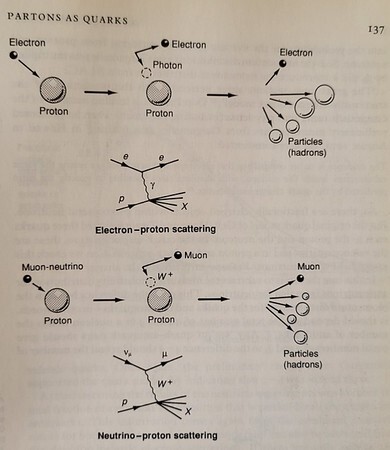
When a muon-neutrino interacted inelastically with a nucleon in Gargamelle, it would change into a negative muon, emitting a positively-charged W+, become ‘excited’, and create several particles as it returned to a normal state. A muon-antineutrino would in a similar way emit a W- and change into a positive antimuon.
Or let’s put it this way:
I actually studied physics in my college days, and at one point in my life was properly trained to understand this shit. With the passage of years, I had to read this very slowly and go back and re-read several sections before it all made sense. I was not assisted in this quest by a few errors by the author that added significant confusion – even seemingly-minor errors like saying ‘backwards’ when she meant ‘forwards’ can really make things difficult for a poor layman trying to hack through this.
But overall I loved this 1992 book and am delighted, after a long search, to have found a copy for sale. The library of Framington State University decided to purge it, apparently, after somebody noticed that the library card (the library card! Be still my heart!) had remained virginal and unbesmirched for thirty-three years:
The reason I loved it so much is that 90% of the physics books for laypeople out there are garbage – so much so that the last time I fell in love with a general-audience physics book was Lee Smolin’s The Trouble with Physics, which more or less agreed with me. I don’t want to spend too much time on this, but there seem to be two groups of authors who write books of this sort. One group, epitomized by the horseshit overture of The Dancing Wu Li Masters, attempt to show how physics is all, like, Zen, man! Time is, like, circular, brah! The other group tries to convince everybody that quantum physics is just so mindbendingly unfathomable that there’s just no way you can really comprehend stuff like Schroedinger’s Cat, not to mention all that counterintuitive wave/particle duality weirdness.
This book, by contrast, takes the refreshingly professional view that subatomic/quantum physics is just a branch of science like any other, something that people have painstakingly pieced together for decades to make it self-consistent, predictive and completely explainable. She doesn’t waste much time talking about stuff that is pure conjecture, such as the “inflationary Universe” model or some types of string theory or even so-called ‘dark matter’. Instead, the book is filled with things that warm my heart, namely pictures of hideously complicated experimental setups that manage to measure things that are notoriously difficult to measure.
Like neutrinos. If neutrinos have one salient property, it’s their ghostliness. Neutrinos can be compared to electrons, teeny-tiny fundamental particles, but they have no electric charge. Since you’ve started reading this review, about 60,000,000,000,000,000 of them have sailed right through your body, continued on down through the earth and are now en route to Neptune. Or, if you're reading this at night, they sailed through the earth first, then up through your feet and out the top of your skull. How exactly does one measure something like this?
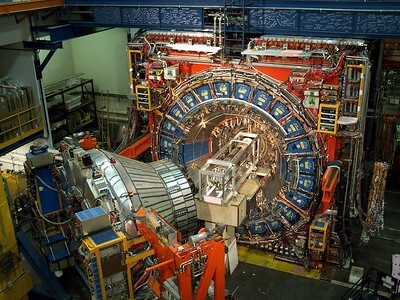
The D0 detector at Fermilab, outside of Chicago, was not designed to measure neutrinos. I include its photo here because, back in my grad-school days, I actually helped to build the damn thing, though to be fair my own role could have been more reliably and cheerfully performed by trained monkeys. In any event, it does provide some clue as to the size and complexity of the detectors mentioned in this book, most of which are similar in general design. And those of you in the Bay Area who have ever driven between San Francisco and South Bay on I-280 may feel a little flush of pride as you drive over the SLAC building, as it was instrumental, so to speak, in figuring out certain aspects of neutrino physics.
One thing in this book I have never studied before is astrophysics, and so this part of the book was particularly interesting to me. I did not realize, for example, that energy produced in the Sun’s core takes nearly a million years to work its way out to the sun’s surface, after which it only requires eight minutes to reach the Earth. But most of the reactions taking place inside the sun produce a neutrino, and these particles, which wander with impunity wherever they wish to go, can reach the surface of the sun in a mere three seconds, which is why so many of them are flying through you at this very moment. Among other things, neutrino measurements can provide more accurate indications of the temperature at the center of the sun than previous methods.
In 1987, a hitherto insignificant star in the Large Magellanic Cloud went supernova. Although the star wasn’t even in our galaxy, it was bright enough for people to see. The last time humans had witnessed such an event was 400 years previously. What’s cool about this event is that a blast of an extra ten billion neutrinos per square centimeter showed up a few hours ahead of the visible explosion. A supernova, I learned, is when a star collapses, in about one second, from about 300 million km in diameter to about 50km, producing an insanely large number of neutrinos. Within a few hours, all the remaining gas surrounding the star's core exploded outwards, creating the visible light that arrived on Earth a few hours behind the neutrinos. How cool that we now have detectors on our planet that can provide an early-warning signal of a supernova!
Much of this book is out of date, but I still had fun and learned a lot.