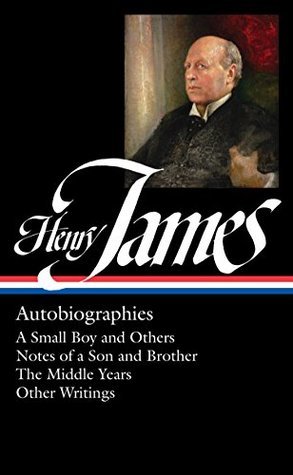
In 1911, deeply affected by the death of his brother William the year before, Henry James began working on a book about his early life. As was customary for James in his later years, he dictated his recollections to his secretary Theodora Bosanquet, who recalled how “a straight dive into the past brought to the surface treasure after treasure.” A Small Boy and Others (1913) and the two autobiographical books that followed—Notes of a Son and Brother (1914) and the posthumously published The Middle Years—stand with James’s later novels as enduring triumphs of his final years. Not only did he create one of the greatest self-portraits in American literature; he also fashioned an indelible account of his renowned family, especially his father, the social philosopher Henry James Sr., his brother William, and his dear cousin Minnie Temple, inspiration for the heroines of two of James’s greatest novels, The Portrait of a Lady and The Wings of the Dove. Collecting these three books and a selection of eight other personal reminiscences (and including as an appendix Bosanquet’s affectionate and insightful memoir “Henry James at Work”), The Library of America’s Autobiographies is the only one-volume edition of James’s autobiographical writings ever published.
Reflecting on his youth, James revisits childhood scenes in Albany and New York City and his erratic education at home and abroad, experiences anew the early delights of attending the theater and looking at art, and recalls meetings with literary and artistic luminaries such as Ralph Waldo Emerson, George Eliot, John La Farge, and Charles Dickens. His memories summon the mood and grandeur of nineteenth-century London and Paris and offer a vivid sense of his precocity of feeling; his account of the “hurried disordered time” after his younger brother Wilky was wounded in combat takes the measure of how the Civil War affected him and his family. Threaded through this story of one writer’s beginnings is James’s insistent, searching exploration of the origin of his genius: “What was I thus, within and essentially, what had I ever been and could I ever be but a man of imagination at the active pitch?”
The shorter writings that round out the volume enrich our understanding of James’s consciousness of self and vocation: a lengthy autobiographical sequence written in his notebooks during 1881–82, newly edited for this edition; “The Turning Point of My Life,” which recalls his decision to become a writer while a student at Harvard Law School; a moving 1905 notebook entry about a visit to the family plot at the Cambridge Cemetery; and an essay that offers James’s singular answer to the question “Is There a Life After Death?”
Henry James was an American-British author. He is regarded as a key transitional figure between literary realism and literary modernism, and is considered by many to be among the greatest novelists in the English language. He was the son of Henry James Sr. and the brother of philosopher and psychologist William James and diarist Alice James. He is best known for his novels dealing with the social and marital interplay between émigré Americans, the English, and continental Europeans, such as The Portrait of a Lady. His later works, such as The Ambassadors, The Wings of the Dove and The Golden Bowl were increasingly experimental. In describing the internal states of mind and social dynamics of his characters, James often wrote in a style in which ambiguous or contradictory motives and impressions were overlaid or juxtaposed in the discussion of a character's psyche. For their unique ambiguity, as well as for other aspects of their composition, his late works have been compared to Impressionist painting. His novella The Turn of the Screw has garnered a reputation as the most analysed and ambiguous ghost story in the English language and remains his most widely adapted work in other media. He wrote other highly regarded ghost stories, such as "The Jolly Corner". James published articles and books of criticism, travel, biography, autobiography, and plays. Born in the United States, James largely relocated to Europe as a young man, and eventually settled in England, becoming a British citizen in 1915, a year before his death. James was nominated for the Nobel Prize in Literature in 1911, 1912, and 1916. Jorge Luis Borges said "I have visited some literatures of East and West; I have compiled an encyclopedic compendium of fantastic literature; I have translated Kafka, Melville, and Bloy; I know of no stranger work than that of Henry James."
In the third autobiography, the unfinished one, Henry James quickly and correctly defuses a dinner-party which is confronted with the sudden intrusion of the figure of the Marquis de Sade and his "unmentionable" writings.